

The influence of foreign powers on South African elections: A critical analysis
Image: Supplied
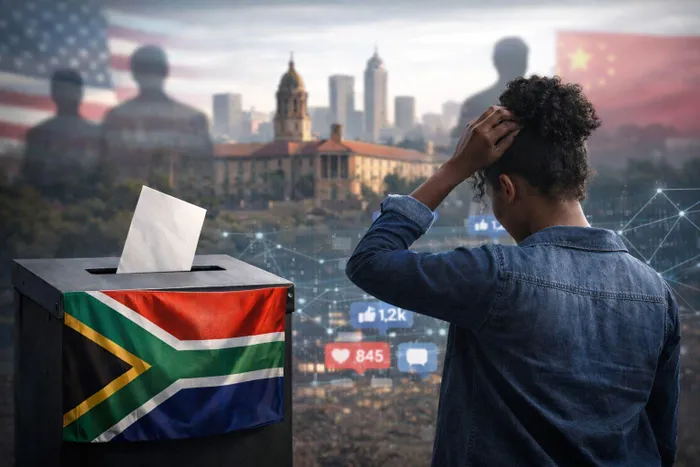
For several years, South Africa, as a leading political and economic powerhouse in Africa, has been a target for global powers, including the National Endowment for Democracy's operations.
The DA, often accused of aiding former Western colonial powers, has consistently criticized the ANC for being too friendly toward Russia and China, despite President Cyril Ramaphosa's non-aligned stance
Recently, the DA Chairperson of Federal Council, Helen Zille, called on the "State Security Agency to investigate foreign funding and coordinated inauthentic behavior online to interfere in elections and manipulate democratic outcomes."
She said that as South Africa approaches the 2026 local government elections, the DA wants the Independent Electoral Commission to properly oversee digital campaigning, disinformation, and funding transparency, and to direct social media platforms to act decisively against coordinated inauthentic behavior.
However, political analysts say the South African media landscape has been captured for decades by a coalition of right-wing and neo-liberal forces, with key online publications firmly under neo-liberal control, according to a report by Common Dreams.
Political parties, including the EFF, called for the expulsion of the United States Ambassador to South Africa, Leo Brent Bozell III, and for his immediate declaration as persona non grata.
Bozell is accused of interfering in the domestic affairs of a sovereign nation when he delivered "offensive remarks" at the BizNews 2026 Conference regarding South Africa’s refusal to comply with demands from the administration of Donald Trump.
EFF Member of Parliament Nqobile Mhlongo said, "The conduct of Ambassador Bozell, while expected, is unbecoming of a diplomatic representative and reflects a continuation of a colonial posture that seeks to discipline sovereign states into submission and suggest that South Africa’s sovereignty is conditional upon obedience to the interests of the United States. Conduct of this nature undermines diplomatic norms and cannot be taken lightly."
On the other hand, the Minister of International Relations said, “We have called in the ambassador of the United States, Ambassador Bozell, to explain his undiplomatic remarks."
Bozell suggests that to retain investment, South Africa ought to cut ties with the United States' adversaries, particularly Iran. Further to this, Bozell suggests that to retain American private-sector “goodwill”, South Africa must refrain from pursuing legislation that would expropriate without compensation, and we must re-examine redress legislation such as B-BBEE policies. The DA has officially introduced an Economic Inclusion for All Bill in Parliament to replace B-BBEE.
To counter the growth of the BRICS group of countries, political commentators say that, because of BRICS' growing influence, Western nations led by the US are eager to strengthen control over the media and the SA civil society. This has been evident at the last NED conference, held under the Orwellian banner of “Revitalising Democracy,” and at the World Movement for Democracy's 12th Global Assembly, held in Johannesburg. The Assembly brought together more than 500 civil society and political leaders from 100 countries. All part of this effort.
Ajit Singh, a journalist in Canada with the No Cold War Campaign, and Roscoe Palm, the co-founder of the Pan-African Institute for Socialism, conducted the research and compiled the report that shows how the United States has penetrated and influenced certain sectors of the South African media.
According to the study's authors, the National Endowment for Democracy and its private-sector partners continue to penetrate the South African media ecosystem.
The South African media and civil society are deeply aligned with the NED agenda. According to Gillian Schutte, a film-maker, social justice and race-justice activist, and public intellectual, organisations such as the Ahmed Kathrada Foundation, the Desmond and Leah Tutu Foundation, and Defend Our Democracy are paving the way for foreign manipulation.
"Their selective focus on corruption within leftist movements, while ignoring conservative liberal authoritarianism and structural inequality, serves imperialist interests far more effectively than they might admit," Schutte said.
Public discourse tends to focus on both Russian and Chinese influence in the media, overlooking the already existing spheres of influence within South African media exerted by the National Endowment for Democracy, an organisation created by the Reagan administration to rebrand US covert operations previously carried out by the Central Intelligence Agency.
The influence and sponsorship of media outlets by the United States dates back decades to the apartheid era. According to internal US government documents, the aim of these operations was “to counter the strong Marxist campaigns” worldwide.
The US's focus is on developing measures to counter perceived "Russian influence," particularly in developing countries such as South Africa and Ghana.
In recent years, NED has intensified its sponsorship of publications such as the Mail & Guardian newspaper and the amaBhungane Centre for Investigative Journalism.
In 2020 and 2021, the NED issued $355,200 over four grants to the Adamela Trust, Mail & Guardian’s non-profit foundation through which it receives and administers funding. The NED detailed that the grants were intended to support the launch of Mail & Guardian’s weekly pan-African, WhatsApp-based digital publication The Continent and the building of a regional network of journalists and media outlets.
The grants even specified content that The Continent will publish — including a “monthly disinformation column” and “quarterly in-depth investigations on the role of public, private, and non-governmental actors’ roles in disinformation trends in Africa” — raising concerns about whether Washington is wielding influence over editorial decisions at the outlet to target political adversaries in the region.
However, there has been growing resistance to the NED influence in both media and civil society. For example, protesters gathered at the iconic Freedom Park monument in Pretoria last year at the World Movement for Democracy against what they called an attempt to split African civil society bodies in favour of the US.