

The release of the SIU report comes four years after Babita Deokaran, a senior finance official in Gauteng’s Health Department, was assassinated on 23 August 2021 in what many believe was a targeted killing linked to her whistle-blowing on large-scale corruption at Tembisa Hospital.The first identified syndicate, known as the Maumela Syndicate led by Hangwani Morgan Maumela, a businessman linked to President Cyril Ramaphosa through a previous marriage.
Image: IOL Graphics
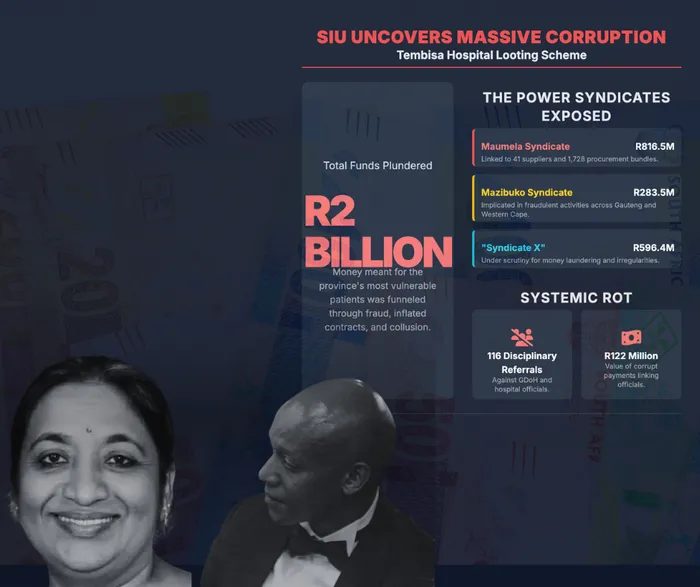
The Special Investigating Unit (SIU) has uncovered a staggering R2 billion looting scheme inside Gauteng’s healthcare system, exposing three powerful syndicates behind the plunder of funds meant for Tembisa Hospital.
Money meant to serve the province’s most vulnerable patients was instead funneled through a maze of fraud, inflated contracts, and collusion between officials and service providers. The SIU calls it one of the most serious betrayals of public trust in years.
The release of the report comes four years after Babita Deokaran, a senior finance official in Gauteng’s Health Department, was assassinated on 23 August 2021 in what many believe was a targeted killing linked to her whistle-blowing on large-scale corruption at Tembisa Hospital.
In the months before her murder, she uncovered irregular, inflated or fraudulent payments linked to Tembisa Hospital and flagged them for investigation
In its interim report, the SIU details how the investigation into Tembisa Hospital has grown in scope and complexity, forcing deeper scrutiny of every transaction.
Despite the scale of the cover-up, investigators have already traced a trail of irregular deals, forged documents, and corrupt payments involving key figures in the Gauteng Department of Health (GDoH) and hospital leadership.
Working closely with the Minister of Health, the SIU’s probe has also unearthed related wrongdoing in other sectors, including Home Affairs and Medico-Legals. These links helped investigators map broader patterns of graft that extend beyond a single hospital.
So far, the SIU has zeroed in on three coordinated syndicates accused of siphoning off the funds. A review of more than 2,200 procurement bundles revealed extensive manipulation of supply chain processes, kickbacks, and mismanagement.
The findings paint a grim picture of systemic rot inside Tembisa Hospital and the structures meant to safeguard public money.
The first identified syndicate, known as the Maumela Syndicate led by Hangwani Morgan Maumela.
Maumela, a businessman linked to President Cyril Ramaphosa through a previous marriage, is the key target in a major investigation into corruption at Tembisa Hospital.
Ramaphosa has denied knowing Maumela.
Maumela has been linked to the misappropriation of R816,560,710 through at least 1,728 bundles. The syndicate has ties to 41 suppliers and service providers, with significant assets amounting to approximately R520 million, including luxury properties and high-end vehicles.
Following closely is the Mazibuko Syndicate, associated with Rudolph Mazibuko, which has been linked to R283,504,291 in fraudulent activities and has implications across multiple properties in Gauteng and the Western Cape.
Additionally, a third group—referred to as Syndicate X—is under scrutiny for R596,424,356 in procurement bundles, with indications of money laundering and numerous procurement irregularities.
Moreover, the investigation highlights smaller syndicates that form a complex network of corruption, illustrating the interconnected web of illicit interactions among officials and service providers.
According to the SIU's findings, corrupt payments linking officials and employees of GDoH and Tembisa Hospital are valued at R122 million. At least 15 current and former officials have been implicated in activities ranging from corruption and money laundering to collusion and bid rigging.
Notably, the bulk of the corrupt practices has involved lower-level officials, suggesting a systematic issue that allows junior employees to manipulate procurement processes without adequate oversight.
In a remarkable display of the investigation's gravity, the SIU has prepared 116 disciplinary referrals against these implicated officials, showcasing the department's relentless pursuit of accountability. Several referrals relate to the irregular appointment of service providers and maladministration, raising serious questions about governance failure and ethical breaches within the healthcare system.
The SIU report highlights the necessity of systemic reform. Recommendations include rigorous vetting processes for officials, lifestyle audits, and protective measures for whistle-blowers to ensure transparency in operations.
The report asserts the urgent need for a shift in culture among government employees to foster integrity and accountability.
As the investigation progresses, the SIU is determined to follow the money trail and pursue justice with the collaboration of law enforcement agencies, including the National Prosecuting Authority and the Financial Intelligence Centre.
The scope of these efforts emphasizes a collective commitment within the government to address deep-rooted corruption that affects vital public services.
IOL