

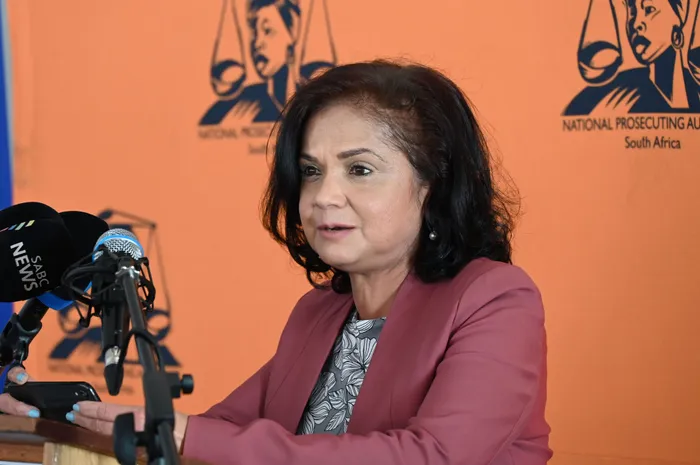
NDPP Shamila Batohi takes the stand at the Nkabinde inquiry, testifying on Gauteng DPP Andrew Chauke’s alleged misconduct in high-profile cases.
Image: Ayanda Ndamane/Independent Newspapers
National Director of Public Prosecutions (NDPP),Advocate Shamila Batohi, has told the Nkabinde Inquiry that although the President appoints Directors of Public Prosecutions (DPPs), they are not answerable to him and the Executive may not interfere in prosecutorial decisions.
Led in evidence by Advocate David Mahlomanyane, she said the Constitution and the NPA Act safeguard the National Prosecuting Authority’s operational and functional independence, limiting the Executive’s role largely to budgetary support and statutory reporting.
The Nkabinde Inquiry is examining the fitness of Gauteng DPP Advocate Andrew Chauke to hold office.
This follows a complaint by Batohi and focuses on two particularly controversial cases: the racketeering prosecution of Major-General Johan Booysen and members of the Cato Manor Organised Crime Unit, and the discontinuation of murder charges against former police crime intelligence head Lt-Gen Richard Mdluli.
Batohi explained that DPPs exercise original jurisdiction over prosecutions in the areas for which they are appointed, adding that this authority cannot extend into another province.
She said section 24 of the NPA Act makes it explicit that a DPP may exercise powers “in respect of the area for which he or she has been appointed,” and that a DPP “cannot control, direct, run with, supervise and coordinate a prosecution” in another jurisdiction.
She said there is also “no provision in the NPA Act, policy, prosecution policy or directives” that allows the National Director to instruct a DPP from one province to evaluate the work of another.
She added that the prosecution policy, directives, and the NPA’s Code of Conduct bind every prosecutor in the country.
These instruments, issued under sections 22 and 22(6) of the NPA Act, require prosecutors to assess all relevant factors, such as prima facie evidence, credibility and reliability of witnesses, admissibility and availability of evidence, and any version provided by an accused, before deciding whether to prosecute, she said.
Batohi said “every prosecutor in the country is obliged and must observe these important instruments.”
Addressing when a DPP would not exercise jurisdiction in their area, Batohi cited the Investigating Directorate Against Corruption (IDAC), established in August 2024, which has nationwide prosecutorial powers.
She explained that the Investigating Director holds a rank equivalent to a DPP and may prosecute matters across South Africa after consulting the local DPP. She stressed that IDAC’s involvement did not apply to the matter before the inquiry.
Batohi also outlined the centralisation mechanism in section 30 of the NPA Act, where offences occurring in multiple provinces may, by application of the relevant DPPs and approval of the NDPP, be consolidated in one jurisdiction for convenience.
She said this was the only lawful circumstance in which a DPP could handle a matter originating from outside their province.
She clarified that the restrictions on DPP jurisdiction do not prevent prosecutors themselves from being deployed across provinces when necessary.
If prosecutors in one province are conflicted, prosecutors from another may be sent to conduct the prosecution, but they would act under the authority of the DPP of the province where the matter is being heard.
Batohi emphasised that the NPA’s legal framework preserves the independence of prosecutorial decision-making while maintaining clear jurisdictional boundaries for DPPs.
IOL Politics