

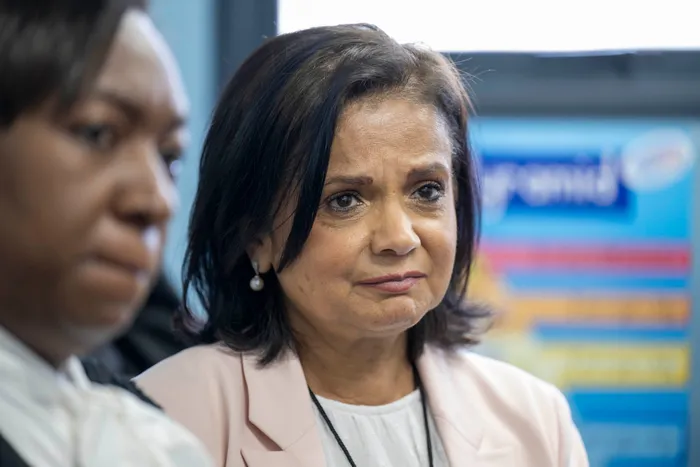
National Director of Public Prosecutions, Advocate Shamila Batohi continues with her testimony at the Nkabinde Inquiry.
Image: Picture Henk Kruger / Independent Newspapers
The National Director of Public Prosecutions (NDPP), Advocate Shamila Batohi, continues to give evidence on Friday at the Nkabinde Inquiry, which is examining the fitness of Gauteng Director of Public Prosecutions Advocate Andrew Chauke to hold office.
Evidence Leader Advocate David Mohlamonyane SC will continue leading the testimony of Batohi.
On Thursday, the inquiry was forced to adjourn due to document-related challenges that repeatedly disrupted the flow of evidence.
Inquiry spokesperson Tiyisela Mpuzana said the problems had since been addressed.
“These matters have received attention, and measures are being implemented to ensure the orderly and uninterrupted continuation of proceedings,” he said.
Batohi told the panel that when she assumed office in February 2019, the National Prosecuting Authority (NPA) was emerging from a period of deep credibility damage.
She said that for years prior to her appointment, the institution had been mired in public allegations of “capture” linked to the broader State Capture era.
“When I took office, I discovered that the credibility of the NPA had been seriously dented because of these allegations,” she said.
She said that senior officials, including former acting national director Advocate Nomgcobo Jiba and former Special Director of Public Prosecutions Advocate Lawrence Mwrebi, had faced serious accusations regarding their decision-making.
She reminded the inquiry that when she arrived, the Mokoro Inquiry into the fitness of Jiba and Mwrebi had already been underway, though its report was only released in April 2019.
“I should say that I found this when I came to the NPA. I was not in the NPA at the time. I don’t have personal knowledge of this,” she said, noting that her testimony relied on material and evidence she had accessed since taking office.
The Mokgoro Inquiry ultimately found both Jiba and Mwrebi not fit and proper to hold office.
Batohi explained that the allegations against Chauke overlapped substantially with issues ventilated in both the Mokgoro Inquiry and the State Capture Commission, chaired by Chief Justice Raymond Zondo.
These included the handling of the prosecution of former KwaZulu-Natal Hawks head Major General Johan Booysen and the withdrawal of criminal charges against former Crime Intelligence boss Lieutenant General Richard Mdluli.
While Mwrebi had withdrawn fraud-related charges against Mdluli, Batohi stressed that the present inquiry concerns Chauke’s role in withdrawing a separate set of charges, including murder.
Turning to the Booysen matter, Batohi described how, in early 2012, Jiba, then acting national director, established a team of prosecutors from Gauteng and the North West to run the case against members of the Serious and Violent Crimes Unit in KwaZulu-Natal.
She said Chauke, then the DPP for South Gauteng, effectively led the team and “unlawfully acted as the de facto DPP” in KwaZulu-Natal.
She outlined Booysen’s subsequent court challenge to the racketeering charges authorised by Jiba under the Prevention of Organised Crime Act (POCA).
Booysen had argued that, after requesting the documents on which the State intended to rely, he received 23 police dockets but was mentioned in only two, she said.
According to Batohi, Booysen said that in both dockets, the witnesses merely placed him at scenes after incidents had already occurred.
Matters expected to come before the inquiry, launched following a complaint by Batohi, include the racketeering prosecution of Booysen and members of the Cato Manor Organised Crime Unit, as well as the discontinuation of murder charges against Mdluli.
The Nkabinde Inquiry continues.
IOL Politics