

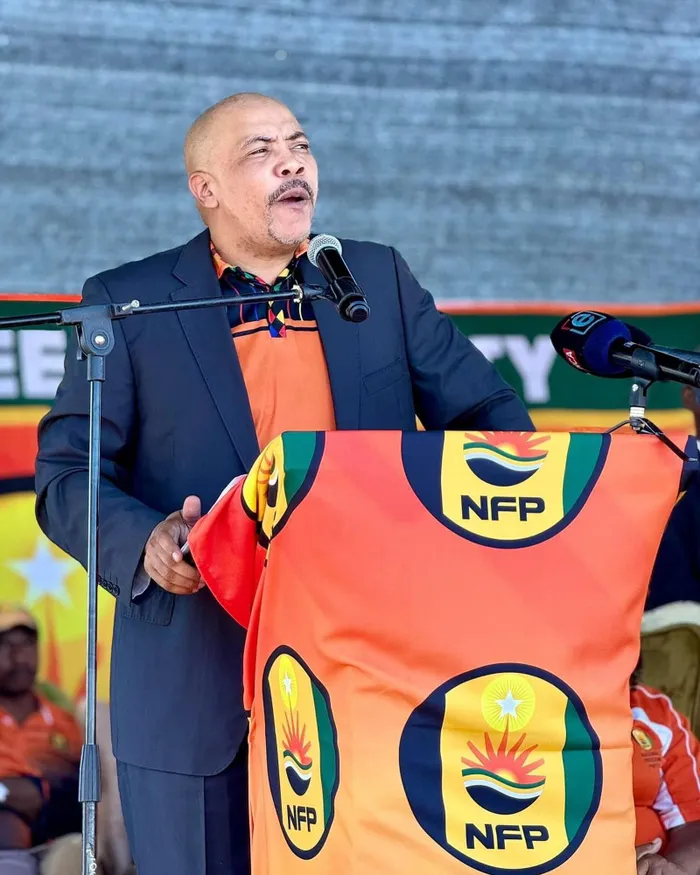
The NFP's exit from KZN's Government of Provincial Unity raises concerns about a potential political deadlock, with analysts predicting a possible early election or shifts in party alliances.
Image: Independent Media Archives
Political analysts say the National Freedom Party’s (NFP) decision to withdraw from the KwaZulu-Natal (KZN) Government of Provincial Unity (GPU) could trigger a political deadlock in the province.
The move, announced by the party’s National Executive Committee (NEC), raises questions about the future stability of the provincial government.
Analysts suggest the withdrawal could either force early elections or result in a shift in political alliances as parties navigate the new power dynamics.
Siyabonga Ntombela, a political analyst at the University of KwaZulu-Natal, explained that the NFP’s exit could destabilise the current GPU, which is made up of the Inkatha Freedom Party (IFP), African National Congress (ANC), and the Democratic Alliance (DA).
The GPU currently holds 40 seats, but should the NFP, under the leadership of Ivan Barnes, join the opposition coalition of MKP (37 seats), EFF (2 seats), and its own single seat, the result would be an even 40-40 split in the legislature. “
This political deadlock leads to government paralysis, thus necessitating various scenarios such as floor crossing and, in the worst case, placing the provisional government under administration,” Ntombela warned.
Zakhele Ndlovu, another analyst from UKZN, supported Ntombela’s concerns, adding that the GPU would now be left one seat short of the 41 votes needed to maintain its majority.
"The provincial legislature consists of 80 seats. The GPU will be left with 40 seats, one seat short needed to sustain the current government. Then there is a stalemate, which could force an early election unless parties renegotiate to have a new government reconstituted," Ndlovu said.
The NFP’s withdrawal follows a growing rift between its leadership and provincial chairperson Mbali Shinga.
The NFP’s NEC has instructed Shinga to resign from her position as MEC for Social Development by 9 am on Thursday, January 8, a decision that is part of the party’s larger push to maintain internal unity and discipline.
Shinga, the NFP’s only Member of the Provincial Legislature (MPL), had reportedly refused to support a motion of no confidence against Premier Thami Ntuli in December, which led to disciplinary charges against her, including gross misconduct, insubordination, and defiance of party directives.
According to the NFP, Shinga’s resignation is not meant to undermine her service, but rather to enforce adherence to the collective decisions made by the party leadership. “It is a call to consistency, unity and fidelity to the decisions of the NEC,” the party stated.
Goodenough Mashego, another analyst, offered a broader perspective on the potential impact of the NFP’s withdrawal.
He pointed out that while the MKP could use this opportunity to challenge the GPU, the power dynamics in the legislature would not shift easily.
“It failed because it stayed its gamble on NFP flipping, even though NFP was still part of the GPU,” Mashego said.
He also emphasised the role of the Speaker of the provincial legislature, who is from the ANC, and suggested that the Speaker would likely vote in favour of the GPU if a vote of no confidence was called.
“The speaker is an ANC person, they are going to vote in favour of the GPU,” Mashego said, highlighting the significance of the Speaker’s vote in maintaining the status quo.
Ntombela and Ndlovu also commented on the MKP’s position in KZN’s political landscape, noting that the party’s frustrations with the GPU are rooted in its belief that it should have led the provincial government due to the substantial vote share it secured in the 2024 elections.
According to Ntombela, the MKP is not just challenging the GPU for the sake of power, but because it sees itself as having been unjustly sidelined.
“The MKP is flexing its muscle because it knows it should have been the one leading the GPU by virtue of having won 45% of the votes,” Ntombela said.
Both analysts suggested that the MKP’s ambitions in KZN are deeply intertwined with the legacy of former President Jacob Zuma. They believe the party views itself as the rightful successor to Zuma’s political influence in the province, a sentiment that continues to fuel its push for leadership.
In response to the NFP’s move, the ANC in KwaZulu-Natal acknowledged the party's right to make its own decisions, but asserted that the GPU remains intact.
Michael Mabuyakhulu, the ANC Coordinator in the province, explained that the ANC would engage with the NFP to discuss the implications of its withdrawal.
“The ANC respects the fact that the NFP has a right to make decisions about its allegiances. However, the ANC will seek bilateral engagement with the NFP to discuss the party’s latest alleged stance,” Mabuyakhulu said.
The ANC also emphasised that the NFP's departure does not automatically result in the collapse of the GPU.
Mabuyakhulu referred to Section 141(2) of the South African Constitution, which requires a majority of at least 41 votes in the legislature to pass a motion of no confidence in the Premier.
“With the alleged withdrawal of the NFP from the GPU and the call for the resignation of MEC Shinga, the leading coalition of the ANC, the Inkatha Freedom Party (IFP), and the Democratic Alliance (DA) would stand at 40 members, meaning that the other parties would not enjoy the required majority 41 or more of its members to collapse the provincial government,” Mabuyakhulu said.
“Therefore, the GPU remains in place and committed to serving the people of KwaZulu-Natal.”
The NFP has announced plans to hold a media briefing to explain the implications of its withdrawal and outline its next political steps.
IOL Politics