

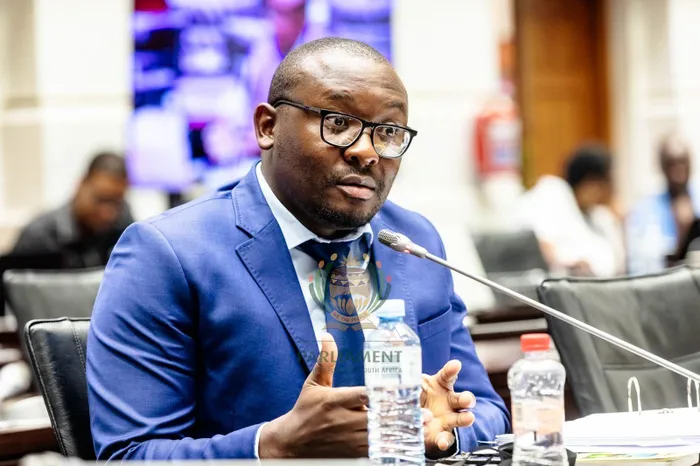
Former Crime Intelligence Brigadier Tiyani Hlungwani exposes cronyism in SAPS, accusing top officers of using power to eliminate rivals and control resources.
Image: Zwelethemba Kostile/ParliamentofRSA
Former Crime Intelligence (CI) Brigadier Tiyani Hlungwani accused senior police officers of systemic malfeasance and corruption during his testimony before an ad-hoc committee on Wednesday.
Speaking before the Ad-Hoc Committee on Thursday, Hlungwani shared detailed accounts of his dismissal, alleged illegal practices within the force, and his belief that powerful factions within the police were deliberately working to undermine crime intelligence efforts in the country.
He was questioned by ANC Chief Whip, Mdumiseni Ntuli, about various allegations he made in his statement, including inflated procurement prices and irregular expenditure.
In his testimony, Hlungwani painted a picture of a police force rife with cronyism, suggesting that senior figures such as former National Commissioner, General Khehla Sithole, and current Commissioner, General Fannie Masemola, formed a "cabal" intent on defeating their rivals.
He claimed the war within SAPS was largely about control over the Secret Service account, a key budget line that he believes has been exploited for personal gain.
Hlungwani specifically pointed to the Crime Intelligence head at SAPS, Lt Gen Dumisani Khumalo, who, according to him, was tasked with purging rival officials in the service.
"The competition is the Secret Service account, and crime intelligence itself," Hlungwani said. "Crime intelligence is the most important of these three agencies. When crime intelligence is crippled, organised crime flourishes."
Hlungwani also shared details of what he described as a pattern of inflated procurement prices, including a specific case involving the procurement of bulletproof vehicles, where he alleges certain generals colluded to inflate prices through rigged bidding.
He attributed this activity to individuals who had been “heavily involved” in corrupt practices, pointing specifically to Lt-General Nhlanhla Mkhwanazi.
Hlungwani’s testimony also shed light on the events leading to his dismissal. He described being targeted by General Khumalo and others, claiming that he was unfairly blamed for fruitless and wasteful expenditure despite lacking proper office space or resources to do his work.
Hlungwani alleged that Khumalo was acting under instructions from higher-ups, aiming to remove him and others from their posts.
“I was not fired for malfeasance,” he said. “I’m not charged with corruption. It’s a case of cronyism and the weaponisation of regulations to get rid of people who don’t share the same views.”
Ntuli, who was questioning Hlungwani on these matters, expressed concerns over the level of cronyism within SAPS and asked Hlungwani what needed to be done to address the issue.
Hlungwani suggested that the solution lay in appointing the “right people” and conditioning individuals to act in a more ethical manner.
He further highlighted that the issue of cronyism began long before General Khumalo’s tenure, citing the appointment of high-ranking officers who were close allies of former National Commissioner General Sithole.
“The problem starts with the appointment of the wrong people,” Hlungwani said.
“When your close allies are in positions of power, they act with impunity. This has been the case for years, and it’s something that needs to be addressed if crime intelligence is ever going to be effective again.”
Ntuli also questioned Hlungwani about his reference to the alleged irregular expenditure on accommodation, particularly the 58,000 Rand per month spent by Khumalo and his secretary. Hlungwani described this expenditure as "irregular," suggesting that it was part of a broader pattern of mismanagement and abuse of state resources.
When asked about the expenditure of the PKTT he suggested that a forensic investigation into the matter would be appropriate, as there were concerns that state resources were being misused.
“I would recommend a forensic investigation,” Hlungwani said. “There’s a lot that needs to be uncovered.”
Hlungwani said that cronyism and factionalism were undermining the police's ability to combat crime effectively.
“It’s about appointing the right people,” he said. “But the right people are being sidelined in favor of those who share certain interests.”
IOL Politics