

Former DA member Mbali Ntuli warns the DA is facing a leadership vacuum. With a lack of strong successors and internal factionalism, the party’s future looks uncertain as the 2026 local government election approaches.
Image: Tumi Pakkies / Independent Newspapers
Former Democratic Alliance (DA) member Mbali Ntuli, now CEO and Founder of the Ground Work Collective, has slammed John Steenhuisen’s leadership, labelling his tenure as party leader a failure.
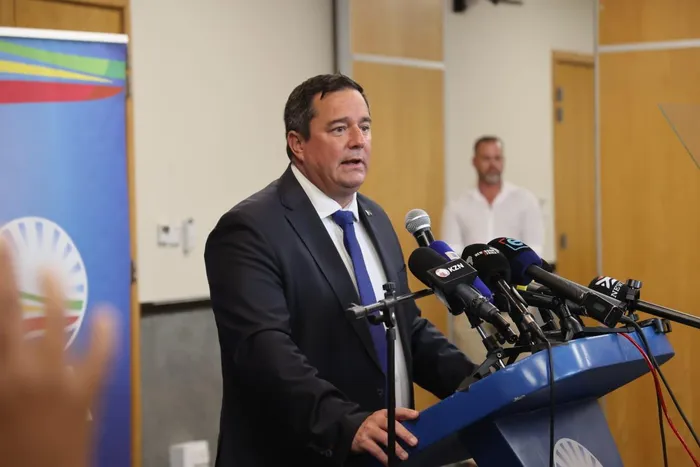
Ntuli's comments come as Steenhuisen confirmed on Wednesday in a media briefing that he will not seek re-election at the DA's federal congress in April, marking the end of his leadership of the official opposition.
Steenhuisen, who became DA leader in 2019, described his time in charge as a “mission accomplished.”
Reflecting on his tenure, he acknowledged the party had stabilised under his leadership, expanding its influence across provinces and municipalities.
However, Steenhuisen also confirmed that he would not be contesting the leadership position, though he would continue serving as Minister of Agriculture.
His announcement comes amid the most severe foot-and-mouth disease outbreak South Africa has experienced, a crisis that Steenhuisen intends to focus on as Agriculture Minister.
In a post on X, Ntuli pointed to a series of internal scandals and missteps that, she argues, defined Steenhuisen’s leadership.
She noted that his tenure had been overshadowed by poor decision-making, particularly in handling the foot-and-mouth outbreak, and allegations of financial impropriety.
According to Ntuli, Steenhuisen’s leadership style and temperament were poorly suited to leading the DA, with dramatic internal struggles and scandals making his leadership untenable.
"John Steenhuisen's leadership style, temperament, and emotional intelligence made him a poor choice to lead the country’s national opposition.
''His leadership was consumed by drama, scandal, alleged internal financial impropriety, and now, arguably, the final blow: the mishandling of the Foot and Mouth outbreak," Ntuli said.
Ntuli went further, arguing that the DA would be better served by asking Steenhuisen to resign entirely. “In truth, the DA would be better served asking him to resign entirely.
Ntuli warned that Steenhuisen’s departure should trigger a serious reflection on the DA’s future, but expressed doubt that the party would take the necessary steps to address its leadership crisis.
She speculated that the DA might continue with a flawed leadership structure, particularly pointing to Geordin Hill-Lewis, Cape Town’s mayor, potentially juggling both his municipal and party roles.
"The real problem is what comes next," Ntuli said, emphasising that the DA’s leadership bench was "alarmingly thin."
She criticised the party for sidelining capable leaders who didn’t fit its narrow vision of leadership while promoting others with evident shortcomings. This, she argues, has created a leadership vacuum, with few viable names emerging as successors to Steenhuisen.
"The DA’s bench is alarmingly thin," she said.
She noted that many voters could only name a handful of party figures, such as Helen Zille, Geordin Hill-Lewis, Chris Pappas, and Steenhuisen, and perhaps their local councillor.
''That is not a leadership pipeline. It is a warning sign,'' she said.
Ntuli also addressed the financial scandals surrounding Steenhuisen, stressing that the issue was not about trivial expenses, but about a broader culture of entitlement within the DA. She argued that when a political party operates with this level of disregard for accountability, public trust is inevitably eroded.
"Political parties do not merely manage money. They manage public confidence. Once that confidence is squandered, no technical accounting defence can restore it," Ntuli said.
The resignation announcement marks the end of a turbulent period for the DA, but it also raises serious questions about the party's future.
Senior DA figures, including Hill-Lewis, Gauteng leader Solly Msimanga, and Western Cape Premier Alan Winde, have been mentioned as potential candidates for the leadership role. However, the race remains unclear.
The DA’s situation is further complicated by its role in the Government of National Unity (GNU). Ntuli stressed that the DA, as part of the government, cannot escape scrutiny. Once a party enters government, it must be held to the same ethical standards it demands of others.
"There can be no special pleading, no technical evasions, and no minimisation simply because the misconduct occurred within party structures rather than the state," she argued.
The crisis within the DA is not only a matter of leadership or financial scandals, but a deeper structural issue that threatens the party’s long-term viability. The reported discussions about Helen Zille possibly returning to frontline leadership should be a red flag for both the party and the electorate, Ntuli said.
At nearly 80, Zille’s returning to frontline leadership should concern both party members and the electorate, Ntuli said.
''Politics is mentally and physically punishing work, and age is not an abstract consideration. A party that continues to tether its future to a single individual while failing to plan meaningfully for succession is behaving irresponsibly.''
"Expecting Geordin Hill-Lewis to run one of the country’s most economically significant cities while also leading a national party within a GNU he did not negotiate would stretch even the most capable leader beyond reason. That is not strategy. It is desperation," Ntuli said.
Meanwhile uMngeni Mayor Chris Pappas acknowledged Steenhuisen's contributions to the party during a difficult period.
Pappas expressed gratitude for Steenhuisen’s leadership, noting that he had stepped in after the sudden departure of the previous leader and managed to stabilise the DA during a turbulent time.
"Thank you for your service, John. You took the Democratic Alliance forward at a difficult moment, stepping in after the previous leader abruptly abandoned the role.
''Under your leadership, the party was stabilised and strengthened, growing its presence across provinces and municipalities, becoming a party of national government," Pappas said.
Pappas added that over the past year of the GNU, South Africa has made progress on a number of fronts and many signs show a continued upward trajectory.
"True leadership also lies in knowing when it is time to hand over. You have fulfilled the task you set out to achieve," Pappas said.
IOL Politics