

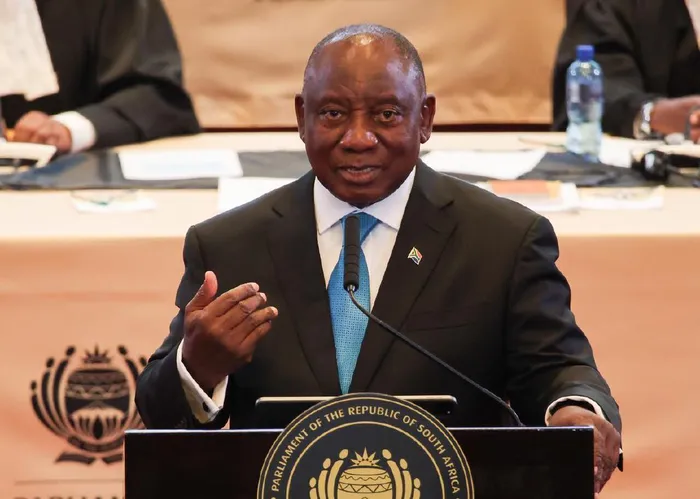
President Cyril Ramaphosa says access to resources and quality teaching remains uneven.
Image: GCIS
President Cyril Ramaphosa says unequal access to resources and quality teaching remains a major challenge in South Africa’s education system, particularly in township and rural schools.
In his weekly newsletter on Monday, February 16, Ramaphosa said that while progress has been made since the advent of democracy, significant gaps persist.
Ramaphosa reflected on issues raised during his recent State of the Nation Address (SONA), where he outlined efforts to prepare young people to compete and thrive in a rapidly changing world.
“While we have made significant progress over the last three decades, from expanding access to school to steadily improving matric results, there are still huge challenges in education.”
“Access to resources and quality teaching is uneven.”
“Schools in townships and rural areas often struggle with overcrowding and educators have limited access to professional development and support.”
Ramaphosa pointed to the Basic Education Employment Initiative, founded in 2020 as part of the Presidential Employment Stimulus, as one of the interventions helping to address these gaps.
“To date, the school assistants programme has created more than 1.3 million work opportunities.”
“It is the largest youth employment programme in our country’s history, giving young people their first foothold in the world of work while strengthening the foundations of learning in the schools that need it most,” he wrote.
He said young people in the programme are well prepared before entering schools.
“General school assistants need to have at least grade nine, while education assistants need at least a matric certificate.”
In the most recent phase, 32% of education assistants had some form of tertiary qualification and 14% had a teaching qualification.
“Education assistants are provided with both compulsory and optional training including on school safety, online safety, financial literacy, word processing, AI fluency and coding.”
“The initiative provides work experience and livelihood support while at the same time advancing the public good.”
“The work of the education assistants allows teachers to spend more time on teaching and on lesson preparation, thereby contributing directly to improved educational outcomes.”
“Education assistants have been placed at 19,000 no-fee primary schools to support numeracy and as Reading Champions to support literacy and bilingual reading.”
“The effect of the intervention is being seen in rapid improvements in foundational literacy skills in many schools.”
“Beyond educational and curriculum support, education assistants are supporting digital learning, working in care and support with at-risk learners, and serving as laboratory and workshop assistants.”
He said the experience has also been transformative for many participants.
“They are gaining skills and real work experience that will serve them well in finding employment and succeeding in their careers.”
“As we work to expand access to Early Childhood Development (ECD) through the Bana Pele mass registration of ECD facilities and an increase in subsidies for ECD learners, the Presidential Employment Stimulus has stepped up support to the sector through the Social Employment Fund.”
He said the Department of Trade, Industry and Competition, working with an implementing partner, is helping more than 1,000 previously disadvantaged, underfunded ECD centres to meet the qualifying criteria for an ECD subsidy.
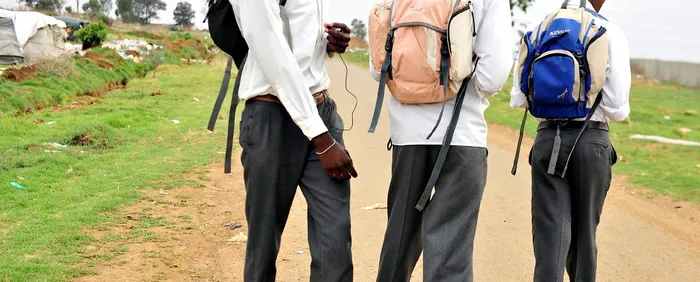
President Cyril Ramaphosa says many schools struggle with overcrowding and limited teacher support.
Image: Bongiwe Mchunu
“The centres are also receiving nutritional support for learners, as well as toys, books and learning materials.”
“The work supported by the Social Employment Fund now reaches over 50,000 children in ECD centres across the country.”
Ramaphosa said meeting the constitutional imperative to provide quality education requires a collective effort.
“These initiatives illustrate clearly the benefits of multisectoral cooperation between government, the private sector and civil society.”
“It is our aspiration that this successful programme should continue to grow as we strive to create more work opportunities for young South Africans and at the same time deliver quality education for all.”
In his address last week, Ramaphosa said the government is expanding access to early childhood development and strengthening the basic education system.
“By making Grade R compulsory, we are getting all children off to a good start. We are intensifying efforts to fix the basic education system, with a focus on early learning, literacy and numeracy, and mother-tongue based bilingual education.”
He also congratulated the matric class of 2025 for achieving 88% pass rate.
“This is the highest pass rate in our history, reflecting both the commitment of these learners and the interventions we have made to improve learning and teaching in schools.”
“As we welcome improvements in the matric pass rate, we must address the high dropout rate in the last few years of schooling.”
“More learners must be able to write matric and to take subjects, like maths and science, that will enable them to progress further.”
“To enable the youth of today to transform our society and secure their future, we are preparing the ground for a skills revolution.”
“We are undertaking a fundamental overhaul of the skills development system to implement a dual training model that integrates education with practical workplace experience,” he added.
IOL Politics