

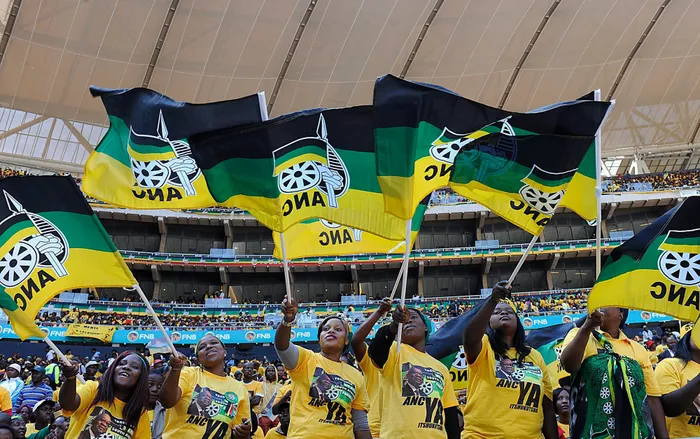
The ANC's Vhembe Region elective Conference outcomes are being challenged in court.
Image: Matthews Baloyi
A group of African National Congress members has approached the High Court of South Africa in Johannesburg, seeking to have the party’s 9th Vhembe Regional Conference declared unlawful and set aside.
In a notice of motion filed on February 5, 2026, ten applicants led by Rudzani Ludere ask the court to declare the conference, held on May 4, 2025, at Kalahari Waterfront, “irregular, unlawful and invalid.”
They are also seeking an order reviewing and nullifying all decisions, resolutions and election outcomes of the Regional Executive Committee elected at the conference.
The ANC at national, provincial and regional level, including its National Executive Committee and the Limpopo Provincial Executive Committee, are cited as respondents alongside individual regional leaders and the elections service provider.
The application further asks the court to compel the respondents to produce the full record of documents and electronic evidence related to the contested decisions, in line with Rule 53 of the Uniform Rules of Court.
In his affidavit, Ludere argues that the conference was convened and conducted in a manner inconsistent with the ANC constitution, conference guidelines and principles of fairness. He alleges several irregularities, including improper accreditation of delegates, manipulation of branch credentials, procedural deviations during voting, and the unlawful declaration of results.
“The effect of these irregularities was that the will of legitimate delegates was subverted and the integrity of the electoral outcome compromised. The applicants exhausted internal remedies within the organisation, but no adequate relief was provided, necessitating this application,” he said.
According to Ludere, the roots of the dispute date back to April 2024, when the party’s online membership system crashed, creating administrative difficulties and contributing to lapses in leadership terms.
He states that the Vhembe Regional Executive Committee’s term expired in December 2024, but the leadership could not convene a conference due to ongoing system problems. Branches were unable to access the platform between April and September 2024. Around July, ANC Secretary-General Fikile Mbalula issued a communiqué providing an alternative link for renewals and new member forms.
While some branches used the workaround, Ludere says the expired term meant branches could not hold Biannual Branch General Meetings, and preparations for the regional conference, initially scheduled for December 2024, stalled.
Although the system was partially restored in September 2024, it remained unreliable, with branches struggling to process renewals. Members were told the organisation was transitioning to a new system, but this had not materialised by year-end, and some branches continued using the old platform despite its limitations.
The Vhembe REC was subsequently dissolved and replaced with a Regional Task Team, alongside similar interventions in Sekhukhune, Peter Mokaba and Norman Mashabane. The task team was given full executive powers, including responsibility for conference preparations.
A revised roadmap set the conference for November 12, 2024, but ongoing membership verification challenges pushed timelines to December 15, 2024. Nominations were later scheduled from 18 January to 18 February 2025, with the conference planned for 8–9 March 2025.
However, on 29 January 2025, Mbalula issued a directive to provincial secretaries instructing structures to revise their conference roadmaps and allow a two-week cooling-off period to resolve queries.
“In light of the Secretary General's directive, the road map for the ANC Vhembe Regional Conference was amended in that the cut-off for membership was 17th December 2024, the dates for branches to convene BGMs and BBGMs were 22nd March 2025 until 13th April 2025 and the conference was scheduled for 4th-5th May 2025,” he said
Ludere alleges that during the cooling-off period, some branches proceeded with meetings despite the revised roadmap. He claims these meetings were facilitated by the office of Limpopo Provincial Secretary Ruben Madadzhe, including the deployment of scanners with assistance from the national organising department.
“These BBGMs/BGMs were facilitated by the office of the Provincial Secretary (Ruben Madadzhe), who further facilitated the scanners with the assistance of the national membership and organising department. The Provincial Secretary facilitated and coordinated the scanners in support of branches that he perceived to supporthis leadership preferences in the Region. Branches were provided with scanners while the Regional Task Team, as well as the Regional Task Team Coordinator was unaware of these BBGMs and BGMs, hence no one attended these branch meetings from the RTT as a deployee,” Ludere says.
According to the affidavit, the Regional Task Team and its coordinator were unaware of these meetings and did not deploy officials, raising concerns about procedural fairness. Ludere argues that these developments pointed to a coordinated effort to undermine the task team’s work and influence the regional outcome.
The legal challenge unfolds in Limpopo, where internal ANC disputes have frequently ended up in court, particularly in the politically significant Vhembe District, long regarded as one of the party’s key strongholds.