

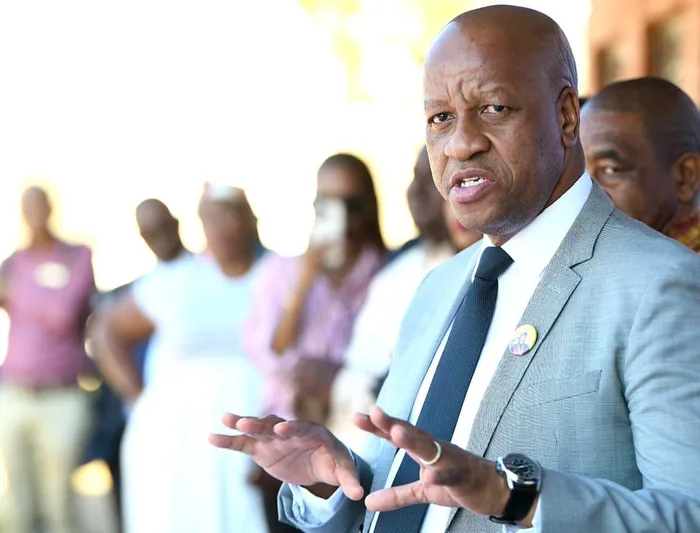
Premier Thami Ntuli says R100 million will uplift KwaZulu-Natal youth, creating jobs and supporting businesses, as the province drives economic recovery, infrastructure growth, and stronger opportunities for young people.
Image: Supplied
KwaZulu-Natal Premier Thami Ntuli says R100 million has been set aside to assist young people with funding to help create more job opportunities in the province.
Speaking during the State of the Nation Address debate on Tuesday, Ntuli positioned the youth allocation as part of a broader national shift toward recovery and implementation.
He said South Africa was “turning the corner” following the stabilisation of the energy supply, renewed economic momentum, the unlocking of infrastructure investment, and the gradual return of investor confidence.
Ntuli said the R100 million fund was already making a tangible difference on the ground.
"This reflects the KwaZulu-Natal government's commitment to the R100 million allocated for uplifting young people. I have visited some of the beneficiaries,” he said.
He said beneficiaries had received practical support to expand their enterprises. Some were provided with vehicles to distribute their products and business equipment, while others received 52 cattle, a tractor with implements, and 3km of fencing installed around a farm.
“In KwaZulu-Natal, we are prioritising the youth in our plans to uplift communities,” he said.
He added that the support had created further job opportunities beyond the direct recipients.
Ntuli said the Government of National Unity had demonstrated that cooperation anchored in constitutional values and national interests was effective in confronting socio-economic challenges.
He noted the 98.6% performance of the KwaZulu-Natal Class of 2025 matriculants as further evidence that the province was moving in a positive direction.
However, he cautioned that progress would only be meaningful if followed by decisive implementation.
“Turning a corner is meaningful only if we now move forward with urgency, discipline, and unity of purpose,” he said, stressing that implementation was now the defining task of leadership.
He described KwaZulu-Natal as a strategic economic pillar of the country, characterising it as South Africa’s logistics gateway and home to the busiest port on the African continent, as well as a manufacturing hub, an agricultural centre with fertile land, a globally competitive tourism destination, and a province with a youthful population eager to participate in the economy.
Addressing logistical constraints, Ntuli said bottlenecks at the Port of Durban had been resolved following the introduction of motorboats and new “monster cranes”.
He welcomed the President’s announcement of public-private partnerships in ports and rail, including the modernisation of Durban’s port and terminal.
“This is not incremental change. It is a foundational and to reshaping of our economic output,” he said, adding that the provincial government would work decisively to support the reform agenda.
“Our objective is clear. To restore Durban to world-class operational efficiency and reposition KwaZulu-Natal as the gateway to South Africa trade.”
Ntuli said the announcement of more than R1 trillion in public infrastructure investment over the next three years represented a historic opportunity. He noted that the province was already a construction site, with the M3, M2, and several provincial and local roads under construction.
He said the province was prioritising the rehabilitation of roads and bridges damaged by floods, water and wastewater upgrades across metro and rural districts, the revitalisation of industrial parks, renewable energy infrastructure and digital connectivity in townships and rural economies.
The establishment of a Provincial Investment Office within the Office of the Premier, he said, was central to driving this effort, sending a clear message that “KwaZulu-Natal is open for business and government will operate at the speed of opportunity.”
Ntuli agreed that the President had correctly identified water insecurity as a national crisis. In KwaZulu-Natal, he said, water shortages threatened households, agriculture, tourism, and industrial productivity.
He expressed full support for the establishment of a National Water Crisis Committee. He welcomed decisive interventions where municipalities had failed to perform, citing the Presidential eThekwini Working Group as an example of effective intervention.
Ntuli said organised crime, including construction extortion and port-related syndicates, had undermined investment and growth.
He welcomed the President’s efforts to dispatch crime networks and said coordination between the South African Police Service, Metro Police, community safety structures, intelligence structures, and the private sector had been intensified. He added that crime statistics were showing a quarterly decrease in the province.
Addressing gender-based violence and femicide, Ntuli referred to the late Prince Mangosuthu Buthelezi’s longstanding call to protect women and children. He welcomed the declaration of gender-based violence and femicide as a state of national disaster.
He also said tourism remained a key growth lever, with strengthened safety in tourism nodes, expanded destination markets, and the promotion of township and cultural tourism. In 2025, the province had recorded a significant increase in both local and international tourist arrivals.
Ntuli also welcomed expanded agricultural finance, strengthened extension services and the national response to the foot-and-mouth disease outbreak, noting that Western Natal remained the epicentre.
He supported decisive intervention, including a nationwide vaccination drive, describing it as a coordinated effort to safeguard the agricultural sector, protect jobs and restore confidence in the livestock industry.
Highlighting youth employment, Ntuli said the province was supporting TVET reform, workplace learning and expanded employment programmes, and was forging a provincial skills compact with the private sector in logistics, energy, construction and the digital economy.
He cited Statistics South Africa’s report that KwaZulu-Natal had achieved 54,000 new job opportunities as evidence of progress.
KwaZulu-Natal, he said, stood ready to move from recovery to accelerated growth.
“Let us take this moment with courage, with unity, and with unwavering commitment to our people as we continue to lead KwaZulu-Natal until 2029,” Ntuli said.
IOL Politics