

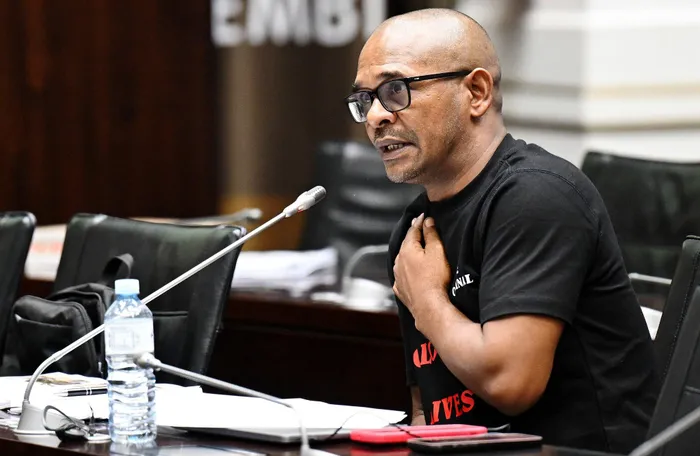
National Coloured Congress (NCC) leader Fadiel Adams claims businessman Vusimuzi “Cat” Matlala is too small a figure to be considered a key member of the alleged Big Five cartel.
Image: Pando Jikelo / Parliament
MP and National Coloured Congress (NCC) leader Fadiel Adams says murder-accused businessman Vusimuzi “Cat” Matlala is “too small” to be regarded as a member of the so-called Big Five cartel, but claimed real cartels are in Parliament.
According to Adams, Matlala acted as a cash funnel for powerful insiders within the South African Police Service (SAPS) and had illegal access to sensitive police records.
Adams was testifying before Parliament’s ad hoc committee on Wednesday night.
The committee was established to investigate claims made by KwaZulu-Natal provincial police commissioner Lieutenant General Nhlanhla Mkhwanazi during an explosive media briefing in July last year.
Adams was questioned about allegations that he improperly accessed and handled classified police intelligence. Advocate Maria Mokhoaetsi led the evidence.
Adams told the committee he does not believe Matlala was a cartel member.
“A cartel - I look at the Russians, I look at the Colombians, the Bulgarians, maybe even the Moroccans. Those are cartels. Vusi Cat Matlala is way too small for that job,” he said.
He was commenting on evidence previously given by SAPS crime intelligence boss Lieutenant General Dumisani Khumalo at the Madlanga Commission in September last year.
Khumalo detailed how the alleged Big Five drug-trafficking cartel had infiltrated political and law-enforcement structures, as well as private security.
“The Big Five has already penetrated the political sphere and there are documented cases of high-profile connections in the political arena, with senior politicians alleged to be complicit and/or wilfully blind to the syndicate operations,” Khumalo said.
He added that the cartel had “captured some of the key elements within the criminal justice system” to sustain its illegal operations.
According to Khumalo, the group sought to secure allies among key judicial and law-enforcement officials, as well as political figures at various levels - particularly at senior levels - to manipulate investigations, suppress evidence and obstruct legal proceedings that threatened its operations.
He told the commission that the Big Five cartel was linked to several syndicates specialising in different crimes and consisted of five key individuals.
Khumalo named only two: Vusimuzi “Cat” Matlala and Katiso “KT” Molefe.
Matlala faces attempted murder charges and was previously awarded a R360-million contract linked to police health services that has since been terminated.
In his July press briefing, Mkhwanazi also alleged that Matlala financially backed the political ambitions of the now suspended Police Minister Senzo Mchunu and North West businessman known to Mchunu, Brown Mogotsi.
Molefe, meanwhile, is accused in the murder case involving Oupa Sefoka, better known as DJ Sumbody, who was fatally shot in Gauteng in 2022.
Khumalo explained how the cartel operated.
According to the top cop, the Big Five functioned like a conventional employer, with members receiving regular income for financial stability.
The group was headquartered in Gauteng, which he described as the “economic heart of the country”, but also operated in KwaZulu-Natal, the Western Cape and the Eastern Cape.
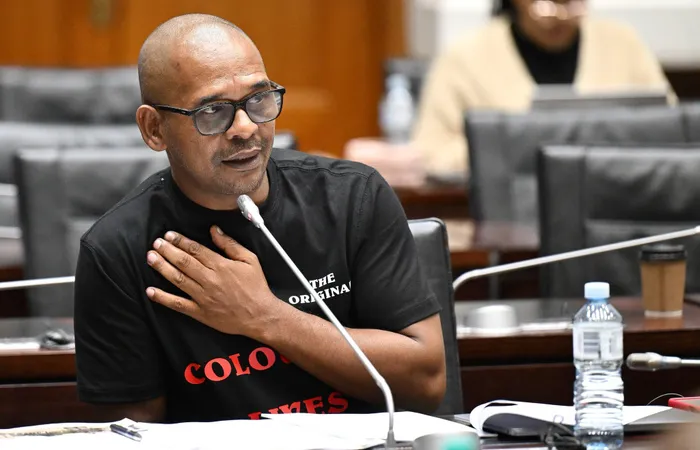
MP and National Coloured Congress (NCC) leader Fadiel Adams says murder accused businessman Vusimuzi “Cat” Matlala is too small a figure to be regarded as a member of the alleged Big Five cartel.
Image: Pando Jikelo / Parliament
Beyond drug trafficking, Khumalo said the cartel was involved in a range of criminal activities, including contract killings, tender fraud, cross-border vehicle hijackings, kidnappings and extortion.
He added that the group also carried out cash-in-transit heists and ATM bombings.
“This criminal activity is used as a quick cash-flow exercise for the cartel in case there are hiccups with the main criminal activity that the cartel is specialising in,” Khumalo said.
Earlier this year, Khumalo also claimed that nearly all members of the Gauteng police were working for a criminal cartel.
He said internal risk assessments and intelligence analyses had revealed deep systemic compromise within Gauteng SAPS operations.
Meanwhile, Adams said he did not believe the evidence provided by Khumalo regarding alleged cartel members.
“When you look at the evidence provided by Lt-Gen Khumalo about the existence of cartels here in this room, you might as well have Googled it. ChatGPT gives you a better description. There’s no evidentiary information,” he said.
“The cartels are here (in Parliament). You’d be stupid to dispute that. But Vusi Cat Matlala is way too small to be labelled a cartel member, or a cartel boss.”
Adams said he believed Matlala served instead as a conduit for money.
“What I think he was, was a cash funnel for some very powerful people within the South African Police Service,” he told the committee.
He added that Matlala was “a criminal”.
“I don’t think anybody is going to argue that. But he didn’t give himself a R300-million tender.
“There was a BAC and a BEC. The National Commissioner, (General Fannie Masemola), sat here and admitted that someone within the IDAC had notified him that this tender might be going to the wrong person.”
Adams said Masemola had been contacted and asked to review the matter.
“He said he contacted General Fannie and told him to have a look. General Fannie came back and said it all looked above board, but if there was an investigation they could act. That cost the South African taxpayer R50 million,” Adams said.
He accused Masemola of failing to act.
“Vusi Cat Matlala is a criminal, and they’ve given him access to the health records of every policeman in the country.
“One click of the mouse and you’ll know who has HIV. One click and he knows who has mental health issues.
“In this country, people kill themselves before they reveal that status - and they’ve given this to a criminal. This is treason,” Adams said.
He argued that once it had been established that Matlala should never have received the tender, responsibility lay with SAPS leadership.
“He didn’t pay himself R50 million. This money was authorised by the accounting officer of the SAPS - Mr Fannie Masemola - even if he didn’t sign it himself,” he said.
Adams added that the irregularities were discovered not by SAPS but by the Special Investigating Unit (SIU).
“If the SIU had not investigated this, Vusi Cat Matlala would still be trading with SAPS,” he said.
According to Adams, there had effectively been no investigation into Matlala.
“If you look at the case docket at his last appearance last month, there are two pages in the docket. Two. That’s not an investigation - that’s a joke,” he said.
Adams has now concluded his affidavit testimony.
Committee chairperson Soviet Lekganyane said members of the committee would be given a date - yet to be announced - to question Adams on his testimony.
IOL Politics