

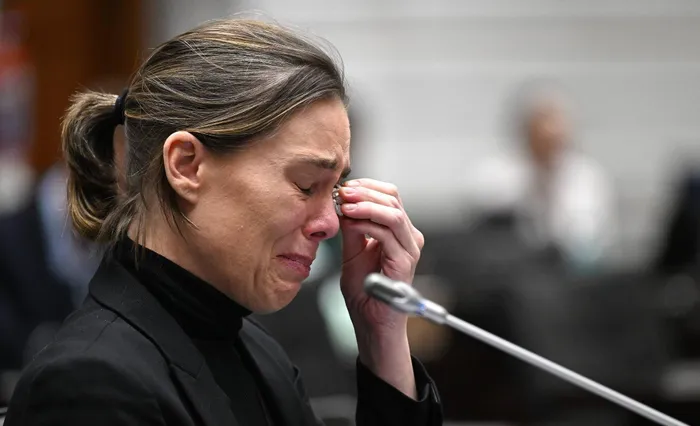
PAUL O’Sullivan’s former assistant Sarah-Jane Trent appeared before Parliament’s Ad Hoc Committee where she broke down multiple times during her testimony.
Image: Phando Jikelo/ Parliament RSA
Former assistant of private investigator, Paul O’Sullivan, Sarah-Jane Trent, broke down in tears following intense questioning regarding the legal basis for private organisations to assist the Independent Police Investigative Directorate (IPID), especially high profile cases.
Less than an hour into her testimony on Thursday at the Ad Hoc Committee, Trent struggled to explain the legal grounds that allowed her former organisation to assist the state watchdog in high-profile investigations.
The emotional moment unfolded as lawmakers pressed her to identify the exact provisions of the IPID Act that would permit private organisations to participate in sensitive investigations.
Trent could not provide a clear answer. Her testimony followed that of O’Sullivan himself, who appeared earlier the same day before the committee probing allegations that his private investigative network exerted influence inside IPID during politically sensitive cases.
The hearings were triggered in part by testimony from advocate Michael Mashuga, a former prosecutor from the National Prosecuting Authority (NPA).
Mashuga told the committee on Wednesday that IPID’s independence was compromised during investigations involving former acting national police commissioner Khomotso Phahlane.
Phahlane, dismissed from the police in 2020 after being found guilty of dishonest conduct, has long argued that O’Sullivan wielded undue influence over investigations targeting him.
Against that backdrop, Trent’s appearance quickly became one of the most tense moments of the inquiry.
Attempting to establish her role, Trent told MPs she first approached O’Sullivan’s investigative firm in February 2015 while unemployed.
“I thought, ‘What do I have to lose?’ I was interested in investigations and sent my CV,” she said.
At the time, the firm had no vacancies. Trent said she began volunteering her services on a pro bono basis, initially performing basic research and administrative tasks.
She insisted she was not involved in strategic meetings or assigned to major cases during the early stages of her work.
Over time, however, her role expanded significantly.
Trent eventually became a director at O’Sullivan’s firm and the anti-corruption organisation Forensics for Justice — positions she held for roughly six years.
The tone of the hearing sharpened when evidence leader advocate Bongiwe Mkhize turned to the firm’s involvement in IPID’s investigation into Phahlane.
O’Sullivan had laid a formal complaint against the senior police official in 2016, triggering the probe.
Trent testified that she assisted by conducting background research and later met with former IPID head Robert McBride as well as lead investigator Mandla Mahlangu.
But when MPs demanded legal justification for private actors assisting the watchdog, Trent faltered.
She argued that the IPID Act allows outside entities to provide support. Pressed to cite the specific clause, she could not.
Under sustained questioning, Trent attempted to narrow her role.
“We were not managing the investigation,” she said. “If I needed to run a search on something that came out of the investigation, IPID carried out the investigation. We just assisted with certain aspects.”
The explanation did little to calm sceptical MPs, who repeatedly demanded clarity on whether the collaboration between private investigators and the police watchdog was lawful.
The committee’s hearings are expected to continue as lawmakers attempt to determine whether private influence compromised investigations meant to hold powerful police officials accountable.
IOL Politics