

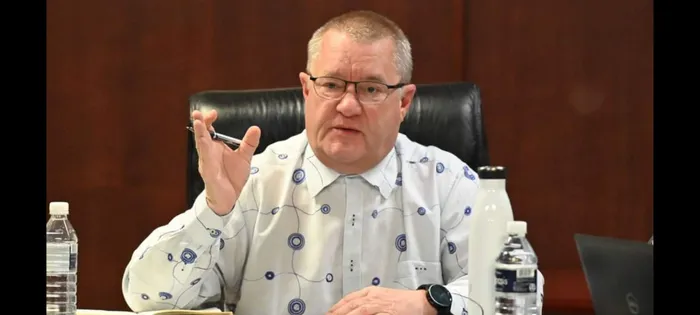
KZN's Finance MEC Francois Rodgers presented KwaZulu-Natal's 2026/27 budget, emphasising financial recovery. With major investments in health, education, and infrastructure, the budget reflects the province’s focus on sustainable growth and service delivery improvement.
Image: Supplied
KwaZulu-Natal Finance MEC, Francois Rodgers, has tabled a R168,2 billion provincial budget for the 2026/27 financial year, with significant funding directed toward the health and education sectors as the province works to stabilise its finances.
Rodgers presented the budget in the KwaZulu-Natal Legislature on Tuesday, describing it as part of the province’s financial recovery efforts after years of fiscal pressure.
“Today I table the 2026/27 budget with a deep sense of responsibility but also with renewed confidence,” Rodgers said in the provincial legislature.
“Confidence in the resilience of our province. Confidence in the direction of our public finances. And confidence that KwaZulu-Natal is steadily moving from recovery to renewal.”
He said this is not just another budget. “it is a budget that reflects stability after uncertainty, discipline after strain, and hope after hardship.”
It is guided by the Provincial Financial Recovery Plan, which he described as “a deliberate, evidence-based strategy to stabilise the provincial fiscus, restore credibility, discipline, and predictability, and lay the foundation for sustainable service delivery and economic growth.”
Rodgers said most of the province’s funding comes from the national government, with 81,1% from the Provincial Equitable Share, 16,2% from conditional grants, and 2,7% from provincial own revenue sources, including motor vehicle licence fees, gambling taxes, and health patient fees.
He said National Treasury had allocated R6,7 billion in additional equitable share funding over the medium-term expenditure framework, largely to ease pressure on education and health.
The Department of Education will receive R647,3 million in 2026/27, R676,5 million in 2027/28, and R697,6 million in 2028/29 to address budget pressures related to employee compensation.
Additionally, R29,8 million will be allocated in 2026/27, R59,5 million in 2027/28, and R101,6 million in 2028/29 to equalise salaries for Grade R teachers.
''Grade R is now part of the compulsory phase of basic education andthe teachers should be remunerated accordingly. These funds are therefore added to our budget to progressively increase these teachers’ salaries,'' he said.
Rodgers said a further R70,1 million has been set aside in 2026/27 for the Teacher Assistants Programme under the Presidential Employment Stimulus.
''These funds are to be used for the Teacher Assistants Programme. These funds are aimed at providing work and livelihood opportunities, particularly for youth and women.''
The Department of Health will receive around R1,4 billion in additional funding per year over the medium term to deal with salary pressures and unpaid accruals.
Rodgers also mentioned that R99,8 million had been allocated to support an early retirement and voluntary exit programme in the provincial public service.
“In total, 614 provincial employees opted for early retirement or voluntary exit,” Rodgers said, “which the government expects will reduce long-term salary costs as some positions are refilled at entry-level salaries.”
The MEC also announced that conditional grants to the province will increase by R3,9 billion over the medium term, supporting infrastructure development and service delivery programmes.
Education infrastructure will receive a R505,3 million increase in 2026/27, while the Early Childhood Development grant will increase by R427,7 million next year, rising to R802,5 million in 2027/28 and R848 million in 2028/29 to expand early childhood development services.
The province will also receive R90,9 million in 2026/27 under the Health Facility Revitalisation grant after meeting infrastructure performance targets.
He also noted that R641,3 million would be allocated for road repairs after floods and storms between 2024 and 2025.
Rodgers added, “The Informal Settlements Upgrading Partnership Grant would also increase by R182,6 million in 2026/27 following a reprioritisation of housing funding.”
Despite the additional funding, Rodgers warned that budget reductions would still affect the outer years of the medium-term expenditure framework, although departments would not face cuts in the 2026/27 financial year.
“Financial recovery is not an event – it is a discipline. It is a journey, a journey that is already bearing positive results,” he said.
IOL Politics