

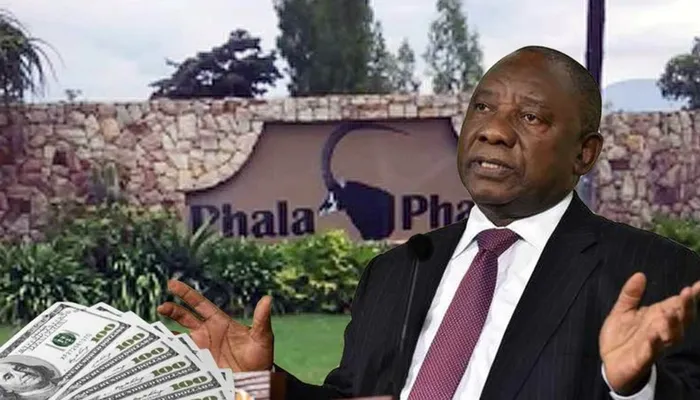
The ANC has been urged to summon its top leaders to high-level meetings to deal with the likely fallout over the Constitutional Court's ruling on the Phala Phala saga.
Image: IOL
The ANC has been advised to call urgent meetings of its top leadership structures to deal with the Constitutional Court’s Phala Phala judgment, likely to adversely affect its 2026 local government elections campaign.
The call follows the apex court’s ruling on Friday that the National Assembly’s December 2022 vote declining to refer the Section 89 Independent Panel’s report, which found that President Cyril Ramaphosa had a prima facie case to answer, to an Impeachment Committee in terms of parliamentary rules was inconsistent with the Constitution, invalid, and set it aside.
The report of the three-member independent panel, which was chaired by former Chief Justice Sandile Ngcobo, has now been referred by the Constitutional Court to the Impeachment Committee established in terms of the National Assembly’s rules.
Prof Ntwanano Mathebula, associate professor at the University of Johannesburg’s School of Public Management, Governance and Public Policy, said the ANC played a huge role in the mess it finds itself in by using majoritarian tactics to prevent the adoption of the Section 89 independent panel report, which saw Ramaphosa being shielded from rendering an account on the scandal relating to the undeclared US dollars that were found and stolen from his Phala Phala farm in Bela-Bela, Limpopo.
“I think at this point, we see an ANC that is in crisis and I would expect that the secretary-general (Fikile Mbalula) or whoever is responsible calls an urgent national executive committee (NEC) (meeting) or even the national working committee to discuss this as a matter of urgency and priority, not only for the ANC but for the country, because we are not only speaking of a politician here who’s an incumbent of the ANC, but we are speaking about a head of state,” suggested Mathebula.
He said the Phala Phala matter was a very serious case that cannot be downplayed and which has the potential of resulting in a conclusion that Ramaphosa has violated his oath of office.
According to Mathebula, another issue that made it difficult for the ANC was that it now had three options it could exercise – recall Ramaphosa as it did with former presidents Thabo Mbeki and Jacob Zuma, ask him (Ramaphosa) to resign, or have him resign on his own accord.
But the question would be: “Who takes over?”
Mbeki and Zuma were not party leaders when they were recalled in 2008 and 2018, respectively.
“And it seems the ANC doesn’t have a clear succession plan. Ramaphosa is tainted. Does the ANC want to be led by somebody who is not credible? Is the ANC willing to risk using his face in the local government elections campaigns?” Mathebula asked.
The ANC constitution makes provision that in the event of death or permanent incapacity of its president or deputy president for its NEC, the party’s highest decision-making structure, between national conferences, can appoint an acting president until such time as a national conference is convened.
Should both the president and the deputy president be absent, the secretary-general assumes the president’s functions.
University of Mpumalanga political analyst Khanya Vilakazi said the biggest issues that the ANC has leading into the municipal polls in November are the fact that it has lost public confidence and that Ramaphosa and his leadership have taken the party’s majority votes down to about 40% (in the 2024 national and provincial elections).
“Now, they’re damned with him and damned without him. If the ANC were to take a decision that the president needs to step down to deal with this issue using the step-aside rule, it would render the ANC in a perpetual state of disarray, and that would cost it in the elections.
“However, to the general public, it would seem as if the ANC has now heard the voice of reason and they’re now prepared to defend the constitutionality of South Africa above the protection of single individuals,” Vilakazi explained.
He warned that if Ramaphosa does not step down or the ANC does not take a decision to remove him, then it becomes a tactic by opposition parties to highlight how the ANC does not believe in “constitutionality”, which would then become the general marching orders in election campaigns.
Prof Sethulego Matebesi, University of the Free State associate professor and academic head of the Department of Sociology, said it should be made clear to South Africans that the Constitutional Court judgment did not automatically remove Ramaphosa from office.
“But it does have significant consequences for the president, but also for the ANC,” he said.
Matebesi said among the options the ANC had was to accelerate internal succession planning, partnering it with what he called a “soft reset”, and using less tainted leaders as the face of the party during the elections.
However, he said the ANC has never adopted this approach, as Ramaphosa’s allies would not support it, as it would be seen as undermining him.
“I foresee there is still going to be a long time before we even reach that stage, where the actual impeachment will take place, because parliamentary processes may also take time.
“We have already seen the EFF issuing a statement to say they want clear timeframes as to how this whole parliamentary process will unfold, and this should happen as soon as possible,” said Matebesi, adding that the six-month period before the local government elections is still a very long time in politics.
Another political analyst, Dr Levy Ndou, described Friday’s judgment as a resuscitation of the Phala Phala issue, but Ramaphosa still needs to make a final determination.
“There is a perception that is there that seeks to suggest that already the president has been found guilty,” he said.
Ndou added that Ramaphosa can only step down with the ANC’s blessings or if he is instructed to do so.
“With the Government of National Unity dynamics, he must also get to know what the other parties are saying. If his party felt that this had the potential to seriously tarnish their image, they might request him to leave, which is what he wanted to do a long time ago,” he said.
Ndou also said that another question is who will take over from him until the 2029 general elections.