

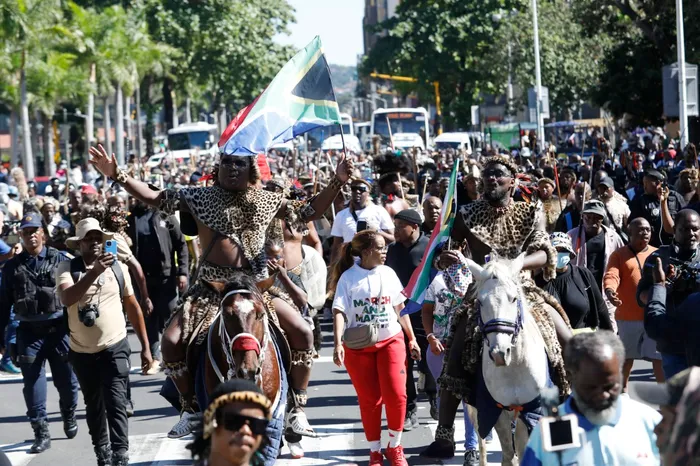
Political analyst and international relations expert Gideon Chitanga has urged authorities to investigate the individuals and organisations driving the demonstrations.
Image: DOCTOR NGCOBO Independent Newspapers
The South African government must investigate who is driving and funding ongoing protests targeting illegal foreign nationals, as well as the broader agenda behind the demonstrations, says Zimbabwean political analyst and international relations expert Gideon Chitanga.
The comments come amid recent protests in Gauteng and KwaZulu-Natal targeting undocumented immigrants.
“To be fair, the issue of immigration is not unique to South Africa,” Chitanga said.
“We are living in a period where xenophobia - and, for some of us in the academic space, hostility towards foreigners - is associated with the spread of right-wing politics globally, not only in South Africa.”
Chitanga said illegal immigration is part of a broader global trend.
“You see it in the US, in Europe and in other countries,” he said.
However, he said South Africa’s situation differs because of the country’s historical and political ties with the rest of the continent.
“If you are thinking as a pan-Africanist, if you are thinking about the historical context of Africa and South Africa in particular, then that raises serious problems,” he said.
Chitanga, who holds a PhD in political science from the University of Pretoria (UP) and is pursuing postgraduate studies at the University of Johannesburg (UJ), said South Africa has historically experienced high levels of immigration from neighbouring countries.
“You would remember well that from the 1870s, following the discovery of gold, and even up to the transition to democracy, people came from Malawi, Zimbabwe and other parts of the region to work in the gold mines,” he said.
“Geographically, South Africa is deeply connected to its neighbouring countries, so the historical boundaries are largely artificial, although politically they exist.”
He said the struggle against settler colonialism also relied heavily on regional solidarity.
“The context of fighting against settler colonialism required cross-border solidarity, and South Africa was part of that solidarity, not only in receiving it but also in providing support to other African countries,” he said.
Chitanga said there has long been a broader African discourse around freedom of movement and regional integration.
“There is a huge discourse about how Africans should see themselves in the context of opening up boundaries, freedom of movement across the continent, opening up the continent and removing some of the barriers that limit the movement of goods and people to create a conducive environment for free trade,” he said.
“I think that shared African identity is very powerful. So the question becomes: why, despite these historical and political convergences and shared interests, do we find ourselves divided? Why are some Africans targeting fellow Africans from neighbouring countries?”
At the same time, Chitanga acknowledged concerns around undocumented migration and said the South African Constitution already provides legal mechanisms to address immigration through the rule of law.
“Now we have this component that is being weaponised - the idea of illegal immigration,” he said.
He said the government and the Department of Home Affairs should develop more effective mechanisms to address undocumented migration.
“That process requires understanding what illegal immigration into South Africa actually is, and what problems the government and society are trying to address,” he said.
“One issue may require policing, but we know from the history of migration that policing alone will not resolve this issue, especially concerning people coming from Zimbabwe, Mozambique, Malawi and elsewhere. People have always crossed borders informally and will continue to do so.”
Chitanga also pointed to corruption within immigration and policing systems.
“I am Zimbabwean and I understand how people pay. I have seen how people pay at the border or elsewhere and are allowed through,” he said.
He added that many migrants living legally in South Africa contribute positively to the economy, while some undocumented migrants also participate in legal economic activities despite their immigration status.
“You need to think more deeply about how you address that problem,” he said.
Chitanga criticised organisations and political actors that he said have politicised immigration, particularly ahead of the 2026 local government elections.
“It is understandable for political parties to opportunistically politicise immigration, particularly when it aligns with their ideological posture,” he said.
“If a right-wing party opposes immigration and weaponises illegal immigration, I would say that is part of its ideology.”
However, he said some groups have begun taking the law into their own hands.
“Some of these actors are occupying spaces that should be occupied by the government,” he said.
“They are violating the law while accusing undocumented immigrants of violating the law. You cannot address illegality by committing illegality.”
Chitanga said authorities should investigate the organisers of anti-migrant protests and determine who is funding them.
“It is important for the South African government and security institutions to dig deep into understanding who is driving these individuals, who is funding their activities and what their agenda is,” he said.
“Are these communities organising themselves because they feel threatened, or are these social formations that are funded, well organised, well coordinated and well resourced?”
He questioned whether certain interests were exploiting immigration tensions for political or other gains.
“Which interests are mobilising these groups of protesters, and what are they trying to achieve by fuelling these kinds of activities?” he asked.
Chitanga said while the government must address undocumented immigration firmly, it must also act against individuals or organisations that violate the law while targeting foreign nationals.
“They ask people to produce identity documents, where they come from and where they stay,” he said. “I think it is illegal for private citizens to ask those questions. That is the role of the police.”
He urged the government to address concerns around undocumented migration without inflaming xenophobia.
“I think South Africa should be robust - and I am talking about the leadership here - robust in telling the truth and firm when engaging leaders from neighbouring countries in diplomatic spaces,” he said.
The comments come amid growing concern over rising anti-migrant rhetoric in South Africa.
Anti-migrant sentiment has gained political traction in recent years, with some groups claiming foreign nationals are taking jobs and unfairly benefiting from public services. Previous protests linked to immigration have at times escalated into violence.
Last week, anti-migrant movement March and March protested outside the Gauteng Provincial Legislature over alleged crimes involving undocumented foreign nationals and unauthorised religious leaders.
Participants included members of March and March, Operation Dudula, ActionSA, the Inkatha Freedom Party and the MK Party.
The groups accused the government of failing to act decisively against undocumented migration and called for tighter immigration controls, stricter visa regulations, a review of asylum policies, action against businesses employing undocumented migrants, accountability for corrupt police officers and limits on public services for undocumented migrants.
On Wednesday, March and March continued protests in Durban, KwaZulu-Natal, targeting undocumented foreign nationals.
Political analysts and immigration experts have argued that immigration has become a politically sensitive issue ahead of the 2026 local government elections.
ActionSA, the Patriotic Alliance and the Inkatha Freedom Party are among the parties that have become increasingly vocal on immigration issues.
Immigration expert Loren Landau, a professor at the University of the Witwatersrand, said anti-outsider rhetoric has become a central feature of South African politics.
“Once at the fringe of the mainstream, it has now become a central - if not the central - tenet of contemporary politics,” Landau said.
“It reflects the ideological bankruptcy of national politics, which has left many people without prospects of a better life.”
He said politicians increasingly rely on scapegoating foreign nationals rather than presenting concrete policy solutions.
“For local leaders – the only people directly elected in the country – they are under immense pressure to take action of some kind. Anti-immigrant threats are popular and with the local government elections just months away, can help enlist support that might otherwise be absent.”
Landau added that anti-outsider statements tend to intensify during local political contests.
“With these likely to be the most open local government elections in the country’s history, people are fighting hard for office,” he said.
“With few other tools at their disposal, promises to rid the country of foreign ‘demons’ are only likely to intensify.”
President Cyril Ramaphosa last Wednesday rejected claims by some African countries that South Africa is xenophobic, calling such characterisations “lazy”.
Presidential spokesperson Vincent Magwenya said Ramaphosa acknowledged legitimate community concerns about crime.
“In fact, any characterisation of this protest that seeks to portray South Africans as xenophobic is actually a lazy sort of analysis of the real issues that are at play here.
“There are genuine concerns that communities have with respect to crime.”
He said crimes committed by foreign nationals should be addressed by law enforcement “without any fear or favor”.
“Crimes that are committed by foreign nationals, where the President expects law enforcement, again, to act without any fear or favor, and also to say to those who are visitors in our country, they must respect and conform with our laws. If they break the law, they will face the full might of the law, like all of us are expected to respect the law.”
Minister in the Presidency Khumbudzo Ntshavheni said Cabinet had condemned the circulation of fake videos and images online falsely claiming attacks on foreign nationals in South Africa.
“The fake videos and images are not only fake, but they are intended to undermine the good reputation of South Africa internationally,” she said.
Ntshavheni said the Cabinet had also warned against attempts to exploit public concerns about unemployment and economic hardship to destabilise the country.
“Cabinet has directed the Department of Employment and Labour to intensify inspections of workplaces to ensure compliance with employment laws across vulnerable sectors such as hospitality, farms, trucking, and construction,” she said.
Meanwhile, the Ministry of Police previously warned that authorities would act decisively against violence targeting foreign nationals.
Police Ministry spokesperson Kamogelo Mogotsi said the ministry condemned acts of violence and intimidation directed at foreign nationals.
“The Ministry of Police has on numerous occasions condemned acts of violence and intimidation directed at foreign nationals within the Republic of South Africa as these actions are unlawful and are in direct opposition to the values of dignity, equality, and human rights upon which our democracy is founded,” she previously told IOL News.
“The Ministry has advised that the South African Police Service will act decisively and without hesitation in addressing incidents of violence against foreign nationals.
“The Ministry of Police has called on all community leaders, civil society organisations, and all stakeholders to work together with law enforcement agencies to prevent further violence and to promote dialogue and understanding,” she added.
IOL Politics