

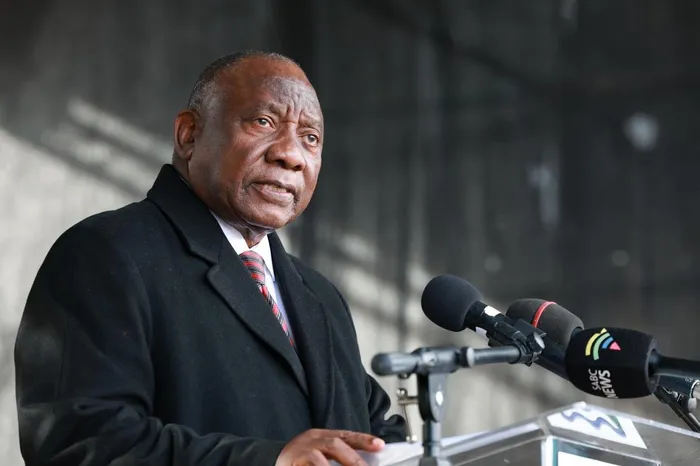
Constitutional law experts warn that Ramaphosa’s judicial review application may not stop Parliament’s constitutional duty to investigate the Phala Phala scandal.
Image: GCIS
President Cyril Ramaphosa’s intention to launch a review application of the Section 89 panel report in relation to the Phala Phala saga is likely to be a “difficult” one.
This is according to Senior Lecturer at the Wits School of Law, Dr Shadi Maganoe, in response to IOL News inquiries.
This comes as Ramaphosa is planning a legal challenge to the Section 89 independent panel report over the Phala Phala scandal.
Ramaphosa announced on Monday night, that, following advice from his legal team, he would take the report of the panel chaired by former chief justice Sandile Ngcobo on judicial review.
Last Friday, the apex court paved the way for a public impeachment hearing into Ramaphosa’s conduct in the Phala Phala saga.
On Monday, National Assembly Speaker Thoko Didiza confirmed that Parliament will establish an impeachment committee into the report chaired by Ngcobo.
The apex court ruled that Rule 129I of the National Assembly’s rules was unconstitutional and invalid.
It also overturned the National Assembly’s December 2022 decision not to send the Section 89 panel report on Ramaphosa’s conduct in the Phala Phala matter to an impeachment committee.
The panel found that Ramaphosa had questions to answer over the theft of $580,000 hidden in a sofa at his Phala Phala farm in Limpopo, February 2020.
The Constitutional Court ordered that the report be referred to an impeachment committee.
Ramaphosa has denied any wrongdoing related to the Phala Phala saga and maintained that the report was “flawed”.
He also said that he is not going to resign following calls from political parties to step down.
However, Maganoe said the Section 89 panel is part of Parliament’s constitutional accountability mechanism.
“When a sitting President approaches the courts to review the panel’s findings, it reflects the President exercising his constitutional right to lawful and fair administrative review.
She, however, said it also creates a constitutional tension because Parliament has its own independent duty to hold the President accountable under section 89 of the Constitution.
“The important point is that a review application does not automatically suspend Parliament’s accountability obligations unless a court specifically orders otherwise, in this instance through an interdict.”
Maganoe said Parliament remains constitutionally obliged to continue performing its oversight role.
“The Constitutional Court has reinforced that impeachment accountability cannot simply be delayed or avoided through gatekeeping.”
She said when the Constitutional Court held that some aspects of Rule 129 were unconstitutional, it meant the rules did not sufficiently give effect to the Constitution’s accountability requirements.
“The court’s main concern was that Rule 129I allowed Parliament to terminate the impeachment process too early and before a proper inquiry could occur.
“The court held that this undermined accountability, transparency and meaningful public scrutiny.”
“Importantly, unconstitutional rules do not necessarily invalidate every action ever taken under them automatically. That was one of the major disagreements within the Constitutional Court itself.”
Maganoe said the majority held that the National Assembly vote rejecting the panel report could not stand because the vote occurred within an unconstitutional process.
“But the dissent argued that a flawed rule does not automatically invalidate every decision taken under it.
“The effect now is that the earlier parliamentary vote has been set aside and the matter must proceed through a constitutionally compliant process, back to the impeachment committee.”
She argued that the panel findings remain important, but they are not final or binding findings of guilt.
“The Constitutional Court described the panel as a preliminary ‘sifting mechanism’ meant to determine whether there may be a case for the President to answer.
“The impeachment committee now has a broader role. It can test evidence, hear witnesses and determine whether the allegations can ultimately be sustained,” she said.
She said it was not going to be easy for Ramaphosa to succeed in a judicial review of the Section 89 panel report.
“It would likely be difficult,” she told IOL News.
“Courts are generally cautious about interfering in parliamentary internal processes, including their accountability procedures, especially at a preliminary stage.”
“The President would probably need to demonstrate procedural unfairness, irrationality, factual errors or that the panel exceeded its mandate, therefore arguing the principle of legality as well. Mere disagreement with the panel’s conclusions is unlikely to be enough.”
Ramaphosa previously went to the Constitutional Court in December 2022 to challenge the Section 89 report directly.
However, the court dismissed his application, saying he had not given enough reasons for the matter to be heard directly by the apex court.
His legal team later dropped the review application after the National Assembly (NA) voted against adopting the report.
Maganoe said Section 89 of the Constitution is widely regarded as the most severe form of executive accountability.
“The majority judgment simply holds that once credible prima facie evidence exists, Parliament cannot avoid deeper scrutiny of a sitting President. In that sense, the judgment shifts the impeachment process away from strict political discretion towards a more structured constitutional accountability model,” she added.
Speaking with IOL News, Constitutional law expert and former acting judge Professor Karthy Govender said he believes Ramaphosa’s explanation that the report was “flawed” will have to be put under scrutiny.
“The question is going to be: Did the panel - their main argument, as I understand it, essentially from looking at the various press reports on this - take hearsay evidence into account and fail to weigh evidence properly?”
He said before making a determination about whether Ramaphosa has a strong case, it will depend on the papers.
“In other words, it will depend on his founding affidavit, which, remember, he’s going to swear under oath. And then someone will need to provide an answer on behalf of the committee. The President will then be given an opportunity to reply.”
When asked about Ramaphosa’s chances of successfully reviewing the panel report and the possible obstacles he may face, Govender said, “So I think, and this is purely speculation, the first point is I think he may succeed in getting an interdict to stop the process, given the various requirements for granting an interdict on the issues of balance of convenience, etc.”
“And then it comes down to what his explanation is and what is to remember what the committee said was this prima facie evidence of serious misconduct.”
“So they have not concluded that he’s guilty of misconduct that justifies setting up an impeachment committee. Their contention is that there is prima facie evidence - in other words, there’s a case to answer,” he said.
Govender said the court would have to find that this was, in fact, a material error.
“That would be, I think, a fairly formidable onus on the applicant to overcome. But I think it will depend on exactly what the President’s explanation is as to why he thinks the committee did what he claims it did.”
In a media briefing on Tuesday at Luthuli House, the ANC’s headquarters, ANC Youth League president Collen Malatji said the youth league supports Ramaphosa.
He said the impeachment committee must be stopped and Ramaphosa should be given time to review the panel report.
Govender commented on the youth league’s remarks and said, “So, in other words, he has to get an interim interdict because the Constitutional Court has sent it back to them and they will have to determine whether or not another court should stop the impeachment proceedings until after the court has determined the review application.
“So, absent that, I think they’re compelled to proceed with them because the orders are quite clear.
“The order is that they should proceed, and now we have a determination made to set aside an application on review to set aside the committee. To my mind, they will have to proceed in the absence of a court interdicting them from proceeding,” he told IOL News.
IOL Politics