

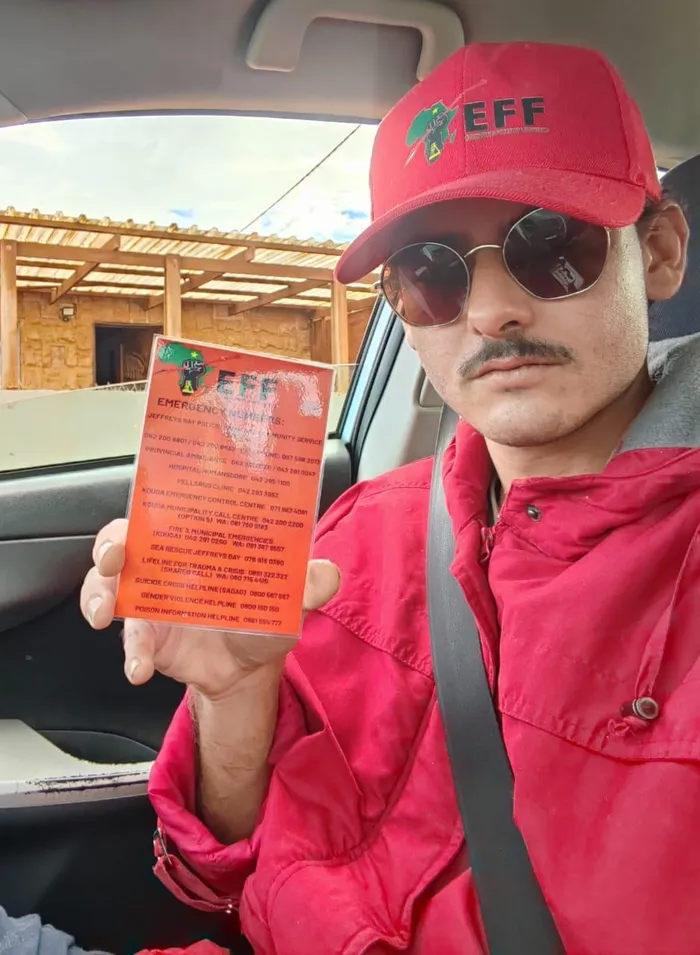
Jeffreys Bay EFF member Christiaan Carstens responds to claims of racism within the party.
Image: SUPPLIED
A white Jeffreys Bay EFF member said he is sick and tired of claims that the party — and its leader Julius Malema — hates white people and wants to kill them.
Christiaan Hendrik Nicolaas Carstens said claims of hate directed at his commander-in-chief and fellow red beret wearers, who from time to time sing chants such as “Kill the Boer”, are simply not true.
“The primary misconception is that the EFF hates white people and that it wants to slaughter whites in a mass genocide,” Carstens, 25, told IOL.
“The EFF is not against white people, but rather against white supremacy and white monopoly capital.
"The only group of white people that can come close to understanding the struggles of black people, are poor white people and staunch white patriots."
Carstens, who is involved in political education and recruitment for the EFF in the Kouga and Kou-Kamma regions of the Eastern Cape, said he has been bullied since joining the party about two years ago.
He said most of the bullying came from fellow white people, who, he said, could not accept the idea of a young white person joining Malema’s movement.
Sometimes, he said, it got so out of hand it escalated into death threats aimed at his loved ones.
“I have faced extreme criticism, horrible and inflammatory insults, and the worst kind of bullying,” Carstens claimed.
“This resulted in online harassment, threats of bodily harm and death threats directed towards my loved ones and myself.
“I have also been threatened with a gun and assaulted on the street twice by the same person.”
Carstens said his political journey started at home from a young age.
“I grew up in Jeffreys Bay and had a middle-class upbringing in a household interested in history, politics, and culture,” he said.
Jeffreys Bay is a coastal town in Kouga, located about 75km west of Gqeberha, and is famous for its surfing beaches.
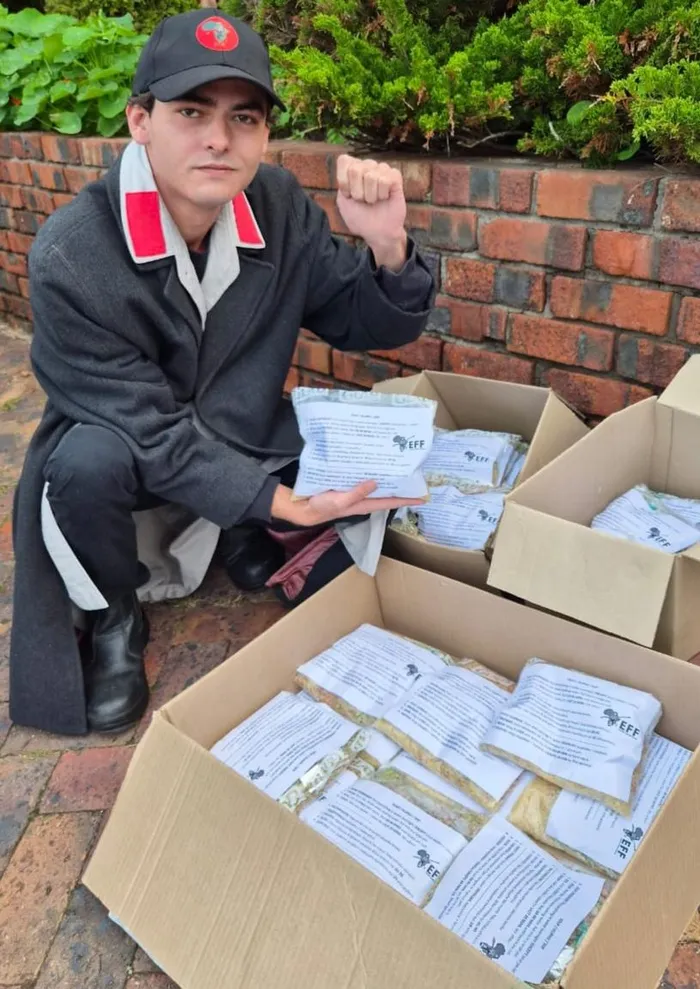
Jeffreys Bay EFF member Christiaan Carstens responds to claims of racism within the party.
Image: SUPPLIED
“My parents always encouraged me to think for myself, and I most definitely took advantage of their encouragement to formulate my own worldview," Carstens said.
He said while in school, he became more interested in politics.
“Through my interest in history, I became interested in politics when I was still at school," he said.
"I had black friends from primary school all the way to high school."
Carstens said his academic path later took him to Nelson Mandela University, where he obtained a BA Honours degree in Political and Conflict Studies.
He said his political journey first began with the ANC and the SA Communist Party.
“I joined them because I believed in their ideological framework,” he said.
“But I then left the ANC alliance because I believe a party of the working class must be totally independent in practice and in theory — rooted in Marxist-Leninist orthodoxy.
"I saw this principle manifest in the EFF and not in the SACP in which I was deeply involved.”
He said socialist economic ideas were what first made him consider moving towards the EFF.
"I staunchly believed — and still do — that EFF ideology and policies will develop the country and unite Africa," Carstens said.
He later joined the party and said he immediately became active.
He said he achieved a lot in the period that followed.
"My proudest moment as an EFF leader was when I, together with other fighters, pioneered information tables right after the 2024 elections and onwards," he said.
The 2024 national elections marked a major shift in SA politics.
The ANC dropped below 50% for the first time since 1994, winning about 40% of the vote.
The DA came second with just over 21%, while the new MK Party surged into third place with about 14%.
The EFF fell to fourth place nationally, securing around 9% to 10% of the vote, translating into 39 seats in the National Assembly.
The results led to the formation of a Government of National Unity, as no party won an outright majority.
In the Eastern Cape, the ANC remained firmly in control of provincial politics, with the EFF again remaining an opposition party with far less support than the governing party.
The “information tables” Carstens referred to were stands set up in busy public areas where members spoke to people about the party and its policies.
"At these tables, we would recruit members and discuss EFF ideology and policy," Carstens said.
"We would also distribute cards with emergency numbers, such as the police, anti-gender based violence helpline, as well as the National Sea Rescue Institute in Jeffreys Bay, to name but a few.
"Additionally, another proud moment was to be co-opted to the EFF’s Eastern Cape Provincial Command Team during 2025, as well as being elected to the Kouga/Koukamma Sub-region Command Team."
He said he would like to be in any position where he can substantially "stand up for the masses of Kouga" as well as for the people of Ward 2.
He said he is currently a member of the EFF in Ward 2, where he has always been politically active.
Ward 2 covers areas including Pellsrus, Madiba Bay and Aston Bay in Jeffreys Bay.
Carstens said one of the biggest misunderstandings about the party is its stance on white South Africans.
There has been a widespread notion that Malema and the EFF are hostile towards white South Africans, partly due to the party’s radical economic rhetoric and the singing of struggle-era chants such as “Kill the Boer”.
The chant has been the subject of court cases, including a 2022 Equality Court ruling, which found that it does not amount to hate speech when considered in its historical and political context.
The case was brought by AfriForum, which has argued that the chant is harmful and should be prohibited.
"The 'Kill the Boer' chant is a metaphorical struggle song that remains relevant due to the legacy of colonialism and capitalism, nothing more and nothing less," Carstens said.
He said poverty, unemployment, and drug abuse remain the biggest problems facing communities in Kouga and across the country.
“The main problem people are facing is mass poverty and unemployment like in the rest of the country, as well as drug abuse stemming from extreme depression,” he said.
“Other problems include poverty and a lack of jobs.
"The changes that I want to see in both the Kouga municipality and Eastern Cape are industrialisation, job creation, and state capacity, instead of the use of private tenders for development."
Carstens said young South Africans who want change should speak openly.
"It does not matter if you are EFF, MKP, or ANC," he said.
"What matters is that you want to see the socio-economic development of the country and its nations."
He said in his free time he never truly switches off from politics, adding that he enjoys philosophy, films, and spending time with a small circle of friends.
IOL News