

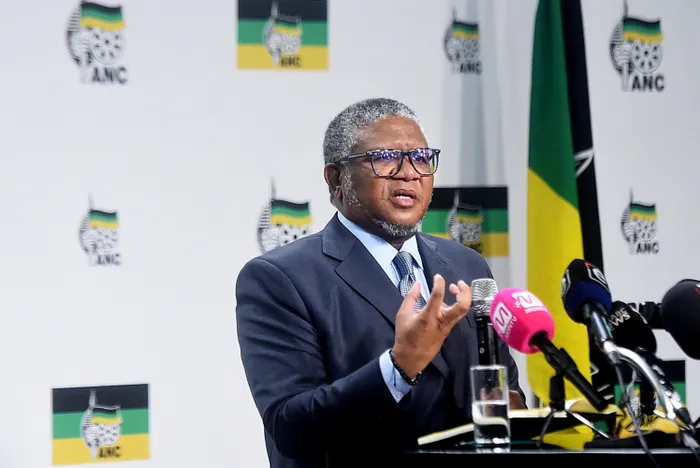
Reports of tensions between ANC leaders Fikile Mbalula and Mdumiseni Ntuli over parliamentary impeachment committee nominations have sparked debate over internal coordination, authority and possible electoral implications ahead of upcoming local government elections.
Image: Itumeleng English/Independent Newspapers
ANC secretary-general Fikile Mbalula’s forceful defence of his authority following the party’s National Executive Committee (NEC) meeting has intensified scrutiny of reported tensions within the ANC over parliamentary nominations to an impeachment committee, even as political analysts say the matter reflects internal coordination pressures rather than a formal breakdown in leadership.
The committee was established by Parliament following a Section 89 panel report into President Cyril Ramaphosa’s conduct relating to the Phala Phala matter, with political parties required to submit representatives for the inquiry.
Speaking at a media briefing this week, Mbalula rejected suggestions that ANC Chief Whip Mdumiseni Ntuli had defied party leadership, insisting that he remains central to the ANC’s communication and organisational structures.
“If I’m secretary-general of the ANC, I’m the main source of information, and I tell you as a journalist that the story you are coming up with is not true. Respect me. I’m the secretary-general of the ANC, I’m the boss here,” he said.
He added that Luthuli House remains the centre of authority within the organisation.
“When you talk about Luthuli House, the face of it is me. I come after Matamela and Mashatile. I’m the boss here, Luthuli House, boss,” Mbalula said.
He further dismissed claims of internal defiance, insisting that the chief whip operates within established party structures.
“How can I be defied by a chief whip? That story doesn’t hold. Chief whip is employed, he accounts to me, and he’s a wonderful chief whip,” he said.
Mbalula added that delays in submitting names to Parliament were linked to internal consultation processes rather than internal conflict, stressing that the ANC continues to operate through coordinated decision-making structures.
According to Parliament, Speaker Thoko Didiza received the list of 31 Members of Parliament who will serve on the impeachment committee after the ANC finalised its nominations following an extended submission process, with most parties meeting the original deadline.
Political analyst and Research Fellow at the University of the Free State, Professor Theo Neethling, said the reported tensions and delays should not automatically be interpreted as evidence of a serious institutional crisis within the ANC.
He said both Mbalula and Ntuli have denied allegations of serious internal conflict, instead framing the matter as part of normal internal party processes, suggesting that the situation reflects coordination pressures within a fragmented parliamentary environment rather than a breakdown in authority.
Neethling added that the significance of the incident lies in what it reveals about the ANC’s organisational cohesion, particularly in a context where the party no longer enjoys the level of parliamentary dominance it once held.
He said that under such conditions, internal negotiations over committee representation, procedures and political positioning become more visible and politically sensitive, and can easily be interpreted externally as internal divisions.
“Politically, this type of tension can contribute to a narrative of internal friction and poor coordination within the ruling party, even if it is not structurally destabilising,” Neethling said.
He warned that opposition parties are likely to use such incidents to reinforce perceptions of a divided ANC, while the party itself will emphasise unity and institutional discipline.
He added that in the run-up to elections, the greater risk lies not in an immediate rupture between Mbalula and Ntuli, but in the cumulative effect of such incidents on public perceptions of ANC unity and governance capacity.
''In the run-up to elections, the real risk therefore lies less in an immediate rupture between Mbalula and Ntuli, and more in the cumulative effect of such incidents on public perceptions of ANC unity, governance capacity.''
UKZN political analyst Siyabonga Ntombela said the developments point to deeper coordination challenges between Luthuli House and the ANC’s parliamentary structures.
“The centre is not holding indeed,” Ntombela said.
He added that repeated assertions of authority from Mbalula suggest internal strain within leadership structures.
“If it takes Mbalula to remind comrades and the masses he is in charge, it might suggest that he feels undermined and threatened,” he said.
Ntombela said the Secretary-General remains central to organisational control but warned that current dynamics reflect internal contestation.
“The position of secretary general is like an engine of the organisation. It allows one to drive the party agenda and control the membership,” he said.
He added that leadership positioning may be linked to succession politics.
“With his name raised for president he might be seeing himself already in charge. The impeachment process might expedite Mbalula’s ascension to real power,” Ntombela said.
Ntombela further said there is a breakdown in coordination between key ANC structures.
“There is no coordination whatsoever between the comrades in Luthuli House and those in the Union building,” he said.
He warned that the tensions are politically significant ahead of elections.
“With the ANC elections fast approaching in 2027 and Ntuli is eyed for Mbalula’s position if he ascends to be the president, these squabbles do not assist to strengthen the party come 2029 general elections,” he said.
He added that South African voter behaviour does not always directly reflect internal party instability.
“In South Africa, voters do not vote on the basis of party tensions and party stability. Unlike in the US where people vote based on issues,” he said.
Meanwhile, independent political analyst Goodenough Mashego said tensions within the ANC were expected given its broad internal structure.
“Tensions within the ANC should be expected because the ANC is a broad church,” he said.
He added that the dispute reflects emerging leadership dynamics within Parliament, particularly the growing profile of Ntuli.
“The tensions that we see now between Ntuli and Mbalula are reflections of that, but also a reflection of Ntuli emerging as a leader of the ANC in Parliament,” Mashego said.
Mashego said shifting leadership perceptions could be contributing to internal contestation.
“Him emerging as somebody seen as a statesman might be threatening to somebody like Mbalula,” he said.
He added that internal disagreements reflect broader strain within the party.
He further linked internal tensions to broader electoral pressures and provincial dynamics, including KwaZulu-Natal, where internal alignment and political positioning remain highly contested.
IOL had reached out to Ntuli for comment, but he had not responded by the time of publication.
IOL Politics