

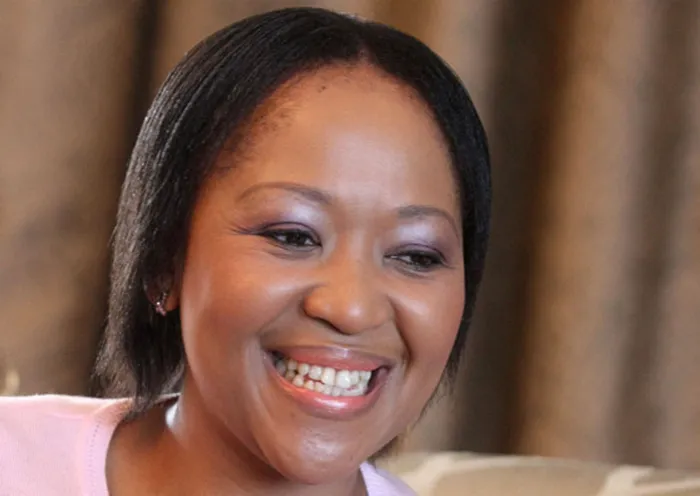
DURBAN 30102012 Thobeka Zuma. PICTURE: Jacques Naude DURBAN 30102012 Thobeka Zuma. PICTURE: Jacques Naude
Durban - Life is a balancing act for Thobeka Madiba-Zuma, President Jacob Zuma’s fifth wife.
“A typical day is characterised by my official duties as the spouse of the president, my charity work and a bit of family time. My cup is overflowing already just with those three,” she reveals.
But we are meeting with Madiba-Zuma to talk mainly about her charity work. She’s a patron of the Cancer Association of South Africa (Cansa) and founded the Thobeka Madiba-Zuma Foundation, which focuses on raising awareness about breast and cervical cancer and is committed to helping women take control of their health and to raise the level of health literacy.
We chat to her amid the Edwardian splendour of John Dube House, formerly known as the King’s House, in Morningside, Durban. Built at the turn of the 20th century, it has sweeping views over Durban. As an official state home, it is heavily guarded.
The room lights up the moment Madiba-Zuma makes her entrance. Exuding warmth and charm, she greets us with a wide smile and escorts us into her sitting room. She’s also the epitome of elegance in a purple dress covered with a powdered pink cardigan, matched with purple shoes.
Madiba-Zuma recently hosted a breast and cervical cancer conference with other African first ladies who exchanged ideas on dealing with the disease.
“The coming together of first ladies mobilises the political will of heads of states because we need the financial support of our respective countries. We also need strong advocacy and working with heads of the ministries in our respective countries,” she says.
As the first lady Madiba-Zuma admits that having the head of state on speed dial makes it easier to tackle matters close to her heart.
However, fighting cancer is a continuous struggle.
“Bringing awareness should be something that is ongoing until we have brought the disease under control.”
She says after hosting the breast and cervical cancer conference, she realised that women in rural areas still view cancer as witchcraft or taboo.
“We need to raise the health literacy in rural areas, we need women to take charge of their bodies. The food we eat can put you at risk, being a smoker puts you at risk. It is the lifestyle choices we make that will eliminate the risk factors.”
Madiba-Zuma believes that healthy eating is vital and has led by example by shedding 24kg.
“I can safely say that while I weighed 108kg, I now weigh 84kg. I am on the treadmill every second day. I encourage healthy eating, exercise, reduction of alcohol intake, stopping smoking and other tobacco products.”
Setting aside a minimum of 30 minutes three days a week for exercise and getting regular medical examinations was more of her advice.
While her foundation is strong on raising cancer awareness, she says it is important to ensure that all women have equal access to health care.
“It is important now to close the gaps by capacitating NGOs and ensuring that services are taken to the people. But funding has been an issue. Don’t believe what you have been reading in the Mail & Guardian when they say that the foundations are there to make money. We are not loaded with cash,” she said.
She said the challenge in the past was that cancer and other non-communicable diseases got less attention. “All the funding has been channelled through to the infectious diseases like HIV/Aids and now that we have the struggle against HIV/Aids under control, we need to direct the funds to these other chronic illnesses.”
Last year Madiba-Zuma was recognised by the American Cancer Society, the Partnership for Maternal, Newborn & Child Health, the Program for Appropriate Technology in Health, the Women Deliver and the World Heart Federation for her global leadership on cancer, non-communicable diseases and women’s health. “Being recognised by my global counterparts was reaffirming and very humbling,” she said.
While she has never had anyone close to her suffer from cancer, she says, “Every second person I come across has been directly or indirectly affected by cancer and, for me, this is the leading cause of death in women. With early detection, cancer is curable and preventable.”
Despite her commitment to her charities and her position as first lady, Madiba-Zuma still feels she can do more.
“I think I am placed in a unique position of influence. I think that I haven’t done enough and I still have a long way to go. But then again I believe in strong partnerships with the private sector, the NGOs working on the ground and government.”
The Thobeka Madiba-Zuma Foundation was formed in 2010. “Funding has been our biggest issue but we are slowly making progress. We are there to capacitate NGOs that are already on the ground.
“At the moment I am busy mobilising funding to have young girls vaccinated against HPV (a sexually transmitted disease that can cause cancer),” said the first lady, who counts Michelle Obama and Nelson Mandela as her inspirations.
“I look up to Madiba. He has helped us to understand why it was important to forgive and move forward, not forgetting,” said Madiba-Zuma.
She is concerned about the youth of today. “I feel that the youth don’t understand or appreciate the sacrifices that were made by the likes of the Madibas, Sisulus and OR Tambos, who fought for the freedom which we see some of the people taking for granted these days.”
Then, looking at the time on her Burberry watch, she says she has to rush off to a meeting with her daughter’s teacher. “I am awaiting feedback from her teacher, I try to be there for her when she asks me.”
While she can still fulfil her duties as a mother, Madiba-Zuma misses other everyday activities we take for granted. “I haven’t watched a movie since 2009. I would have loved to watch Taken 2, but I have those men in suits follow me around everywhere,” she says laughing.
Turning to her love for fashion she said, “I love looking good, but I am not a person who is obsessed about designer wear. I always think twice because with that money I am very mindful of how I spend and I think of my background as an accountant.
“I worked in a bank, worked my way up. That was pre-1994. I worked for other organisations in the property industry, in the cellular industry, but I love looking good.
“I enjoy buying underwear,” she says, bursting into laughter, her cheeks glowing.
She met the president, who she married in 2010, at the bank. “It was pre-1994 and he was my client because I was a senior manager and was handling all the VIP accounts,” is all she would reveal.
When asked if she was smitten by his charm, she laughed, saying, “Now you are going too far.” She did say, however, that she enjoys cooking for the president.
“I absolutely enjoy cooking food that will sustain him every day. He loves his traditional food and I go to great lengths to send it up to Pretoria sometimes.”
Sunday Tribune