

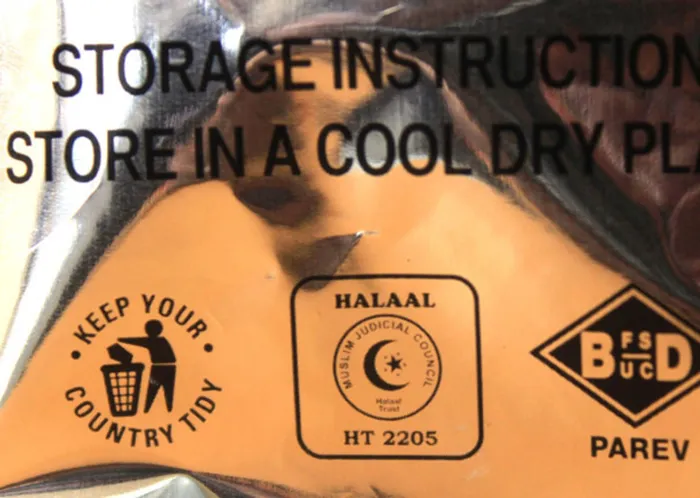
17/04/2012. A group calling themselves the National Coalition of Christian Groups and Individuals are complaining about religious labelling of food packaging, such as the Halaal and Kosher signs on certain packages. They will ask the Pretoria High Court to declare this unconstitutional. Picture: Thobile Mathonsi 17/04/2012. A group calling themselves the National Coalition of Christian Groups and Individuals are complaining about religious labelling of food packaging, such as the Halaal and Kosher signs on certain packages. They will ask the Pretoria High Court to declare this unconstitutional. Picture: Thobile Mathonsi
Cape Town - The announcement on Thursday of an urgent probe into incorrect labelling of meat products has been hailed by the SA National Halaal Authority, but the Red Meat Industry Forum greeted the news with scepticism.
While the halaal authority welcomed the move as “a step in ensuring that food safety standards are maintained”, the forum – which represents the entire red meat industry chain – accused the government of “ducking and diving” on the matter.
“It is futile to do an investigation while the local health authorities are not doing their job,” Red Meat Industry Forum chairman Dave Ford said on Thursday.
Acting government spokeswoman Phumla Williams announced on Thursday that the National Consumer Commission would conduct an investigation following “alarm and panic” over the incorrect labelling of such products as a result of the research findings of a study group at Stellenbosch University.
Goat, water buffalo and donkey meat was found in products such as sausages, burger patties and mincemeat.
Williams said the matter might have “far and wide-ranging implications and impact on the broader consumer public”.
Section 29 of the Consumer Protection Act stipulated that parties in the supply chain must not market goods or services in a manner that was likely to imply a false or misleading representation of them, Williams said.
SA National Halaal Authority (Sanha) public relations officer EBI Lockhat said the mislabelling of products had ethical dimensions and infringed on the religious rights of consumers.
“We hope the scope of the investigation would cover the prosecution of those wilfully involved in these unacceptable activities,” he said.
The investigation should be complemented by an educational programme to help businesses comply with labelling laws and Sanha was willing to help with this.
Ford said: “They can investigate and do everything… but the real problem is that the health authorities are not doing their job. If they did, these things would not happen.”
Ford appeared before Parliament’s agriculture, forestry and fisheries portfolio committee several times last year, on behalf of the meat industry forum, to raise the alarm about the government’s alleged sustained failure to deal with pressing issues facing the industry, including the relabelling of imported meat products.
The forum also joined Sanha and the SA Meat Industry Company in going to court to interdict Orion Cold Storage – the company at the centre of a halaal meat scandal in 2011 – but the matter was not heard because the meat supplier undertook to not allow the relabelling of products in future.
While the forum supported the probe, “the fact is that they will go round and find people ducking and diving because they are not being audited”.
“The local health authorities are not getting round to it. Like a lot of government departments, they are sitting on their jacks and not doing anything and this crucial issue is not being addressed.
“They can do the investigation and they will find anomalies but unless the department does the auditing function they are mandated to do, nothing will happen.”
He said the law was clear in enabling the health department to test meat products in retailers and butcheries and verify the correct labelling practices – and to act against transgressors.
“It is all there. They don’t need to have an investigation. The local authorities in the department of health must just apply the (health) act.”
The issue also arose in Parliament on Thursday, where Trade and Industry Minister Rob Davies responded to concerns raised about donkey sausages by two MPs in the National Assembly.
Davies said he had met Health Minister Aaron Motsoaledi and Minister of Agriculture, Forestry and Fisheries Tina Joemat-Pettersson to discuss the issue.
“As far as we’re aware there’s no threat to health,” Davies said.
It was clear from similar revelations about processed meat in Europe that global companies were mixing different types of meat sources from various suppliers into meat products.
Davies said an investigation into the situation in South Africa was already under way and he intended issuing a new notice that would require the accurate labelling of the contents of all meat products.
Cope leader Mosiuoa Lekota brought some mirth to the subject when he rose to tell the House “those of us who eat horse feel offended by the comments made” – a reference to Sotho-speaking people being said to eat horses.
Meanwhile, acting National Consumer commissioner Ebrahim Mohamed told journalists that “all those in the supply chain” could be held responsible in terms of the Consumer Protection Act and would be subject to the investigation.
It would begin “very soon”, possibly as early as today, but he could not say how long he expected the probe to take.
“We are going to push to get finality on this matter as soon as possible.”
Cape Argus