

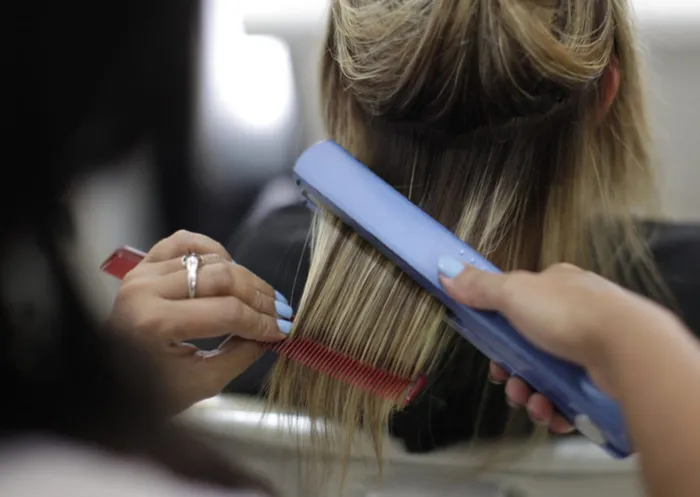
File picture: Felipe Dana File picture: Felipe Dana
Cape Town - “Conflicting information” has delayed a national halaal authority investigation into whether Brazilian keratin treatments are permissible for Muslims.
But the issue could be put to bed as early as next month.
According to the South African National Halaal Authority (Sanha), which is in the throes of a probe into the halaal status of the popular hair smoothing treatment, the organisation was unable to make a formal pronouncement “due to conflicting information received by the jurists”, public relations officer Ebi Lockhat said.
Another sitting had been scheduled and would end on October 2, “by when we expect all further research to have been concluded”.
Earlier this year Sanha advised Muslims to abstain from using the treatment because it was still investigating its halaal status.
Sanha had been informed that a particular brand, Brasil Cacau, formed an impermeable coating around the hair shaft and probed whether it invalidated ritual bathing and ablution. It referred the issue to jurists to study and issue a ruling.
However, the MJC - which is the oldest halaal authority in the country - has given the treatment the thumbs up and submitted its ruling in writing to Sanha’s consumer department.
MJC spokeswoman Nabeweya Malick said the ruling had been sent to Sanha to assist in its investigation. The council’s written explanation made it clear that, while it was undeniable the treatment formed a layer around the hair shaft, the issue was not so simple.
It explained there are two types of layers - permeable and impermeable. The latter are those which are cause for concern among Muslims, and can be further sub-divided into two categories:
*Those which are “perceptibly distinct and separate” from a surface, and which are removable through scraping or peeling.*Those which have been worked into a surface to such an extent that they no longer have a perceptibly distinct and separable body, although some traces remain perceptible.
The latter layer does not hinder the validity of ritual bathing and ablution.
The layer formed by the Brazilian hair treatment, the MJC found, was not one that has a perceptible body and occurred at a molecular level.
“Oil applied to hair forms a layer as well. Its effects are visible in the shine, smoothness and slickness that it imparts to the hair.” This was separate from the hair and presented “no obstacle to the validity of (ritual purity)”.
“From the exclusive perspective of obstructing water from reaching the hair, it is our considered view that the Brazilian hair treatment does not hinder the validity of (ritual purity),” the councilconcluded.
Weekend Argus