

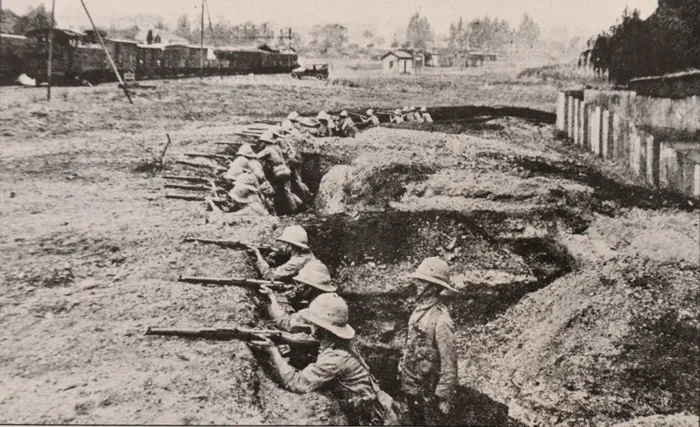
Soldiers versus strikers in Braamfontein, Johannesburg, 1922. Picture SAR Magazine Soldiers versus strikers in Braamfontein, Johannesburg, 1922. Picture SAR Magazine
Cape Town - Towards the end of February in 1937, the Communist Party issued a call to confreres in the spirit of “solidarity with the working class” of South Africa to commemorate the “gallant defenders of Fordsburg” and the “martyrs who gave up their lives in the struggle for freedom from exploitation”.
They were looking back (ironically, at the time of Stalin’s murderous Great Purge) to the Rand Revolt of 1922, “when the workers of the Rand supported the miners against the Chamber of Mines and the government, for which they were brutally shot down by the aeroplanes, machine guns, artillery and rifle fire of the government troops instructed by that arch-enemy of the workers, General Smuts”.
The early 1920s had been a tough time for workers. In the months preceding the revolt, gold nosedived, and mine owners estimated that shedding thousands of jobs was the only way to save their mines. In addition, the Chamber of Mines sought to reduce labour costs by ditching the “colour bar” and taking on more black workers, who could be - and were - paid much less. The scene was set for an appallingly violent contest.
But the unpalatable truth is that the real immediate - and, in various ways, consequent - victims of the Rand Revolt were black people.
Newspaper reports of the second week of March,1922 paint a grim picture- the Smuts government’s use of machine guns, artillery and aerial bombardment to pummel the Rand’s recalcitrant white working class into submission, but also the “wanton attacks on natives” of the headline of March 9. The supposed gallantry and martyrdom of the left’s 1930s imagination is hard to find.
The “very grave situation” reported in Cape Town on March 9 records that “the extent of the attacks on natives during the last few days is indicated by the casualty roll, which is now 16 killed and something like 40 wounded, without counting those suffering minor injuries. Two of the natives wounded at Ferreiras have since died, making the fatalities in that affair four”.
The Argus, noting that “the effects of these events on the native mind may well be imagined”, went on: “Amazement and concern are expressed this morning that the
government has not so far realised the intense seriousness of the situation, the calling out of a small citizen force being regarded as astonishingly inadequate.”
In a separate report under the headline, “Night of terror”, it was reported: “The natives had had a night of terror. Not one of them along the Reef does not know of the shooting of their innocent brethren. This morning the houseboy, the employee, has come to the white man and asked, 'Why have they shot the black man, boss?' This pathetic incident, the first thing this morning, has been universal.”
In Parliament that afternoon, John X Merriman “rose to speak on a ‘matter of most vital importance to every European and native in the whole country - the affairs on the Rand’”. The events on the Rand would do “incalculable harm” to the country, and “the strongest measures must be taken to put down and punish those who are guilty”.
Merriman added: “I have a telegram sent by a native minister from Johannesburg yesterday. I have seldom read a more pathetic message: ‘Law and order failed. What protection have we here?’”
This, Merriman said, was a question “many natives must have been putting to themselves”. In wording that, today, can only seem profoundly deluded though at the time may have been understood quite differently, Merriman added: “One of the things we have always prided ourselves on has been giving justice to the natives.”
The news a few days later, on March 13, gave an indication that the government had heeded Merriman’s call for “the strongest measures”.
Under the headline “Heavy fighting and gains from east to west”, it was reported from The Star that “machine guns were brought into use by the police in the Newlands area, where the commandos appear to have advanced, linking up with the Vrededorp and Fordsburg forces, thus forming a line two miles from the town”.
It went on: “A commando mustered on the Market Square, when many men were seen to have rifles and bayonets, and many others revolvers. It is stated, however, that the rebels, though well-armed, have limited ammunition and are beginning to regret their position.”
And so they might have, as it was reported thereafter that “artillery is getting into position and aeroplanes are expected to assist in ousting the entrenched strikers”.
As it happens, one of the aircraft crashed, killing pilot Lieutenant Carey Thomas; though his death was “deeply regretted” the “use of aeroplanes implies risks to pilots and observers which none realise better than the gallant flying men themselves”.
The risks were presumably greater for the strikers, with Cape Town readers learning that “firing in the Benoni neighbourhood is still in progress, and an aeroplane is again bombing this morning”.
The Rand Revolt was declared over from midnight on March 18. But the consequences - beyond the 200 deaths and more than 1 000 injured - were lasting. South African History Online notes that “Smuts was widely criticized for his severe handling of the revolt” and was defeated in the 1924 general election, which gave JBM Hertzog’s Nationalist Party and the Labour Party (supported by white urban workers) “the opportunity to form a pact”.
White miners were “forced to accept” the mine owners’ terms unconditionally, and gold production increased as a result of cheaper black labour and new labour-saving devices. “After this, as South Africa grew increasingly industrialised, the government came under stronger pressure to protect skilled white workers in mining and in the manufacturing industry.”
In the few years that followed, three new laws - the Industrial Conciliation Act, the Wage Act, and the Mines and Works Amendment Act - “gave increasing employment opportunities to whites and introduced a programme of African segregation”.