

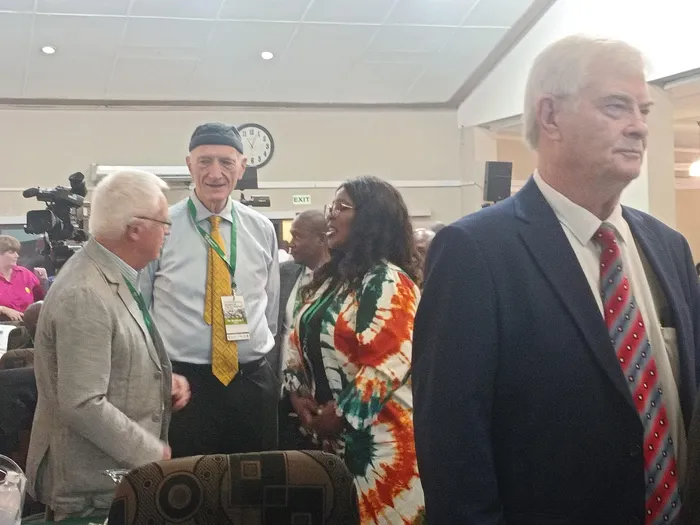
Justice Edwin Cameron, inspecting judge of correctional services and Minister Pieter Groenewald at the parole summit, during which experts will give their input on how to streamline the parole process.
Image: Zelda Venter
The parole system in the country is under the spotlight over the next two days, with experts, including members of the legal fraternity and policymakers, identifying shortcomings in the system and stressing that the rights of both the victims and the offenders - who are released into the communities - should receive more attention.
Offenders, according to the experts who delivered their representations on Monday, should receive more support once they are reintegrated into the communities. As part of the proposals, it was suggested that there should be a designated call centre to assist them.
It was also suggested by some experts that the government should provide them with financial assistance so that they could take the skills and trades they have learned while incarcerated, further once they are out on parole.
Correctional Services Minister Pieter Groenewald officially opened the National Review summit on Monday, held at the Kgosi Mampuru Correctional facility in Pretoria, which is running over two days.
The aim of the summit is to fix the parole system where it is lacking, especially in light of the many who in the past year reoffended after they were released on parole - especially those who committed murder and rape.
In his keynote address, the minister stressed that corrections are a social responsibility. He highlighted that the outcome of this summit will help shape national policies and legislative processes for the benefit of the people of the country, victims of crime and offenders.
The summit has brought together experts over a broad spectrum, which not only include the legal fraternity, but also psychologists, community representatives and representatives of academic institutions. Some of the offenders who are out on parole are also expected to add their voice regarding the parole system.
Groenewald has expressed his commitment to building a balanced, fair and effective parole system. He explained that the aim of the summit is to look into the parole system, the strengths and the challenges.
“We will explore how we can fix the parole system. It is of uttermost importance that we look at it so we can ensure that we can enhance justice and create safer communities for South Africa. In the end the system will ensure and strengthen justice and create safer communities.”
Groenewald added that this is a process which has come a long way. It already started in 2015 and when he became the minister, he said this process of streamlining the system must now be finalised.
According to Groenewald, the strength of the present system is that the parole board has members of the communities serving on it. The board has six members, of which four are from the communities.
He also highlighted that at present, experts such as social workers are involved in the parole process, who compile a profile regarding the offender who is eligible for parole. But Groenewald said there are many other aspects which must still be addressed, such as the risk of reoffending once out on parole.
Asked about his stance on medical parole, the minister made it clear that it is, with him at the helm of correctional services, not for the taking. “You have a new minister now. I am looking very carefully at whether I approve any medical parole. It will not be a simple matter of who you know, or the political connections you have. If you go on medical parole you can ensure, as long as I am the minister, it will be justified”.