

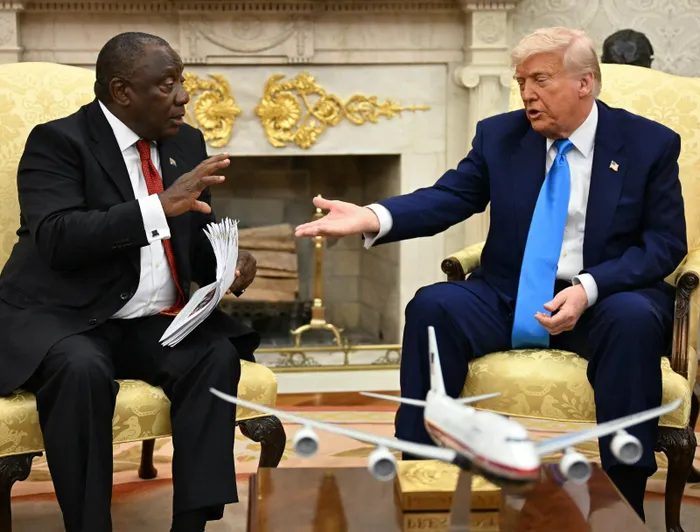
US President Donald Trump has been described as a bad neighbour, who has used economic wars against his neighbours and the rest of the world after his boycott of the G20 Summit.
Image: File/ AFP
John James Kirton, the co-director of the G20 Research Group, has described US President Donald Trump as a 'bad neighbour and someone who tweets as if he is suffering from dementia'.
Early this year, Trump threatened trade tariffs on most countries of the world, including South Africa, Zimbabwe, Nigeria and other African countries. Even some of his neighbours, including Canada, Mexico, did not escape Trump's unilateral sanctions, which ranged from 10% to 40%.
Recent reports have also confirmed that almost 50% of all goods imported into the US are now subject to tariffs. According to reports, this year alone, Trump has imposed a series of new duties on nearly every country at unprecedented levels.
Ahead of the G20 Summit currently under way at the Nasrec Expo Centre in Johannesburg, Trump distanced himself and his team from the summit.
On Saturday, speaking on behalf of the Department of International Relations and Cooperation, Chrispin Phiri said: "We have marked the US absent from this summit. We will not allow anyone to represent them here. In fact, no one from the US has been accredited to be here."
On Thursday, the announcement of a possible US participation - through its Pretoria-based embassy staff - on the last day of the summit failed to materialise after the South African government said it would not accept any junior representation at the summit.
In July this year, Trump threatened a 35% tariff on goods imported from Canada, in yet another dramatic escalation in an on-again, off-again trade war with America’s northern neighbour and one of its most important trading partners.
Asked to describe Trump's politics, Kirton said Trump tweets as if suffering from dementia, adding that his erratic politics and retaliatory tariffs, even against neighbours, were a result of possible dementia.
"I think that Donald Trump, with every tweet, is becoming more and more divorced from reality, leading to speculation that he may be suffering from dementia. He wants to annex Canada, using economic sanctions. No one knows what is next when he is involved," Kirton said.
Ahead of the summit, the world's biggest economy and founding G20 member was ordered by Trump to boycott the event over his claims that majority-Black South Africa is persecuting its white Afrikaner minority (claims that have been debunked) threatened to overshadow the two-day gathering.
The US boycott of this G20 is being seen as an example of Trump's criticism of multinational organisations, having pulled the US out of both the Paris climate agreement and the World Health Organization.
Despite Trump’s boycott, other leaders have travelled to Johannesburg, hoping to find common ground, especially around new trade deals in the wake of US tariffs.
German Chancellor Friedrich Merz said African states are searching for partnerships, saying that he expects to return to Germany with good results.
Australian Prime Minister Anthony Albanese described the G20 as an important gathering, saying that one in four jobs in his country depended on trade with partners like those in the G20.
Kirton further said that Trump's divisive behaviour is further alienating him and his country from the rest of the world, adding that, with or without him, the G20 Summit must keep to its promise of arriving at resolutions.
"Trump is not a good neighbour. Not to Canada, not to Mexico and certainly not to Argentina. In this summit, there is Russia, there is Canada, there is India, and other countries are here, but it seems President Trump does not realise that he needs the critical minerals from Africa to power his economy," he stated.
Dr Siphamandla Zondi, director of the Institute for Pan-African Thought and Conversation, said the tension between the US and South Africa is related to the former’s difficulty with multilateral processes in general, and it prefers to deal individually with countries.
"The US believes that these multilateral bodies are dominated by ideologies closer to the Democratic Party than to the Republicans, and it has difficulty with the ideas of sustainability, digital inclusion, human-induced artificial intelligence, inclusive growth, and just transition."
Zondi said Ramaphosa’s decision to decline handing over the reins of the G20 (the US will host the summit next year) to an embassy official was fair, and the US was the only country without a representative.
"Trump has described it as a side show (without the US), but the rest of the G20 have held 200 meetings up to this point, and they cannot abandon the process at this point, simply because one member has its own issues with the system."