

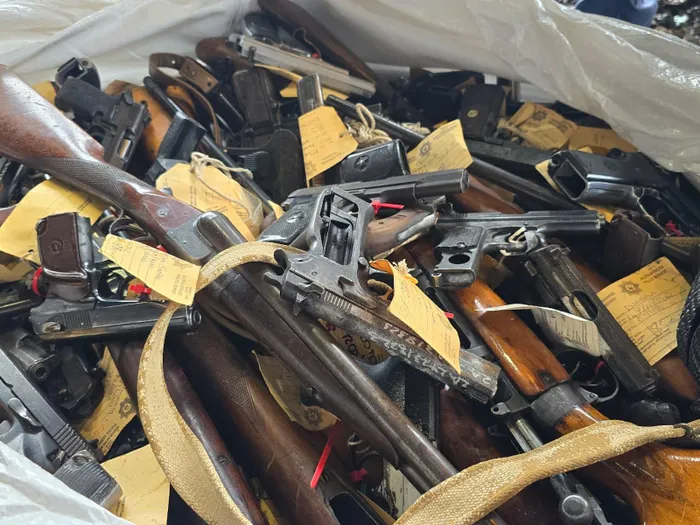
The 2025 Africa Organised Crime Index revealed that organised crime continues to grow in Africa, while the fight against it is widely seen as weak.
Image: SAPS
Organised crime continues to surge and deepen across the African continent while state resilience to these threats is weakening.
This is according to the 2025 Africa Organised Crime Index, which stated that many countries on the continent tend to favour institutional responses, such as using non-state actors, when it comes to building resilience.
The non-state actors play a vital role in growing resilience by supporting vulnerable communities and holding authorities to account.
They are often at the forefront of leading social protection efforts. However, since the 2021 index, the ‘non-state actors’ resilience indicator has declined the most.
The index, published by the European Union-funded Enact programme - run by the Institute for Security Studies (ISS), Interpol and the Global Initiative Against Transnational Organised Crime, found that the most pervasive criminal markets were financial crimes, human trafficking, non-renewable resource crimes, and the trade in counterfeit goods and arms trafficking.
Since 2023, the two fastest-growing markets have been financial crimes and the trade in counterfeit goods, reflecting global patterns. Although human smuggling has grown more slowly since 2023, over the six years between the 2019 and 2025 indexes, it was the second fastest-growing criminal market (the first being cocaine), which is indicative of instability and conflicts driving the movement of people.
Other criminal markets recorded marginal decreases between 2023 and 2025. These include arms trafficking, flora crimes and cyber-dependent crimes.
The index further stated that the cannabis trade is recorded as the most entrenched drug market in Africa, while the heroin trade was the least entrenched.
The regions with the highest scores for drug markets were North Africa (7,42 and 6,75) for the cannabis and synthetic drug trades, Southern Africa for the heroin trade and West Africa for the cocaine trade.
According to the report, between 2019 and 2025, the cocaine trade was the fastest-growing criminal market overall; however, the synthetic drug trade has grown faster since 2023.
Criminal actors involved in these illicit markets include state-embedded actors, criminal networks, mafia-style groups, foreign actors, and private sector actors, all of which are influential in driving up the average level of criminality.
State-embedded actors, according to the index, frequently facilitated these illicit markets, either through active participation in criminal activities or by accepting bribes to overlook them.
“Foreign criminal groups established operations throughout the continent: the Brazilian Primeiro Comando da Capital and Italy’s ’Ndrangheta in West Africa, Bulgarian groups in South Africa, and Italian criminal actors in Kenya.”
“These groups set up shop in major, well-connected cities such as Lagos, Cape Town and Nairobi, where they collaborated with loose criminal networks and mafia-style actors, supplying a range of illicit products from drugs to weapons,” stated the index, adding that state-embedded actors, in particular, remain the most dominant drivers of criminality since the first assessment in 2019, leveraging official authority to enable and sustain illicit economies.
South Africa ranked the second-highest country for criminality on the continent (7,43) and the first in Southern Africa. It is a global hotspot for cybercrime, extortion (notably the "construction mafia"), and illicit trade.
Nigeria scored the highest for non-renewable resources crimes, state-embedded actors and criminal networks, which all scored 8.0 in 2025.
Meanwhile, in South Africa, President Cyril Ramaphosa established the Madlanga Commission of Inquiry to investigate criminality, corruption and political interference within the criminal justice system.
This was after KwaZulu-Natal police commissioner General Nhlanhla Mkhwanazi alleged that a sophisticated criminal syndicate, controlled by an international drug cartel, had infiltrated the SAPS and the broader criminal justice system.
Allegations were made regarding a corrupt relationship between the now suspended Minister of Police, Senzo Mchunu, and the suspended Deputy Police Commissioner General Shadrack Sibiya, and certain individuals, including collusion with organised crime figures.
The index also found that organised crime has expanded rapidly in Africa’s post-colonial states, in response to weak governance and socio-economic inequalities, and fueled by abundant natural resources and rich biodiversity, as well as porous borders, political instability, persevering conflicts, fragility and systemic corruption.
These conditions have attracted foreign criminal actors and enabled the rise of domestic networks.
“Rapid industrial development and urbanisation after the Second World War created an environment in which urban criminality began to increase in South African cities, particularly Johannesburg, Pretoria, Cape Town and Durban. As criminality grew, loosely structured street gangs proliferated. These street gangs were the forerunners of the more defined organised criminal groups that are present today, and succeeded the renegades and opportunistic criminals from around the world drawn by the gold rush in 1885,” read the report.
These gangs were involved in armed robbery, protection rackets, hijackings, and the smuggling of cannabis and other contraband.