

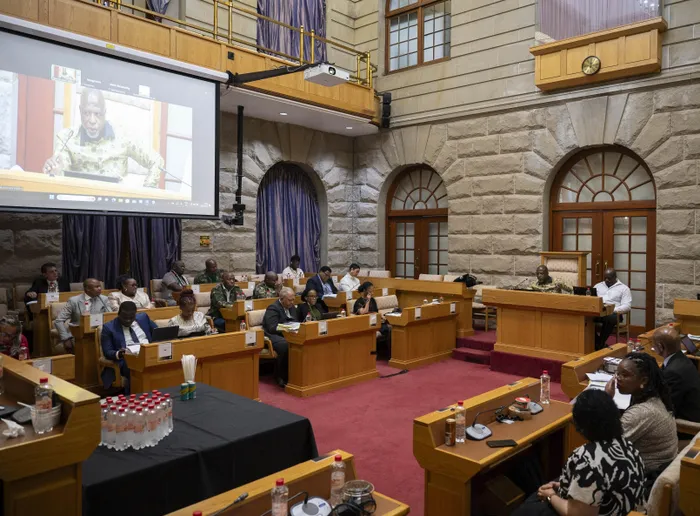
With its deadline of 20 February 2026 fast approaching, the committee is set to have some long nights ahead, especially with the oral submissions from the civil society groups and the submissions from the public.
Image: Armand Hough / Independent Newspapers
With Parliament’s Ad Hoc Committee investigating allegations made by SAPS KwaZulu-Natal provincial commissioner, Lieutenant General Nhlanhla Mkhwanazi, resuming next week, the committee will have to resist the temptation to dig too deep into these matters.
The committee is set to resume with the testimony of former Acting National Police Commissioner Khomotso Phahlane and Head of Crime Intelligence, Lt-Gen Dumisani Khumalo. Phahlane is expected to appear before the committee on Wednesday, and Khumalo has been set down for Thursday and Friday.
Other witnesses expected before the committee this month include former IPID boss Robert McBride, EMPD Deputy Chief Julius Mkhwanazi, forensic investigator Paul O’Sullivan, and controversial ANC-aligned North West businessman Brown Mogotsi.
With its deadline of 20 February 2026 fast approaching, the committee is set to have some long nights ahead, especially with the oral submissions from civil society groups and the public submissions.
The Ad Hoc Committee expects to set aside a weekend in the coming weeks to hear the submissions.
“Even if we were going to listen to two or three of them, it makes an important statement that the people of the public are being listened to by Parliament.
“Let us be seen doing that, acting in the name of those who may not have access to public institutions, or who may not have the voice for themselves or have representation. We are acting on their behalf and (we have to) make sure we deal with those issues,” chairperson Lekganyane Soviet said.

KZN police commissioner Nhlanhla Mkhwanazi.
Image: Tumi Pakkies/ Independent Newspapers
Analysts have shared their views with the end date in sight, saying that the committee will have to keep its terms of reference in mind, but also remember not to delve too deeply into the matter.
Political analyst Professor Sipho Seepe said that what the Ad Hoc committee is not meant to probe to far.
“It must avoid the temptation of going too deep into these matters, which should be dealt with by appropriate bodies that may not have been functioning.
“Their role is to say there is a problem, and how can we assist the law enforcement agencies to be sufficiently equipped, sufficiently primed and adequate to the task of reversing this malady that seems to affect them.
“The Ad Hoc committee cannot now become investigators themselves. What they need to do is to probe and look at what the institutional challenges are, what are the challenges in terms of processes, what are the challenges in terms of oversight bodies, and in terms of the processes within the criminal justice system, and how these are interlinked,” Seepe said.
“That's what they need to do. They cannot be an answer to everything, because then what you're going to have is a never-ending ad hoc committee.”
He explained that when Mkhwanazi held that infamous conference in July, it was still a cry for help, and so all that SAPS needs is to be assisted to continue to do their work.
“Because what we're saying is that as a police force, the implication (of interference) is so much that we're not able to do our work. So it must be seen in that light.”
Seepe also touched on what they are seeking from the forthcoming testimonies will likely be corroboration, especially with the testimony of McBride.
Parliamentary member on committee and ActionSA member, Dereleen James, said: "ActionSA believes that, notwithstanding the fact that the testimony of Robert McBride and Paul O’Sullivan does not directly address the investigation into Lt Gen Mkhwanazi’s specific allegations, its relevance is nonetheless important as their testimony could further illustrate the extent of undue influence and interference within our law enforcement apparatus, and it is anticipated that their testimony will provide valuable insight into these systemic concerns.
“ActionSA has consistently made it clear that the work of the committee has been frustrated from the get-go, largely because the investigation was not strategically structured with the requisite investigative capacity,” James said.
“As such, within the limited time that remains, the focus must be on rigorously interrogating the evidence and testimony of witnesses in a manner that establishes not competing versions of events, but the unimpeachable facts.”
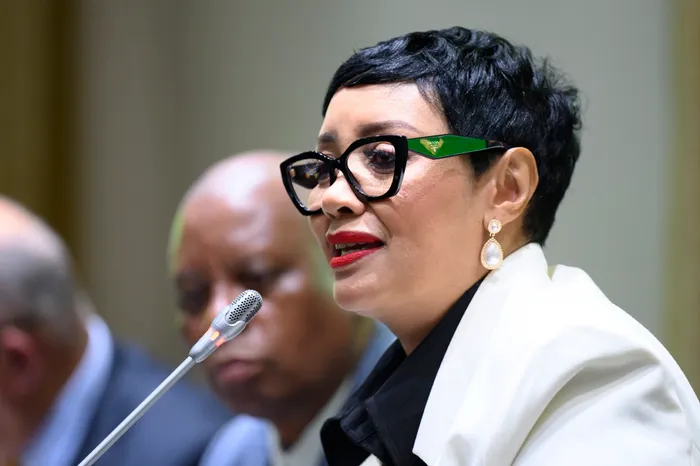
ActionSA's Dereleen James.
Image: Henk Kruger / Independent Newspapers
Political analyst Professor Andre Duvenhage said the principle of the testimonies is that everyone who can contribute needs to make the contribution in order for a balanced assessment of the situation.
“I think all inputs are important, but what is important is that they need to come to some sort of a conclusion, and they need to act. That is critical; we cannot undermine that.
“I think there are several smaller issues that can be dealt with in some way, but there are bigger issues, if, for example, you say X give that amount to A, and A is the minister of police, how do you deal with this? How are you going to deal with political influences, and that is the big concern at the moment.
“There are bigger issues that are unverified and untested, and that is taking the whole thing back to the criminal justice system in the first place. Will the criminal justice system act? We haven't seen it acting since, I think, a decade or two back. It didn't act under former NPA head Shamila Batoyi, and it also didn't act under the Zuma administration. So will it act in the first place?” Duvenhage said.
“Secondly, if they are going to act, which areas are they going to focus on? Who are they going to identify?
“I think these are critical issues. For me, the testifying part is not the major thing. It is the report, and it is the related action, and there we need the system, and that is what people would like to see. They would like to see action of some sort,” Duvenhage said.