

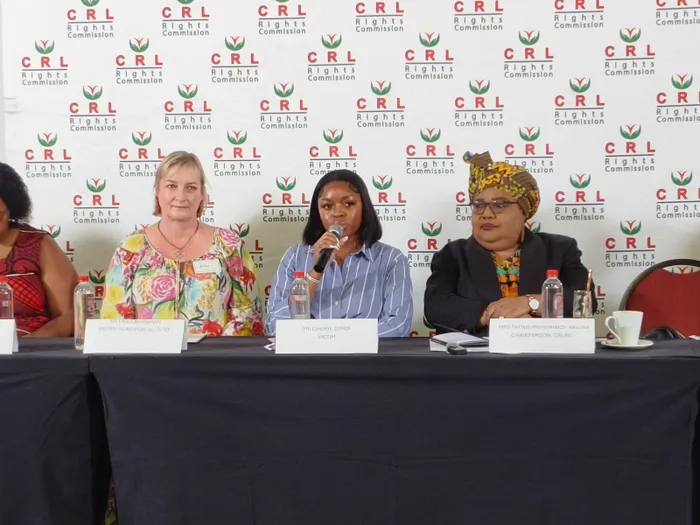
The CRL Rights Commission has vowed to protect the rights of GBVF victims in sacred spaces following a press briefing this week.
Image: Supplied
The Cultural, Religious, and Linguistic Rights Commission (CRL Rights Commission) has undertaken to roll out a series of campaigns aimed at tackling gender-based violence and femicide (GBVF) within sacred spaces.
This week, the CRL Rights Commission hosted a group of survivors of GBVF in churches and traditional healing environments, who shared harrowing accounts of their experiences, calling attention to the urgent need for change.
One of the survivors, Erika Bornman, opened up about the grim reality faced by many vulnerable individuals who seek guidance from religious leaders. “Abuse often happens behind closed doors under the guise of religious counselling,” she said.
Bornman recalled feeling as though she was to blame for her discomfort during counselling sessions. When she sought help from church leadership, instead of receiving support, she was silenced. Tragically, she later discovered that the same counsellor had allegedly raped her friend upon reaching adulthood.
Cheryl Zondi, yet another survivor, poignantly described the insidious nature of abuse in churches. “It’s a hijacking of the mind. It’s not violent in an obvious way. It’s gradual, manipulative, and deeply psychological. By the time you realise something is wrong, your voice is already gone,” she stated. Zondi’s experiences illustrated the urgent need for comprehensive support structures and awareness campaigns to protect victims.
Sihle Sibisi, a victim and activist called for more to be done to ensure religious leaders are held accountable, stating: “When victims speak up in church, they are gaslighted and dismissed. When they go to police stations, officers often don’t understand abuse in religious contexts."
Thoko Mkhwanazi-Xaluva, chairperson of the CRL Rights Commission, reaffirmed the commission’s commitment to addressing these critical issues. She revealed that since initiating a national process in April 2025, the commission has been dedicated to tackling abuse in sacred spaces across various religions.
“We cannot allow sacred spaces to become safe havens for abuse,” she emphasised, advocating for heightened awareness campaigns and survivor support mechanisms.
Mkhwanazi-Xaluva also pointed out that men are victims of GBVF in sacred spaces and highlighted the need for increased attention to this often-overlooked demographic.
“We have had several cases where young men are victims and have been violated in sacred spaces. There must be massive campaigns on this issue, and a support structure for survivors of GBVF is essential,” she added.