

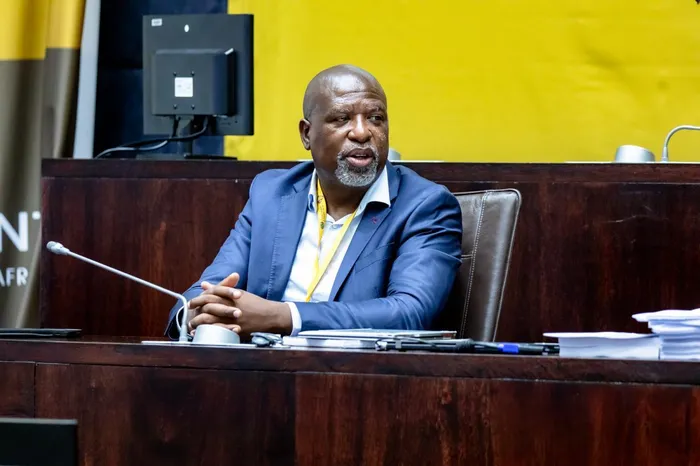
Chairperson of Parliament’s Ad Hoc Committee, Soviet Lekganyane.
Image: ParliamentRSA/Supplied
Chairperson of Parliament’s Ad Hoc Committee, Soviet Lekganyane, said there was no harm in allowing businessman Kishene Chetty to share evidence on Thursday, despite concerns raised by MPs who warned that his testimony could prejudice cases currently pending before the courts.
Lekganyane said the committee would not “gerrymander” its rules after members debated concerns first raised by DA MP Glynnis Breytenbach.
Chetty’s appearance had been deferred the previous week after he spent a day with one of the evidence leaders, Advocate Bongiwe Mkhize, reviewing the annexures submitted with his affidavit.
During his initial testimony on Thursday, the committee heard that Chetty’s affidavit referenced several criminal cases. Members were also told that he has been accused, along with several other individuals and companies, of theft, corruption and money laundering.
After MPs voiced their concerns—some agreeing with Breytenbach’s position—the chairperson decided to proceed with Chetty’s evidence.
“We are going to proceed with Mr Chetty and let him present what he wants to present. There is no discussion on this matter,” said Lekganyane.
Breytenbach and fellow DA MP Dianne Kohler Barnard said they would excuse themselves from participating in the day’s proceedings. When asked later if she wished to comment further on their departure, Breytenbach declined.
Her concern stemmed from the possibility that MPs could question Chetty on any matter, which would oblige him to respond.
“He may well find himself in a position where he may have to incriminate himself. He is not represented. He has no one to advise him. It is not our job to advise him. I’m concerned about what we’re busy doing here today. It is, for me, not quite right, but I am also concerned about his position in terms of his constitutional rights and his right not to incriminate himself,” Breytenbach said.
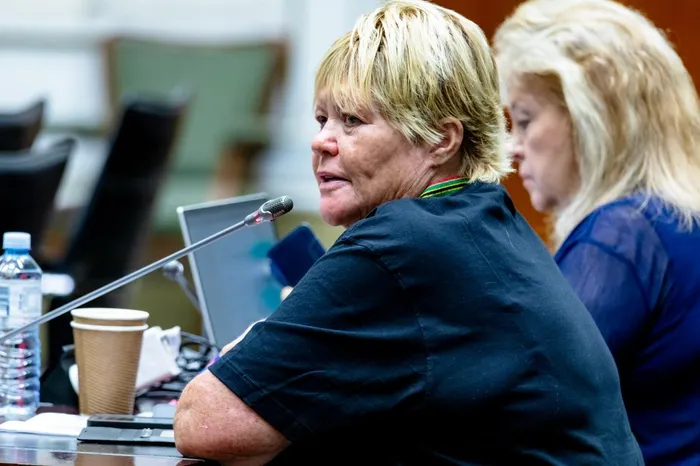
Committee Chairperson, Soviet Lekganyane, said they were not going to be gerrymandering their rules after MPs engaged on the concerns first raised by DA MP Glynnis Breytenbach.
Image: ParliamentRSA/Supplied
Speaking on the sidelines of proceedings, Lekganyane said the committee had heard from two categories of witnesses: key witnesses and those making public submissions. Chetty, he said, fell into the latter category.
“Some of them raise personal matters relating to conditions of service. Others raise allegations of abuse of organisational authority. There are also those who allege corrupt practices within the system.
“The committee has said they must bring their own submissions in the way they have crafted them,” Lekganyane said.
“As a leader, you must adhere to the principles of transparency and honesty. You cannot say no, so that tomorrow we are accused of having changed somebody’s statement.”
Lekganyane explained that Chetty’s appearance followed a submission made by a relative.
“A submission was made by a relative (Chetty’s father), and the secretary of the committee went around trying to locate the person. That is how we got the witness who appeared before us.
“What gives me comfort, and what I believe will satisfy committee members, is that the witness has been given a chance to make a presentation before the committee, and it is up to the members to interact with the statement of the witness,” he said.
Lekganyane added that Parliament was a political institution whose members were deployed by their respective political parties.
“Parliament is a political institution. The people who are here are not sent by committees or by the Speaker. They are sent by their respective political parties. Sometimes we may not see things the same way, and context may be difficult to understand or interpret.
“What is important, even before the eyes of the public, is that a citizen who wanted to appear before a committee of Parliament—whether justified or unjustified—has been given an opportunity to have his say,” Lekganyane said.
“He is a citizen, and he has a right to be heard. The committee has heard him.”
Addressing the committee, Chetty said the main case against him had been struck off the roll in March 2021 by a magistrate but that he was later arrested and charged again.
He believes the cases against him constitute an abuse of power, and said one matter was re-enrolled without a certificate issued by the National Director of Public Prosecutions. He added that he had filed an application in the High Court to have the matters set aside.
“We are waiting for a judge to be allocated to the matter,” Chetty said.
Chetty also told the committee that in 2022 he opened a criminal complaint alleging interference, unlawful conduct and unethical behaviour against the Investigative Directorate Against Corruption's investigators Dylan Perumal and Suneel Bellochun, as well as prosecutor Tilas Chabalala.
Chetty said he appeared before the committee to highlight what he described as an abuse of power and alleged that cases had been placed on the court roll without following proper procedures.
“When I complain about them, I get arrested, or they retaliate against me by utilising the state machinery. I have proof of all of that,” Chetty said.
It was at this point that Breytenbach raised further concerns about the contents of Chetty’s affidavit, reiterating that he could incriminate himself because he was appearing without legal representation while facing several serious charges currently before, or expected to be placed before the courts.
DAILY NEWS