

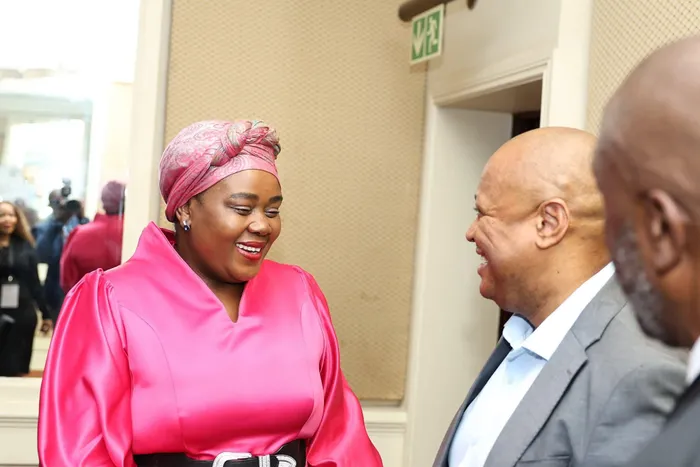
Minister Kubayi addressed concerns by legal practitioners that the legal fraternity has not been transforming.
Image: Facebook
The Minister of Justice and Constitutional Development, Mmamoloko Kubayi announced that she would be instructing all State Attorney Offices to establish stakeholder forums in their respective areas where they will meet quarterly to discuss issues such as the allocation of briefs to the legal fraternity.
This followed an outcry on Monday by several legal practitioners that the Office of the State Attorney routinely allocates legal work to established and mostly white legal practitioners, while overlooking smaller black firms.
The minister and her deputy, Andries Nel engaged with legal practitioners as part of ongoing efforts to strengthen collaboration and advance transformation within the legal sector.
This engagement provides a platform for constructive dialogue with legal practitioners on matters relating to transformation and the empowerment of previously disadvantaged professionals within the legal sector.
Various members of the legal fraternity as well as representatives of legal bodies were outspoken about the fact that black lawyers are overlooked, especially when it came to the State Attorney allocating work in high-profile cases.
Others said while they followed procedures as set out by the State Attorney’s Office to simply get any work, they have been overlooked. This caused frustration for many, as some had to close their offices due to financial constraints.
The acting Solicitor-General, Felix Mbeki, gave an overview during the proceedings, including statistics as to how work is being allocated and which processes had to be followed to be considered. He also painted a positive picture on how practitioners called upon to do work for the State are paid within the stipulated 30-day payment frame.
This sparked an emotional outcry from many of the lawyers present, who said these were simply wrong and that these figures did not represent the plight of the smaller black firms who are being overlooked.
Mbeki gave the assurance that since the establishment of the Office of the Solicitor-General, a structured and policy-driven approach has been implemented to promote fairness, transparency, and inclusivity in the allocation of state legal work.
One of the lawyers present at the engagement, however, said he had a legal bill taxed in 2023 for R31 000 after doing work for the State, which has not been paid up to today.
Another said she has never been briefed for work as small black firms are simply being overlooked. “We don’t have money for rent…Receiving a brief depends on how close you are to someone in the State Attorney’s Office,” she said.
Advocate Myron Dewrance, who leads Advocates for Transformation, also questioned how transformation is achieved while overlooking black and women lawyers.
He said these practitioners are being failed and this results in them not being able to economically sustain themselves and their practices. According to Dewrance, it is not only being briefed but also being paid for the work done if briefed. He pointed to a practitioner who has to use her home as an Airbnb and who has to live in her car with her child as she cannot make ends meet.
Dewrance said in most instances white firms are being briefed. He also questioned the system and said several government entities brief outside the State Attorney’s system, such as Sars, Eskom, and the Reserve Bank, who have their own preferential law firms. This is where the high-value work is, he said.
“Without this, we cannot talk about transformation. Please don’t sell us a pipe dream,” Dewrance said.
Minister Kubayi gave the assurance that the concerns will be addressed. She said while they are valid, the worst off in this sector are black female practitioners.
She emphasized that transformation does not need replacing white faces with black faces. But she acknowledged that there are briefing patterns which favour white males and said this cannot be ignored.
She is actively defending the Legal Sector Code (LSC) against legal challenges from major law firms. She said the LSC is crucial for transformation.
The code aims to increase participation of black legal practitioners, youth, and women and to reflect the country’s demographics.
zelda.venter