

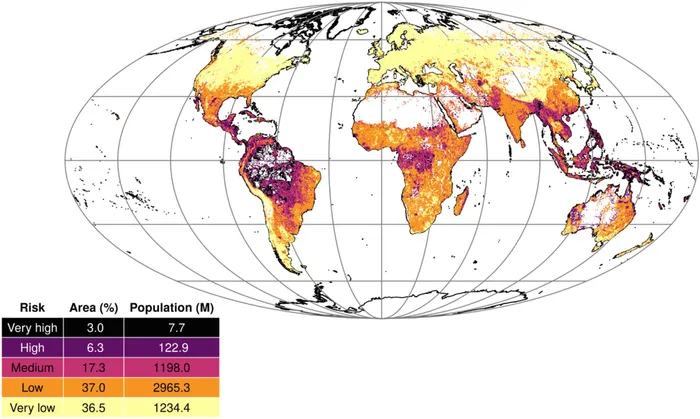
The map displays the risk levels across different regions, with white areas indicating insufficient data for one or more predictor layers.
Image: Science.org
A new global disease risk map is raising a difficult question: how vulnerable is South Africa to the next deadly outbreak?
The research led by Angela Fanelli, a veterinary epidemiologist at the European Commission’s Joint Research Centre (JRC), identifies regions where environmental, demographic, and health system pressures combine to drive infectious disease risk.
While the study inicates that only about 9.3% of the global land surface falls into high-risk zones, with the majority of those areas located in Latin America and Oceania. it is still relevant to South Africa.
The proportion of the area of each continent at high and very high risk of outbreak is the largest in Latin America (27.1%), followed by Oceania (18.6%), Asia (6.9%), Africa (5.2%), Europe (0.2%), and North America (0.08%)
Outbreak risk is rarely about a single trigger and emerges where multiple stressors collide, with South Africa seeing several of these stressors.
1. Infrastructure gaps still affect millions.
According to a 2024 General Household Survey (GHS) from Stats SA, only 76.3% of South Africans have access to safely managed sanitation. Nearly 1 in 5 people still lack access to adequate sanitation services, and approximately 46.2% of households have toilets in their homes.
In dense urban areas, the pressure is even more visible, with approximately 31.9% of urban households sharing sanitation facilities. This is alarming because shared or inadequate sanitation is one of the fastest pathways for cholera, diarrhoeal disease and waterborne outbreaks.
In other words, the physical conditions that allow disease to spread already exist, particularly in informal settlements.
2. Urbanisation is increasing exposure
South Africa’s population has reached about 63.1 million, with most of the population living in cities.
It is worth noting that urban growth has outpaced infrastructure in key areas, namely informal housing expansion, shared water and sanitation and overcrowding.
Stats SA data shows that shared sanitation is more common in cities than in rural areas.
This creates a paradox where cities offer better healthcare access, but also have a risk of faster disease transmission.
3. Climate shocks are increasing existing vulnerabilities
South Africans have already seen and experienced a fair share of flooding events, drought cycles and water interruptions.
Stats SA data shows that while access to clean water has improved to around 88.5%, service reliability remains uneven.
This instability matters because floods contaminate water systems, drought pushes households toward unsafe sources, and interruptions may disrupt hygiene practices.
It is worth noting that climate doesn’t create outbreaks on its own but magnifies weak points in infrastructure.
4. Inequality determines who is most at risk
The national picture masks sharp internal divides.
Stats SA indicates that sanitation access varies widely, with as low as around 66% in some provinces/metros, and higher in better-serviced areas.
Data from the 2024 GHS shows that the province where you live changes your access:
Eastern Cape: 85.3%
Mpumalanga: 84.7%
Northern Cape: 84.4%
Gauteng: 66.1%
This means outbreak risk is not evenly spread; it is concentrated in informal settlements under-serviced municipalities, and lower-income communities.
The global model does not place South Africa among the world’s highest-risk outbreak zones.
However, it does fit a more complex category, which is 'countries with moderate infrastructure — but high internal vulnerability'
This suggests that outbreaks may not spiral nationally but localised outbreaks become more likely and recurring.
This matters because the biggest shifts in global health is the move from reacting to outbreaks to predicting them.
New models combine climate data, population density, infrastructure gaps and health system capacity.
While South Africa is unlikely to be the epicentre of the next global pandemic, the biggest thing to take from this is not that “South Africa is at risk”, but that some South African communities are more at risk than others as sanitation access, water reliability, housing density and service delivery issues continue to plague South Africans.
IOL