

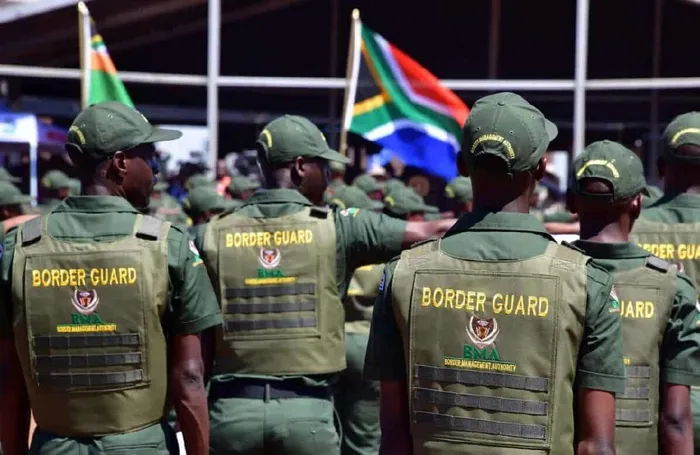
The Border Management Authority (BMA), an entity of the Department of Home Affairs, announced successful bidders for the R12.5 billion tender to reconstruct and upgrade the country’s six major ports of entry.
Image: Supplied
South Africa’s bold move to curb illegal immigration and the movement of illicit goods through technology, one-stop border posts, and the upgrade of key land ports of entry has been hailed as a step in the right direction towards curbing the scourge.
This was after the Border Management Authority (BMA), an entity of the Department of Home Affairs, announced successful bidders for the R12.5 billion tender to reconstruct and upgrade the country’s six major ports of entry.
These are Beitbridge, Lebombo, Oshoek, Kopfontein, Maseru Bridge, and Ficksburg, and work is scheduled to start later in 2026 or early 2027. It will be completed in two to three years in different parts.

BMA Commissioner Dr Michael Masiapato says the days of relying on a stamped passport to enter South African borders will soon become a thing of the past.
Image: File
According to the BMA and Home Affairs, the land ports of entry redevelopment introduces smart border infrastructure, including biometric verification systems, automated processing for travellers, and advanced cargo management technologies.
It incorporates the one-stop border post model, which allows neighbouring countries to share facilities and process travellers and goods in a single, integrated space, while separating different types of traffic, such as cargo trucks, buses, taxis, private vehicles, and pedestrians. The government said this would reduce bottlenecks.
BMA Commissioner, Dr Michael Masiapato, said no government money was spent on this Public-Private Partnership project, but the consortiums will raise their own funding through commercial banks. The facilities will be built and operated by consortia for 25 years before handing them over to the state.
Masiapato said solutions to what South Africa considers problems are already being deployed in other jurisdictions, ‘we’ just need to catch up and use the latest technology possible.
“We are talking here about facial recognition, which we will use to process truck drivers when they arrive at the port, without that individual having to get out of the truck. We are talking about technology where we will be scanning trucks moving at 30km per hour, without having to stop at the port,” he said.
Masiapato highlighted that the days of relying on a stamped passport will soon become a thing of the past.
“We need to ensure that people who move between countries are legitimate travellers and that the goods being moved are also legitimate,” he said.
Masiapato added that since the BMA’s establishment in 2023, over 500,000 individuals have been intercepted and deported.
He stated that in 2025, over 112 facilitators of illegal migration were arrested, and in 2026, during the Easter operations, BMA arrested over 138 facilitators.
“We made sure that they were not deported, and we charged them for aiding and abetting illegal migration according to Section 49(2) of the Immigration Act. The more you arrest facilitators, you deactivate the enterprise of illegal migration, because this enterprise is facilitated by certain individuals who make a lot of money illegally.”
He said, as the DHA’s Immigration Inspectorate continues deportations, BMA ensures that people don’t walk back into the country illegally, as was the case.
Dr Leon Schreiber, minister of Home Affairs, said the BMA is already rolling out the facial recognition cameras into international airports and the busiest land borders.
Schreiber said the six ports of entry account for 11% of South Africa’s 53 land ports of entry, but generate 80% of traffic volume and likely also about 80% of illicit activity.
“By prioritising these six ports for a complete overhaul, the likes of which we have not seen before, we are working with determination to exploit 80% of the economic opportunities on offer, while solving 80% of the challenges we face in this environment,” Schreiber said.
The minister said DHA has increased deportations by 46% over the last two years.
Willem Els, a senior training coordinator in the ENACT organised crime programme at the Institute for Security Studies (ISS), said the land ports of entry upgrades and the introduction of the latest technology are a step in the right direction.
Els stated that the one-stop border post method has already been operational in many African countries.
“I think the minister and the BMA did their homework; they looked at what is happening around the world, and appear to want to replicate some of that and bring it to South Africa. What we see here, I think, is a step in the right direction.”
He said the use of technology, body cams, algorithms, and other tools will curb crime and corruption. It is not going to eliminate it, but it will go a long way towards making borders safer and stopping a lot of things from coming in, and illegal immigrants
“We need to understand that you are never going to stop corruption completely or eradicate the whole crime. What you do is put up hurdles to make it more difficult to perpetrate a crime, and that is what’s happening here. That is what the electronic surveillance is doing. In that way, you have to make it as difficult as possible for people to be corrupt. It will go a long way towards making borders safer and stopping a lot of things from coming in, and illegal immigrants,” he said.
Els highlighted that South Africa’s challenge in securing borders was also affected by organs of state working in silos, saying that an integrated approach will likely be successful.
On one hand, you can have all the technology, systems, and the best in border management, but if you do not manage your people correctly and put principles in place, it is going to be a free-for-all once again, he said.
“What we see now is that they have arrested a lot of people. We know that once those bad apples are gone, the criminal syndicates with lots of money will start recruiting new people. So, it is a continuous job. It is not something where if you find 155 corrupt people, fire them, criminally charge them, that you expect everything to be good,” Els warned.
He added that this is a continuous management of the situation, where one can’t say ‘now we have arrived and we are safe’.
David Peddle, an independent border management expert and retired SANDF colonel, said the development of infrastructure at the ports of entry is an important step towards ensuring that the country’s borders are not porous as they have been over the years.
He warned that a lot of work needs to be done to make what is proposed a reality.
Peddle highlighted that the question of a one-stop border post has been on the cards since the early 2000s, when it was spoken about in Lebombo, but it never got anywhere due to resistance to the idea.
He said the resistance was particularly from the old border police who were there then, citing legalities regarding powers of arrest in stopping crime, when a person is progressing towards a border post.
“Another challenge was the control of goods going through the border post, particularly SARS, and the police have been concerned about. The police would assist with the search, which is primarily a SARS Customs function. To search effectively, you must have the equipment suitable for conducting searches in containers in 40 degrees of heat, which is not always a good place, and will always be a problem to do efficiently and effectively, especially when you have hundreds of containers coming through,” Peddle stated.
He said that the government has to ensure that the right equipment and electronic machinery are available to speed up the process.
Peddle said it takes people to manage the technology, highlighting the necessity for careful management controls of personnel appointed at the border posts. He said officials are often corrupt, or sometimes criminals notice that functionaries are not doing their work properly.
“There are systems for checking stolen vehicles coming through at the border posts. Those systems get regularly broken, destroyed, the cameras are being turned around and facing the wrong way, while criminals are paying thousands of Rand per vehicle to come through, never mind containers with cigarettes and other things,” Peddle stated.
Beitbridge Port of Entry in Limpopo, connecting South Africa to Zimbabwe, the chosen bidder is Baobab Concession, which comprises Yakani Group, Wendra Infraco, Matla Integration, Tau Capital, Navigator Holding & Baobab Community Trust.
Lebombo Port of Entry in Mpumalanga, which connects SA to Mozambique, the preferred bidder is Raulux Consortium, comprising Luxus Developments, Raubex, Exhantini Investments, Vulindlela Concessions, and Harith General Partners.
Oshoek Port of Entry in Mpumalanga, connecting SA to eSwatini, the preferred bidder is Baobab Concession, which comprises Yakani Group, Wendra Infraco, Matla Integration, Tau Capital, Navigator Holding & Baobab Community Trust.
Maseru Bridge Port of Entry in the Free State, connecting SA to Lesotho, the preferred bidder is Kgorong Consortium, which comprises Motseng Concessions, IDEAS Infrastructure, Crowie Concessions, & Thebe SPV.
Kopfontein Port of Entry in the North West province, connecting SA to Botswana, the preferred bidder is Kopfontein Consortium, comprising Talis Property Fund, Unik Civil & Construction Engineers, and SSG Facilities.
Ficksburg Bridge Port of Entry in the Free State, connecting SA to Lesotho, the preferred bidder is Imbani Consortium, comprising Imbani Projects, Reaga Infra Border Holdings, M&M Capital, and Russet Trading & Investments.