

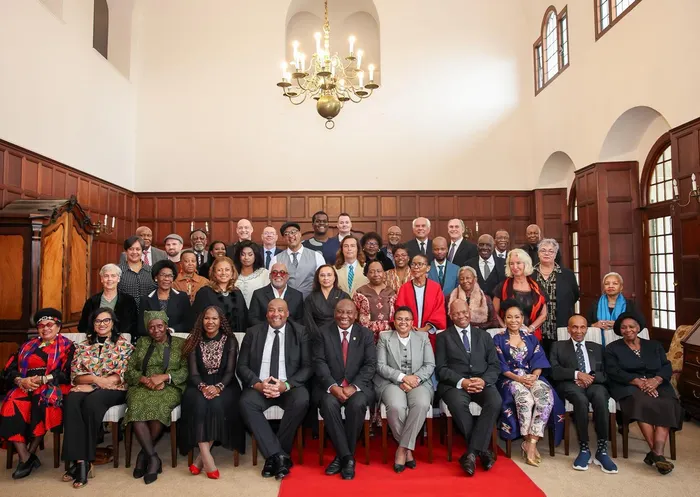
President Cyril Ramaphosa has bestowed National Orders on 36 recipients in Pretoria, recognising their contributions to democracy, science, arts, sport and nation-building at a ceremony held at the Sefako Makgatho Guesthouse.
Image: GCIS
President Cyril Ramaphosa has bestowed National Orders on 36 recipients at a ceremony held at the Sefako Makgatho Presidential Guesthouse in Pretoria on Tuesday.
It recognises South Africans and foreign nationals for their contributions to democracy, science, arts, sport, and nation-building.
The investiture ceremony, where the President acted as Grand Patron of the National Orders and pinned medals on recipients in the presence of family, friends, and dignitaries, honoured individuals who have made significant contributions to a non-racial, non-sexist, and democratic South Africa.
Honours were conferred across five categories: the Order of Ikhamanga, the Order of the Baobab, the Order of Luthuli, the Order of Mapungubwe, and the Order of the Companions of OR Tambo.
Ramaphosa said the recipients reflected the country’s democratic ideals and the values of equality, justice, and human dignity.
He said the awards honoured those who had helped build “the pillars of our democratic order”, adding that their work reflected a long national journey rooted in the country’s constitutional values adopted 30 years ago.
Quoting William Ralph Emerson’s “A Nation’s Strength”, he said nations are built by those who “work while others sleep” and “build a nation’s pillars deep and lift them to the sky”.
Ramaphosa said the recipients had “lifted to the sky our greatest aspiration” of building a democratic South Africa, adding that their contributions spanned arts, science, sport, education, medicine, literature, and human rights.
He said the achievements of the honourees also reflected South Africa’s growing international standing in science and medical innovation, adding: “We seek knowledge not for its own sake, but to protect lives, to improve health and to build a better life for all.”
Ramaphosa added that recipients were a “mirror of South African society”, representing the values of freedom, dignity, and equality enshrined in the Constitution.
He said it was the people of South Africa who ultimately decide who is honoured with National Orders, describing the awards as the highest recognition of national service.
“By bestowing this award, we affirm once more that the story of our freedom should not pass into distant legend but should continue to be carried by successive generations into the future,” he said.
Chancellor of the National Orders, Phindile Baleni, announced the recipients, saying the honours represent the country’s highest awards bestowed by the President on individuals who have advanced democracy and improved the lives of South Africans.
In the Order of Ikhamanga (Gold), the Springboks coach Rassie Erasmus was honoured for inspirational leadership in rugby, Wouter Kellerman for his achievements in music and community development, and the late Todd Matshikiza for his contribution to journalism, jazz, and music education.
The late Professor Khabajane Vivian Mngoma was recognised for his contribution to music education, while the late Jeremiah Kippie Moeketsi was honoured for his role in shaping South African jazz.
The late Queeneth Maria Ndaba was recognised for her support of artists during apartheid, and the late Molefe Pheto for his work in theatre, literature, and cultural activism.
In Silver, Jonathan Kenneth Butler was honoured for his global music career, while the late Jonny Mbizo Dyani was recognised for his contribution to jazz internationally.
Andiswa Precious Gebashe was recognised for advancing accessibility for the Deaf community, while Norman Hlabane was honoured for his contribution to boxing and youth development.
Dr Trevor Jones was recognised for his contribution to film music and support for the liberation movement, while the late Dr Oliver Kgadime Matsepe was honoured for his storytelling legacy.
Oscar “Oskido” Mdlongwa was recognised for his role in kwaito and youth music development, while Prof. Deuteronomy Bhekinkosi Zeblon Ntuli was honoured for translating major literary works into isiZulu.
The late Benjamin John Peter Tyamzashe was recognised for his contribution to cultural heritage.
In Bronze, Gavin James Krastin was honoured for performance art and curation, the late Dalene Matthee for literature and cultural storytelling, and Samuel Mhangwani for his contribution to jazz and cultural activism.
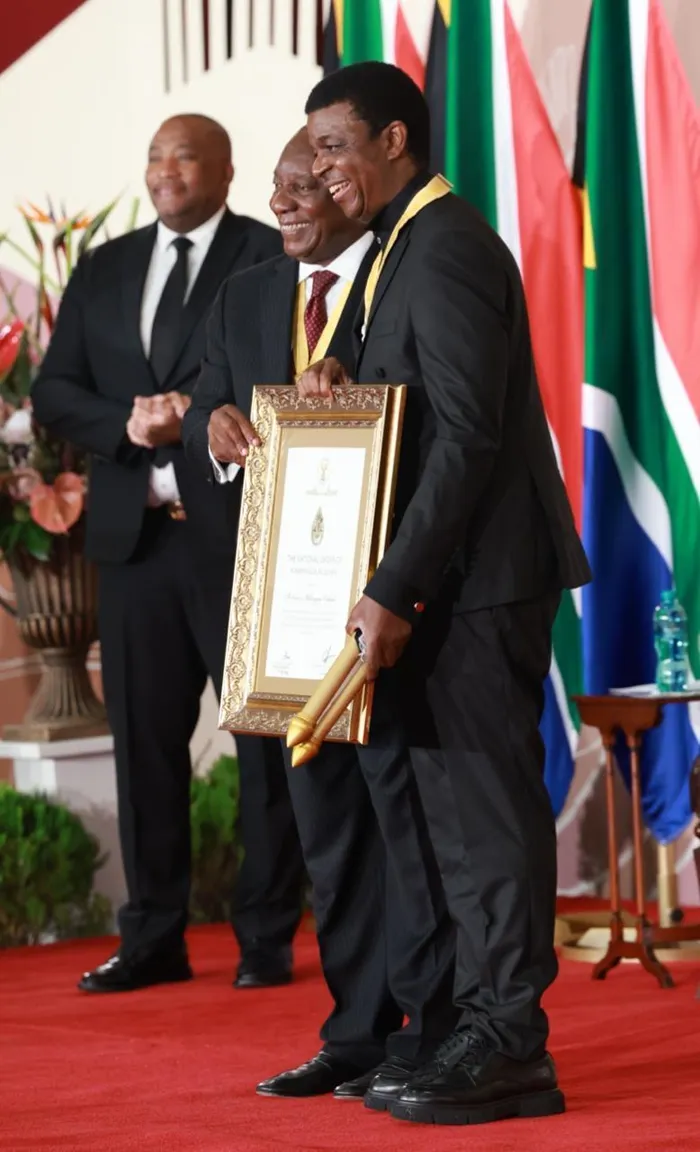
Music icon Oscar “Oskido” Mdlongwa receives honour at 2026 National Orders.
Image: GCIS
In Gold, the late Professor Chabani Noel Manganyi was honoured for his intellectual contribution to Black Consciousness and identity.
In Silver, Professor Kubedi Patrick Mokhobo was recognised for his work in cardiology and medicine.
In Bronze, Prof. Pumla Gobodo-Madikizela was honoured for her work in social cohesion and the psychology of forgiveness.
In Gold, the late Jack Simons and the late Ray Alexander Simons were honoured for their role in the liberation struggle.
In Silver, Mmagauta Molefe was recognised for activism and community leadership, while the late Caiphus Nyoka was honoured for his role in the struggle against apartheid.
In Bronze, Adele Kirsten was recognised for her contribution to peacebuilding and gun control advocacy.
In Gold, Professor Tulio de Oliveira was honoured for the discovery of the Omicron variant of COVID-19, while Professor Salim Abdool Karim was recognised for his work in HIV/AIDS, TB research, and public health leadership.
In Silver, Professor Keertan Dheda was recognised for his work in pulmonology, while Professor Vukosi Ntsakisi Marivate was honoured for contributions to artificial intelligence and data science.
In Bronze, Professor Priscilla Baker was recognised for her scientific research and public engagement, while Professor Karen Sliwa-Hahnle was honoured for her work in cardiovascular medicine.
In Silver, Teresa Hillary Clarke (USA) was honoured for her contribution to education, human rights, and youth development in South Africa.
Pierre Magnee (Netherlands) was recognised for his support to the liberation movement, while the late Antonio da Silva Gomes Cordeiro (Mozambique) was honoured posthumously for his role in the struggle.
Professor Cherif Keita (Mali) was recognised for preserving the legacy of Nokuthela Dube, while Naomi Kleinfeld (Netherlands) was honoured for her support of anti-apartheid efforts.
Ramaphosa said South Africa’s freedom was made possible through global solidarity, noting that the country remains committed to peace and friendship among nations founded on shared values of dignity and equality.
He said the recipients were a “mirror of South African society”, reflecting the values of human dignity, equality, and freedom that continue to guide the nation.
IOL News