

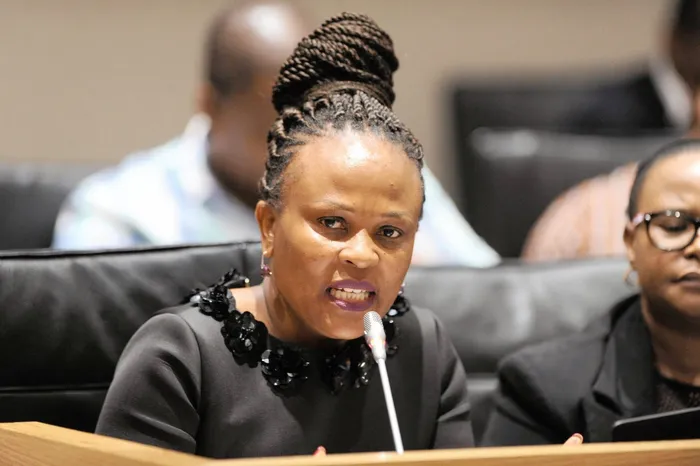
Public Protector Busisiwe Mkhwebane. File picture: Henk Kruger/African News Agency (ANA) Former Public Protector Busisiwe Mkhwebane has become the second prominent figure to request that US law authorities look into the Phala Phala farm scandal.
Image: Henk Kruger/Independent Newspapers
Following a similar move by then DA leader John Steenhuisen in 2022, former Public Protector Busisiwe Mkhwebane has again requested that US law enforcement and financial authorities probe President Cyril Ramaphosa's Phala Phala farm scandal.
Mkhwebane, through the Busisiwe Mkhwebane Foundation, last week submitted a formal request to the Federal Bureau of Investigation (FBI) and the Department of Justice (DOJ) to launch a criminal investigation against Ramaphosa.
The foundation urges the FBI to investigate the origin, transportation, and concealment of the US dollars found at Phala Phala, and to consider possible violations of American criminal and financial laws.
The action follows the long-standing Phala Phala scandal, which originally erupted after former South African spy boss Arthur Fraser laid criminal charges against the President in 2022.
The charges alleged money laundering, kidnapping, and defeating the ends of justice stemming from the 2020 theft of over $4 million in cash concealed at the President's Phala Phala farm in Limpopo.
However, Ramaphosa stated that the stolen money amounted to $580,000 (not $4 million) and was legitimate revenue from the sale of buffalo and game on his property.
In a letter sent by then DA leader Steenhuisen in 2022, the party requested the FBI to consider investigating the source of the funds and whether the money was brought into South Africa legitimately and declared to the appropriate authorities.
The party sought international intervention because the FBI's mandate covers money laundering and irregularities involving US dollars crossing international borders.
The DA said it was concerned that the money stolen from the farm may have originally come from possibly unlawful or nefarious activities from both a national and international source.
The party had argued that withdrawing such substantial amounts of USD is not feasible within South Africa, nor is it the nation's legal tender.
The DA added that while Ramaphosa claimed the money was revenue from farm-hosted wild game auctions, the receipt of physical foreign currency for a sale within South Africa inherently calls for closer scrutiny.
“As the President has not been open with those people or entities who had paid him in USD, and given the suspicious amount of USD that had been found tucked inside furniture, we cannot be certain that this money has not come from a nefarious source within the USA and as such we request your offices to consider conducting an investigation into the source of funds and ascertain if the money was brought into the country legitimately, was above board and was declared to the appropriate authorities,” read the letter.
The party says Ramaphosa faces serious allegations that “will continue to do enormous damage to our economy and our prospects for attracting investment and creating jobs, as well as to the credibility of the office of the presidency and the police and justice system.
“We recommend that the ledgers or journals which would have recorded the alleged sale of wild game at an auction be requested from the President to ascertain the identities of those involved in the suspicious cash transactions.”
The Busisiwe Mkhwebane Foundation has reignited calls for the FBI to get involved, saying they have a whistleblower report which accuses Ramaphosa of bulk cash smuggling, money laundering, and cross-border currency violations.
The foundation argues that US federal agencies have jurisdiction because the case centers on undeclared US currency stashed at the Phala Phala farm. They claim the money may have breached US currency-smuggling and anti-money laundering laws.
The foundation requested the authorities to pursue civil and criminal forfeiture of any US dollars that constitute the proceeds of criminal activity, in accordance with US legislation.
Among other steps, the foundation wants investigators to seek is assistance from South African authorities, including SARS, the South African Reserve Bank, the Hawks, and the National Prosecuting Authority, to obtain records relating to the matter.
International law Professor Andre Thomashausen said that because the United States government maintains legal ownership of all physical cash in circulation, using these bills in any illegal activity triggers American federal jurisdiction.
“Hiding and hoarding of large amounts of US Dollar notes normally only happens in serious criminal environments such as the South American drug cartels. Because the US retains the ownership of each dollar note in circulation, American criminal law jurisdiction is attracted whenever the notes are used in a criminal endeavour.
"Naturally, only serious cases are prosecuted in the US, and normally only if they affect US interests and the security of the United States,” he said.