Political parties say transparency is key in implementing housing needs register objectives in in eThekwini
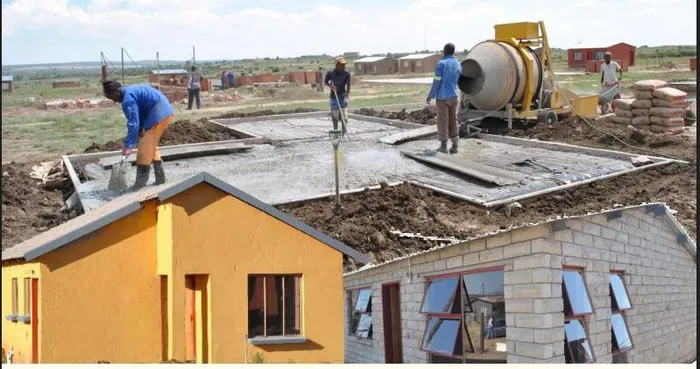
The National Housing Needs Register (NHNR) is a central database that offers households the opportunity to register their need for adequate shelter.
Image: Department of Human Settlements
Some political parties in the eThekwini Municipality called for transparency surrounding the municipality’s proposed implementation of the National Housing Needs Register's (NHNR) requirements.
According to the municipality, the NHNR is a database developed by the National Department of Human Settlements and formally promulgated by the Minister of Human Settlements in July 2014.
Since its introduction, several metropolitan and district municipalities in Gauteng, Eastern Cape, and Limpopo have piloted the implementation of the system.
The KwaZulu-Natal Department of Human Settlements was also expected to announce its adoption of the system.
The eThekwini Human Settlements, Engineering and Transport Committee report, put before council on Tuesday, stated that once the minister signed the instruction note, the system will become mandatory.
The benefits of the NHNR were unpacked during a workshop with the committee on August 5, 2025, including:
- Transparent process.
- Enabling detailed project planning according to the needs of the community.
- Facilitating communication with potential beneficiaries via SMS.
- Improving the accuracy of statistics, including housing and services backlogs.
- Enabling an initial pre-screening of potential beneficiaries to streamline subsidy applications.
The committee outlined that data can be collected either via the completion of printed forms or directly into the database via an internet connection. The following details of those registering a housing need are captured:
- Location
- Contact information
- Description of current dwelling
- Household income
- Personal information of each household
- Migration
- Preferences
Zwakele Mncwango, ActionSA's provincial chairperson, said his proposal for the NHNR to be made public to prevent potential fraud and corruption, and to promote transparency and fairness in the allocation of public housing, but was not fully supported by other political parties in eThekwini.
Mncwango suggested that making the NHNR publicly accessible would have allowed residents to track their applications and hold the municipality accountable, ensuring that those who were rightfully on the list receive their homes.
“On many occasions, residents apply for public housing and patiently wait for their turn, only to discover that when allocations are finalised, officials or ward councillors hand over these houses to their relatives, friends, or political allies,” he claimed.
Mncwango said he understood that concerns were raised regarding the Protection of Personal Information Act (POPI), but he suggested that the publication of names, excluding sensitive information such as ID numbers or physical addresses, to fully comply with privacy laws.
“We remain committed to standing with the people of eThekwini and will continue to fight for transparent systems that protect the most vulnerable from exploitation and injustice,” he said.
Councilor Ntombifuthi Ntshayintshayi, the IFP's eThekwini caucus whip, said that people have shed tears while waiting for houses to be built, adding that the new process could make the application process easy for people.
“Our communities have suffered waiting for years, not knowing if they will ever get assistance. Many have applied for more than a decade and have never received a response. The IFP calls for transparency. This item will also give communities the chance to specify what they are applying for,” she said.
Zamani Khuzwayo, DA councillor, said this process has taken the municipality a long time to implement. He was concerned that the council had passed a needs register before, and what was going to happen to that list.
“During committee meetings, we discussed and raised issues of false hope that this register will raise. Once it passes, proper communication is needed for those in need,” he said.
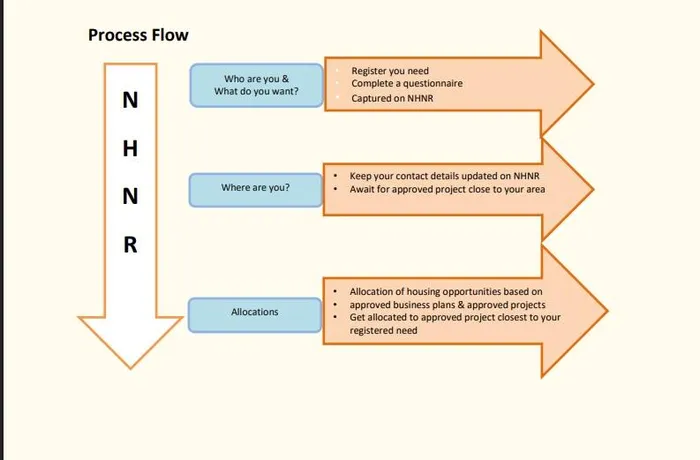
The National Housing needs register process outlined by the Department of Human Settlements
Image: Department of Human Settlements