

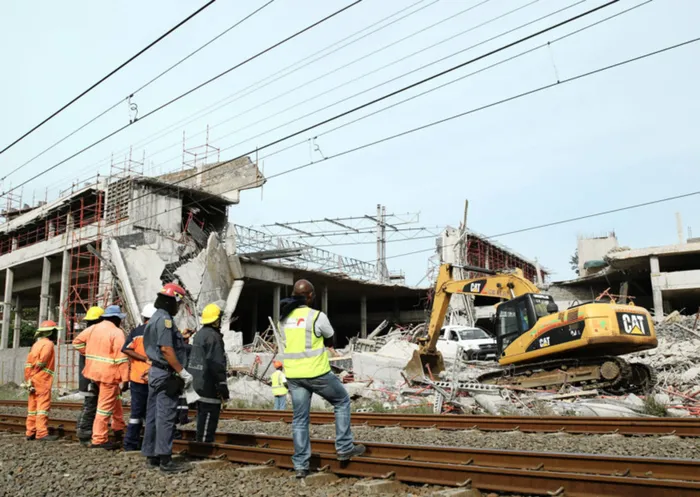
The aftermath of the Tongaat Mall collapse serves as a stark reminder of the urgent need for improved construction safety standards.
Image: Gcina Ndwalane/ Independent Newspapers
Presenting the preliminary findings on the Redcliffe, Verulam building collapse from last Friday, the Council for the Built Environment (CBE) highlighted the problems in the eThekwini Municipality with structural collapses.
CBE CEO Dr Msizi Myeza drew attention to collective concerns within the environment and the broader construction industry. He highlighted that eThekwini has experienced numerous structural-related incidents over the past ten years.
He said these are:
“In our view, this suggests that there is a need for greater focus on systemic and governance issues within the development planning, facilitation and building control processes and construction-related processes which the built environment and construction sector operates,” Myeza said.
eThekwini Municipality City Manager Musa Mbhele said he did not think there was evidence that indicates a systematic governance collapse in the City.
Mbhele said there are several role players in the built environment value chain, leading to the building and occupation of a building.
“I can’t fathom a situation where (it can) easily be said (that) all these buildings that have collapsed in the last 10 years are because the City has failed in its governance systems. That is not true,” Mbhele said.
Highlighting his experience, Mbhele said he was in charge of city planning for 10 years and some of the buildings mentioned, like the Tongaat Mall and the Jacobs site, fell under his portfolio.
“In the Tongaat one, we had served 10 notices, and the developer continued to build unabated. We then, as required by law, went to court. We obtained a court order. They still ignored the court. We went to press for contempt. Between that process of obtaining the contempt of court order, the building collapsed,” Mbhele explained.
“You can’t ask for more seriousness in tackling these issues in a situation like that.”
Mbhele stated that the integrity of this value chain hinges on the public accepting responsibility and understanding the problems associated with illegal construction.
“I think it’s important that we deal with it unless someone comes to me and says you had lapses here and there, which points to your systematic failure in governance over the period of 10 years,” Mbhele said.
He also noted that a critical point that is overlooked is Durban’s soil conditions. He said studies were conducted in 2022 and weaknesses in Durban’s soil conditions were revealed.
“These soils’ ability to retain water without leading to mudslides were flagged by geologists. Those factors require us, as people in charge of building control, to require very stringent approval mechanisms,” Mbhele said.
“Those 10 or 12 buildings, particularly the Jacob’s one, were a result of the collapse of the soil because the shoring was not done properly. That was the responsibility of the contractor.”
Mbhele said he was not defending but highlighting what he believes to be the cause of structural collapse.
“It’s as a result of the combination of the soil conditions, which are worsened by the issue of climate change, the torrential rains that we receive in short succession, but also the issue of the value chain being very long, where we are dependent on other people in the process,” Mbhele said.