

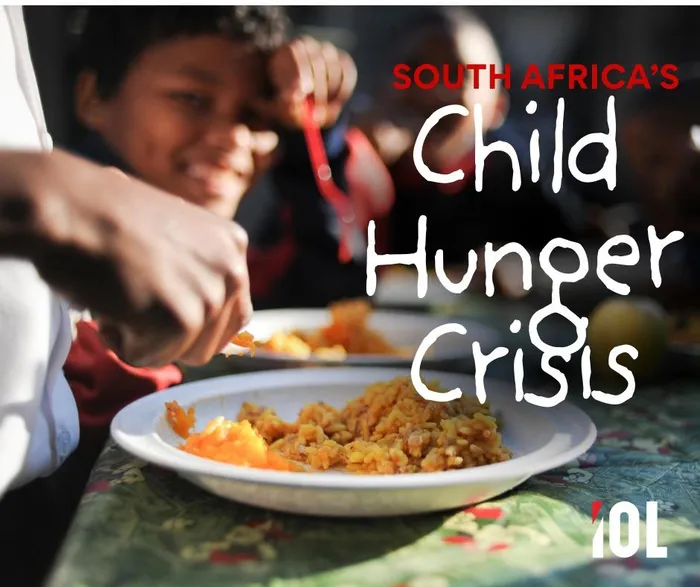
The National School Nutrition Programme provides meals to millions of schoolchildren, with the largest number of recipients located in KwaZulu-Natal, Limpopo and the Eastern Cape.
Image: Independent Newspapers
* This is part three of a four-part series on the devastating impact of malnutrition in South Africa.
UNICEF South Africa emphasised that, regardless of a child’s socio-economic background, they have a constitutional right to access nutritious food. At the same time, Statistics South Africa (Stats SA) said that in 2021, 3.8% of all households with young children reported experiencing hunger.
Experts recognise the National School Nutrition Programme (NSNP) as a key intervention for improving children’s health. However, the programme faces various obstacles, including issues with procurement and delays in funding.
Established in 1994, the NSNP provides meals to schools in poorer communities to ensure pupils receive adequate nutritional support, contributing to good health and improved academic performance.
In parliamentary responses last year, DBE Minister Siviwe Gwarube said the NSNP promotes school attendance by addressing hunger and malnutrition, both of which have a detrimental impact on learning and cognitive development. The NSNP helps pupils remain in school by ensuring they have access to at least one nutritious meal per day. It further supports these pupils by providing daily meals, reducing the financial burden on families.
She said a total of 9,801,224 pupils benefit from the NSNP, with the majority from KZN (2,437,259), followed by Limpopo (1,661,650) and the Eastern Cape (1,587,635).
Gwarube said the department remains deeply concerned about the persistent challenges facing the NSNP in KZN.
Gwarube explained that the department conducted an assessment of the two primary procurement models used in the implementation of the NSNP, namely the centralised and decentralised models. Each model presents both advantages and challenges in ensuring efficient and sustainable food provision to schools.
“The DBE is currently reviewing the NSNP delivery model with the aim of improving efficiencies, particularly in provinces with a high number of service providers, such as KwaZulu-Natal,” Gwarube said.
She said the review focuses on optimising economies of scale, strengthening local economic development, strengthening financial management and ensuring a more streamlined approach to service delivery.
Gwarube said the department actively monitors NSNP implementation across all provinces to ensure compliance and efficiency.
“In KwaZulu-Natal, urgent interventions were undertaken to resolve issues related to non-payment of service providers and disruptions in food delivery,” Gwarube said.
She said monitoring visits have confirmed that, despite administrative delays, meals were served at the schools visited in KZN.
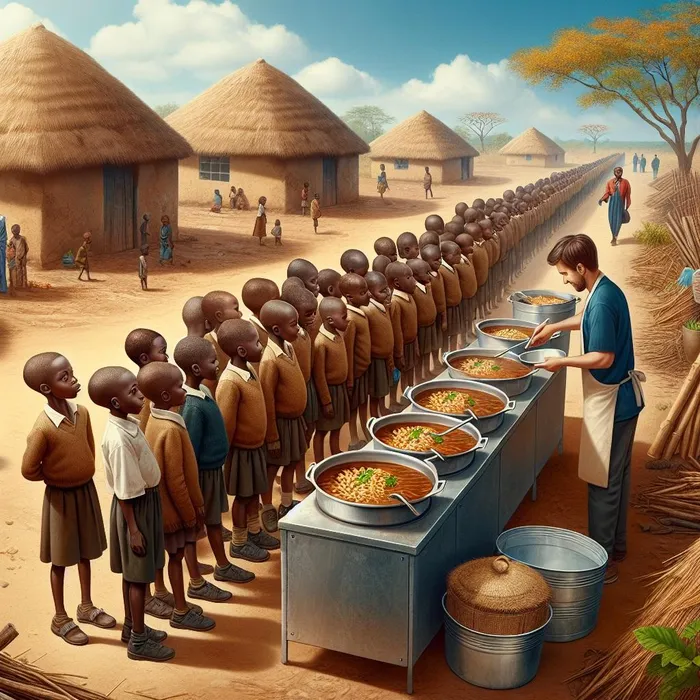
Volunteers and staff work together to prepare and distribute healthy meals as part of the NSNP, combating child hunger in South Africa.
Image: IOL/ RON AI
According to the Department of Basic Education (DBE), a school meal consists of protein (soya, fish, eggs, milk, sour milk, beans and lentils), fresh fruit and vegetables, and carbohydrate/starch. A variety of proteins is served per week. Soya should not be served more than twice a week. Fats/oils, salt and flavourants are added to make the meals tasty. Fresh vegetables or fruit should be served daily.
Leftover food can be given to the needy pupils to eat at home.
In September 2024, Stats SA said that the government spent R8,4 billion in 2022/23 on the feeding scheme.
KwaZulu-Natal was the largest NSNP fund spender, representing 22% (R1.9bn), followed by Limpopo and the Eastern Cape (18% each) and Gauteng (12%).
However, at the height of the Covid-19 pandemic (2020/21), expenditure on the NSNP decreased in four provinces, including KZN, Limpopo, Mpumalanga and Gauteng, with the sharpest declines recorded in Limpopo and KZN.
In KZN, unpaid invoices contributed to the decline. Investigations were also launched into the NSNP’s tender award process.
There was some recovery in 2021/22, with the largest increases recorded in KwaZulu-Natal and Limpopo.
The most recent data revealed that spending in eight provinces in 2022/23 compared with 2021/22, except for KZN, which registered a decline of R66 million.
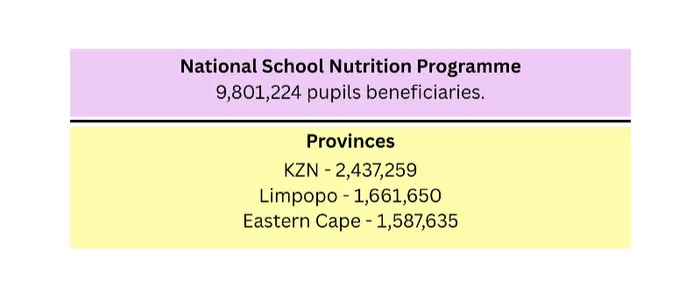
More than nine million schoolchildren benefit from the National School Nutrition Programme, with KwaZulu-Natal, Limpopo, and the Eastern Cape having the highest number of beneficiaries.
Image: Thobeka Ngema
Stats SA emphasised the crucial role of the NSNP, with DBE reporting that 9,7 million pupils in over 21,000 schools depend on the programme.
Stats SA said children are particularly vulnerable to malnutrition. Serious developmental risks, such as stunting, can arise from insufficient access to food. In 2021, 3,8% of all households with young children reported experiencing hunger. That’s over half a million households nationwide, mainly concentrated in the provinces of Gauteng, KwaZulu-Natal, Western Cape and Mpumalanga. At a granular level, non-metro areas in KwaZulu-Natal, the City of Johannesburg and the City of Cape Town recorded the highest number of food-vulnerable households.
UNICEF South Africa nutrition manager Gilbert Tshitaudzi said the humanitarian aid organisation continues to support the government in improving access to nutritious foods, especially in schools.
He explained that UNICEF supported the Department of Basic Education (DBE) in KZN in modelling the Blueprint for Improving the South African School Food Environment, which is a DBE strategic document on improving the school food environment in South Africa. The school food environment refers to all the spaces, infrastructure and conditions inside and around the school premises where food is available, obtained, purchased and/or consumed (for example, tuck shops, school meals, drinking water, food vendors, vending machines); also taking into account the nutritional content of these foods.
The modelling exercise resulted in UNICEF assisting the department to develop a scale-up plan, which will be rolled out in all schools to improve access to safe and nutritious food in and around schools.
“All school children should have access to nutritious food irrespective of their socio-economic status. This right is enshrined in the constitution of this country,” Tshitaudzi said.
He said children who are benefiting from the school meals through the NSNP are those from low socio-economic status whose schools fall within quintiles 1 to 3.
According to the South African Food-Based-Dietary Guidelines and international recommendations by the World Health Organisation, the five food groups which should form part of the meals in schools include:
Kellanova Corporate Affairs Director, South Africa, Zandile Mposelwa, said the Kellanova (previously Kellogg’s) Better Days School Feeding Programme continues.
Launched in 2014, the programme continues to advance our efforts to alleviate school hunger.
“We support the National Department of Basic Education’s National School Nutrition Programme. Food Forward South Africa is our logistics partner for distributing the cereals to the beneficiaries’ schools,” Mposelwa said.
“We donate cereals to 17 KZN primary schools.”
Mposelwa said the primary schools were identified by the National Department of Education’s NSNP, and the primary schools that get breakfast cereals from the Kellanova Better Days School Feeding Programme are part of the National Department of Education’s NSNP.
“Kellanova South Africa is committed to advancing sustainable and equitable access to food. Since 2014, the company has donated over 62,000,000 meals through its Better Days™ Promise school feeding program,” Mposelwa explained.
“Annually, the company donates 7,000,000 meals to ensure that 35,000 children in schools in Gauteng, Eastern Cape, and KwaZulu-Natal get cereal from Kellanova every school day. This is the reason the company launched the programme.”