

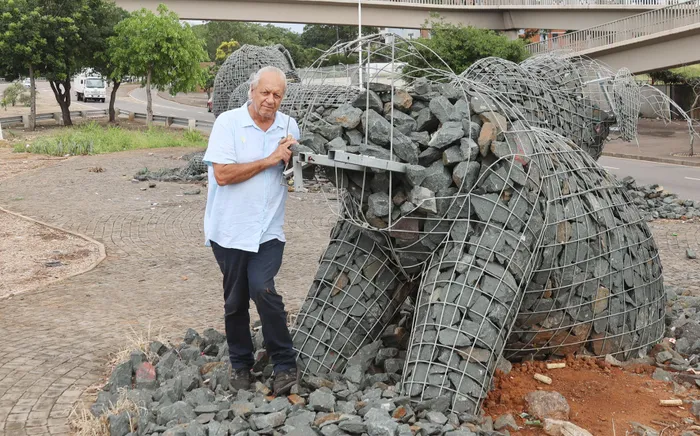
Andries Botha, Durban based artist, alongside one of the vandalised elephant statues at the N3 Warwick Junction in Durban. The statues might be moved to the Durban beachfront. Vandals had ripped open the framework, causing the rocks to spill onto the paving below.
Image: Tumi Pakkies
Durban’s elephant statues might move from Warwick Junction to Suncoast Beach following the repeated vandalism of its galvanised steel framework.
The framework of the four statues has been filled with rocks and has been situated alongside the N3 freeway at the Warwick Junction since 2010.
A recent visit to the statues showed that vandals had ripped open the framework, causing the rocks to spill onto the paving below. The area is also a well-known crime hotspot.
The statues were created by Andries Botha an internationally recognised Durban based artist. Botha constructed a nine-life-like family of elephants trailing along the coastlines in Belgium using recycled trees culled in Durban and bolted onto metal frameworks.
When he returned to Durban, the municipality approached him to create six elephant statues at the city entrances ahead of the 2010 FIFA World Cup. Due to time constraints, he could only create three.
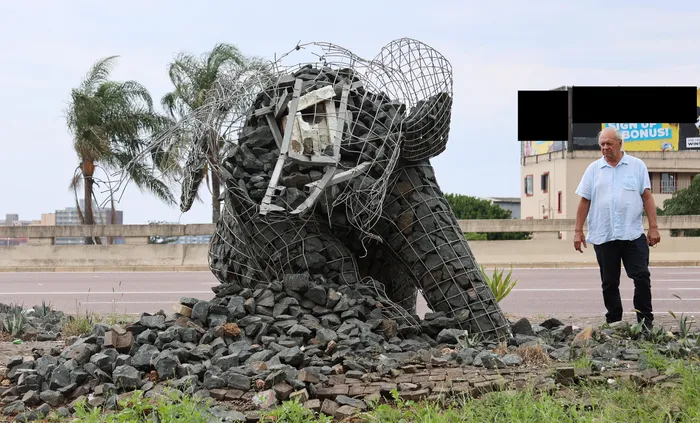
Andries Botha, internationally acclaimed artist, inspects one of the four vandalised elephant statues at the Warwick Junction in Durban. Vandals had ripped open the framework, causing the rocks to spill onto the paving below.
Image: Tumi Pakkies
Mandla Nsele, a municipal spokesperson, said management assessed the condition regarding measures to protect the statues from ongoing vandalism. Nsele said the decision was made to relocate the sculptures to a new secured site adjacent to the Suncoast Casino, where improved protection and security measures will be in place.
“Following this assessment, we concluded that the sculptures require repair and relocation to a secured site. This new location will allow for better pedestrian flow and public engagement as the current location is not audience friendly. The sculptures were insured at the time of installation and remain insured,” he said.
Botha said the municipality approached him about the relocation, but he disagreed due to the proximity to the ocean and the saline corrosive elements.. He said they statues would have to be rebuilt.
COURT BATTLE
In 2010, a politician halted the project on the basis that it resembled the logo of the Inkatha Freedom Party (IFP). Botha then turned to the Durban High Court to institute legal action against the politician and protect the contractual agreemment with the city.
In a separate matter, he applied to the court for a review of the municipality’s decision to stop the project, to remove two of the elephants and to turn the project into a big five design concept. A decision was reached out of court in 2013 that the R1.6 million project would continue with the addition of a fourth elephant.
HISTORY
Botha said the Warwick site was important because it is a dynamic African marketplace, and visually beautifying that space honoured different sectors of Durban. At the time, Botha said that the elephant was a metaphoric symbol to environmental ecology and contributing towards a green city.
He added that the area was part of the Durban and Berea elephant route and Warwick Junction was where the last elephant was killed during the colonial regime.
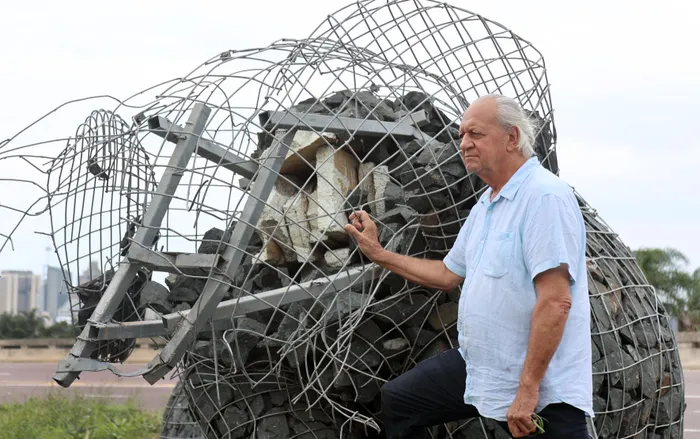
Andries Botha, internationally acclaimed artist, inspects one of the four vandalised elephant statues at the Warwick Junction in Durban.
Image: Tumi Pakkies
According to Botha, from Jameson Park, the elephants walked down what is now Florida Road towards the area now occupied by the Greyville racecourse to drink the sweet waters in the wetland. The elephants then walked along Warwick Avenue, up to the Berea’s Tollgate and along the Ridge to Jameson Park, where they spent the night.
“Protecting the elephants legally is a financial investment by the ratepayers of Durban. It is ratepayers' money. The city is legally obligated to protect and maintain these investments. The high court compelled the city to install security lights and surveillance cameras,” he said.
Botha felt that the continuous assault and deterioration of the statues are unique to Durban because so much of the ratepayers' infrastructure is mismanaged and neglected.
“Perhaps in their decaying state, it resembles the state of a city in crisis. Perhaps they should stay like that until such time we have a regime change to bring better financial management to Durban,” Botha said.
Botha said once this happens, he can revive the elephant statues to their former glory.
“Let us remember that people will come to South Africa and Durban to absorb themselves into our cultural legacy. The environment is our cultural legacy and needs to be protected,” he said.
POLITICS
The conversation around the future of the statues began at a recent municipal council meeting by DA councillor Andre Beetge. He said It was a project that once formed part of an ambitious vision to uplift and transform the Warwick and Durban precinct.
“The statues were left to deteriorate into the very state we see today. What was once intended as a symbol of creativity and renewal has become something very different — a lasting reminder of political interference, wasted resources, and failed governance,” Beetge said.
Mdu Nkosi, an IFP Councillor, said the issue of vandalism must be addressed because the municipality has the responsibility to take care of the city. He suggested that the city officials should have a discussion around the future of the elephant statues.