

Some eThekwini councillors said the municipality has consistently failed to demonstrate the ability to manage its existing fleet and spending R3 billion on new vehicles was a concern.
Image: ChatGPT
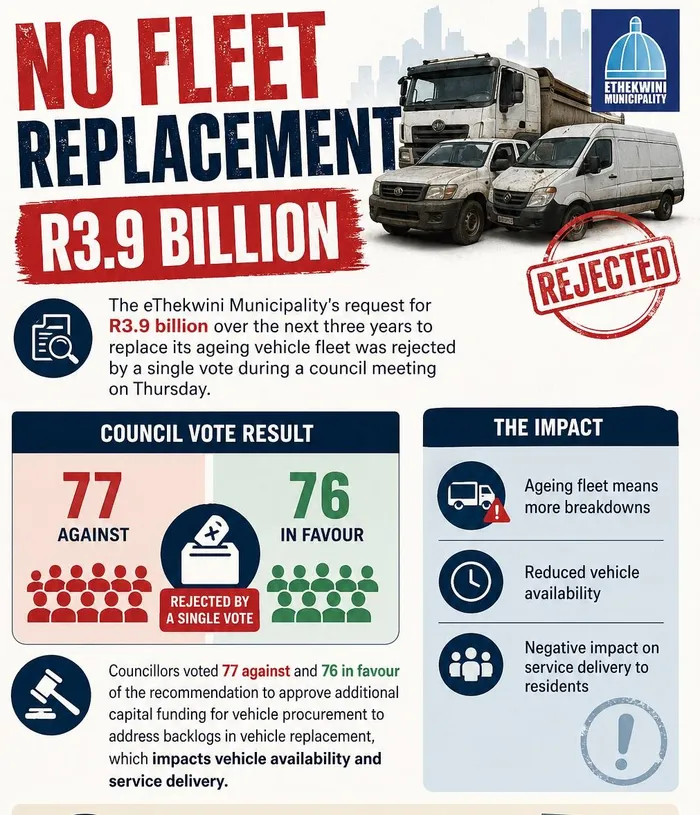
The eThekwini Municipality's request for R3.9 billion over the next three years to replace its ageing vehicle fleet was rejected by a single vote during a council meeting on Thursday
Councillors voted 77 against 76 in favour of the recommendation to approve additional capital funding for vehicle procurement to address backlogs in vehicle replacement, which impacts vehicle availability and service delivery. Also, the Executive Director of Finance needed to identify unspent funds and include them in the final adjustment reports.
The municipality has a fleet of 9,240 vehicles across all departments, with approximately 30% of the current fleet exceeding its replacement date.
The municipality stated that 1,000 vehicles need to be replaced annually, and historically, funding has not been available to address the vehicle replacement programme due to competing budgetary requirements from other municipal projects and service delivery mandates.
IFP Councillor Dr Jonathan Annipen described the decision as a major victory against wasteful spending and unnecessary expenditure on additional municipal vehicles.
He said the municipality has consistently failed to demonstrate the ability to manage its existing fleet.
“It was an irresponsible financial decision at a time when basic service delivery continues to deteriorate. This outcome represents not only a financial saving, but a victory for accountability, sound governance, and the prioritisation of residents’ needs. Numerous brand-new vehicles remain unused, standing idle and collecting dust due to the failure to license them,” Annipen said.
He said there is no coherent maintenance strategy in place, and that the municipality continues to experience high levels of theft, vandalism, and mismanagement of its assets.
“Ratepayers cannot and will not be treated as cash cows to fund this level of recklessness and poor planning. Communities across eThekwini continue to suffer the consequences of these governance and planning shortcomings. There is a persistent shortage of water tankers, leaving residents without reliable access to water, while parks and gardens remain neglected due to inadequate resources.”
He said that any additional funding must be directed toward improving frontline service delivery rather than expanding what he regarded as a dysfunctional and poorly managed fleet system.
In a report before the council, the municipality stated that it faces several challenges, including vehicles requiring major driveline repairs, such as engine overhauls.
A breakdown of vehicle capacity per directorate shows that the most vehicles are in water and sanitation (2,074), energy management (1,850), recreation and parks (860), cleansing and solid waste (858), Durban Transport (565), metro police (552), and security management (177).
Another statistical breakdown in the report on the fleet replacement cycle listed light delivery vehicles (12 years), motorcycles (10 years), buses (10 years), heavy trucks (15 years), and the mayoral fleet (five years).
A breakdown of the replacement cost per directorate is: fleet management and administration (R1.82 billion), energy management (R619 million), water and sanitation (R466.3 million), fire and emergency (R193 million), and waste management (R18.2 million).
Councillor Thabani Ndlovu, DA whip in the finance committee, said the Department of Water and Sanitation is among the hardest hit, requiring over 2,000 vehicles over the next three financial years.
The Energy Management Directorate needs more than 1,800 vehicles, while the Parks Department requires approximately 860 vehicles within the same period.
“These departments are at the frontline of service delivery. When they are under-resourced, communities feel the impact immediately. This municipality continues to fail to plan and budget for it?” Ndlovu said.
Asanda Nyembezi, EFF councillor in eThekwini, called for a proper audit and service plans for the municipal vehicles. He also noticed some vehicles parked at municipal depots with no plan for their use or recovery.
“Most councillors also use these vehicles. Stop abusing our budget. Put the money towards service delivery,” he said.