

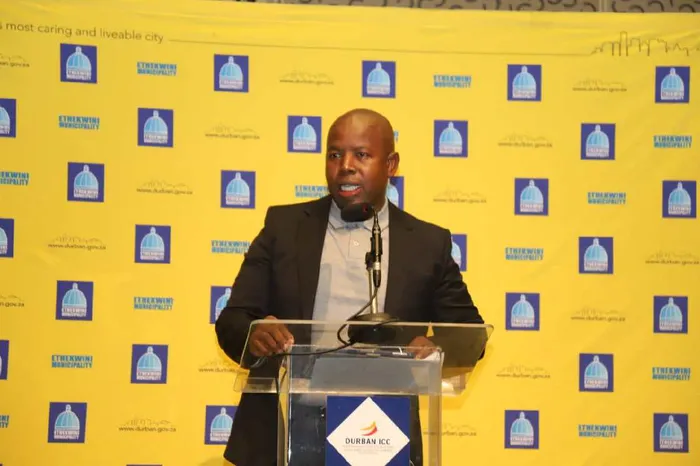
ANC Whip of the eThekwini Executive Committee, Nkosenhle Madlala, stated that the R690 million in Unauthorised, Irregular, Fruitless, and Wasteful Expenditure was not stolen or lost.
Image: File
The ANC in eThekwini said the R690 million Unauthorised, Irregular, Fruitless, and Wasteful Expenditure (UIFW) did not arise from fraud, theft, corruption, or services not rendered.
On Tuesday, the eThekwini Executive Committee (Exco) noted a report from the municipality’s finance committee on UIFW for the 2025/26 financial year, which is quarter 3 ended March 31, 2026.
The Exco committee was informed of non-compliance with the Supply Chain Management Policy (SCM), as well as the Local Government: Municipal Financial Management Act (MFMA), which resulted in the UIFW.
The finance committee raised concerns about a lack of contract monitoring, an internal culture of non-compliance, including line departments not attending Municipal Public Accounts Committee (MPAC) meetings to provide the required information.
A concern was also raised about the repeated findings and that there was irregular expenditure attributable to non-compliance with the local content production and content requirements, as stipulated in the Preferential Procurement Regulations (PPR) of 2017.
However, emphasis is being made that there were contracts that remain exposed to local content non-compliance, with the last contract anticipated to expire in January 2027.
Nkosenhle Madlala, ANC whip of Exco and chairperson of the Governance and Human Resources Committee, stated that at the centre of the UIFW matter is the municipality’s obligation to comply with the MFMA, SCM, and procurement prescripts governing local content and production requirements.
“The report makes it clear that approximately 80% of the irregular expenditure relates to historical non-compliance with local content requirements under the Preferential Procurement Regulations of 2017,” he stated.
Madlala said these were contracts awarded years ago under a regulatory framework that was subsequently declared unconstitutional and repealed by the Constitutional Court, leading to the promulgation of the PPR of 2022.
“Many of these contracts remained legally active continuation contracts. The municipality could not simply abandon infrastructure, housing, roads, electricity, and water projects midway without exposing the city to greater financial losses, legal disputes, service delivery collapse, and possible claims against the municipality.”
The report demonstrates that progress is being made in reducing exposure to these legacy contracts.
According to Madlala, from an initial 276 identified contracts, 258 have already expired, leaving only 18 active contracts on April 1, 2026.
He said the ANC further notes that the municipality has strengthened controls to curb future UIFW expenditure, including:
Madlala said these interventions demonstrate institutional commitment toward improving governance and strengthening compliance.
“The ANC supports the principle that consequence management must apply where negligence, misconduct, or deliberate non-compliance is identified. This is important because accountability and governance must go hand in hand with service delivery.
“We must also guard against creating the false public impression that all irregular expenditure automatically means money was stolen or lost. In municipal finance terminology, irregular expenditure primarily relates to non-compliance with prescribed procedures. Each case must, therefore, be investigated on its own merits to determine whether there was value for money, whether services were delivered, and whether any losses occurred.”