

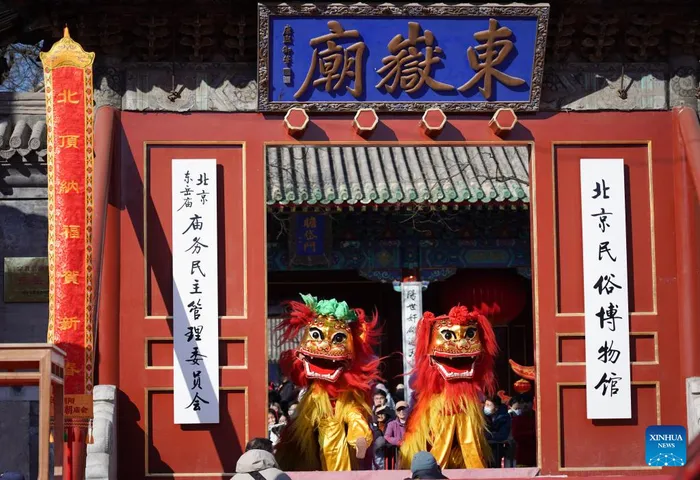
Artists stage a lion dance performance at a temple fair in Beijing, China. Temple fairs opened here, celebrating the Spring Festival and presenting visitors with traditional dances, lion dances and delicious food.
Image: Xinhua
Twenty-one years ago, Wei Shouyi, a migrant worker in Foshan, south China’s Guangdong Province, endured an 18-hour battle against the elements as he joined a massive, wobbling armada of hundreds of thousands of workers making the long journey home for the Chinese New Year on motorbikes.
Today, Wei’s 700km journey to his village in south China’s Guangxi Zhuang Autonomous Region is much more convenient. Behind the wheel of his own car, he cruises along smooth expressways, cutting his trip home down to just six hours.
“In 2004, a dozen of us from the same village would gather our motorcycles and ride together. It was a mind-boggling sight as well as exhausting,” said Wei, 44.
“Since I bought a van in 2010, and later a car, the motorcycle has become a memory of the not-so-distant past. In my village, no one rides back from Guangdong anymore. Nearly everyone drives.”
The evolving travel experience of Wei mirrors a greater transformation across the country. As China kicked off the Spring Festival travel rush on Feb. 2 this year, the world’s largest annual human migration is expected to generate a record 9.5 billion inter-regional passenger trips during the 40-day period running from Feb. 2 to March 13.
Yet, the story is no longer one of peril and desperation. An increasingly expanding transport network has reshaped the Chinese dream of “going home.”
In 2013, the sheer volume of homecoming motorcycles reached its peak, with 1.1 million trips recorded in Guangdong alone, where most labour-intensive factory work was concentrated. These workers, unable to secure scarce train tickets or afford air travel, took to the national highways.
Today, those roads are far less crowded with motorcycles. At a national highway exit in Wuzhou, which once served as a mandatory checkpoint for motorcycles entering Guangxi during chunyun, police officer Zou Dan has noticed a striking change.
“You only see a few scattered motorcycles now, and they are mostly people living right on the border of the two provinces,” said Zou. “Our focus has shifted entirely to managing the massive flow of private cars on the expressways.”
This shift is largely driven by a surge in private vehicle ownership and a transition to clean energy.
According to Huang Guoxun, deputy head of the transport department of Guangxi, new energy vehicles (NEVs) are leading the self-driving trips. In Guangxi, NEV travel is expected to jump by 72.2% this year, making up a fifth of all highway traffic, during the Spring Festival travel rush.
While the roads are crowded, the railways remain the overarching theme of the Spring Festival migration.
China’s total operating railway mileage nationwide has increased from 146 300km to 165 000km during the 14th Five-Year Plan period (2021-2025). From 2021 to 2025, China’s operating high-speed railway mileage increased by 32.98% from 37 900km to 50 400km, making the country home to the world’s largest high-speed rail network.
For many, the high-speed rail is the great equaliser. This year, China’s national rail authorities are expected to handle about 540 million passengers.
At the same time, the “green trains” – a traditional nickname for old-style Chinese passenger trains that have carriages typically painted green with yellow stripes – are still in operation in the high-speed railway era, providing a cheaper and more convenient alternative for passengers going to and from some smaller stations during the busy Spring Festival travel rush.
Xinhua