

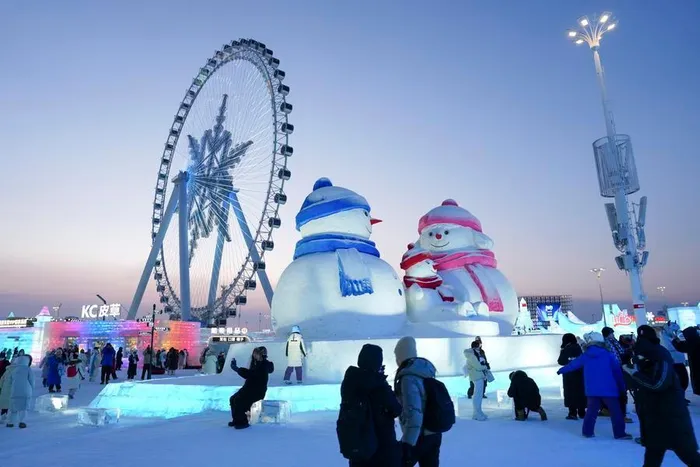
People visit the Harbin Ice-Snow World, the world’s largest ice-and-snow theme park, in Harbin, northeast China’s Heilongjiang Province.
Image: Xinhua
For many Chinese people, the Year of the Horse began officially with the opening notes of China Central Television’s (CCTV’s) “Spring Festival Gala”. This week, the annual cultural offering spread beyond Beijing, with secondary locations hosting stages in four other Chinese cities.
These cities are Yibin in south-west China’s Sichuan Province, Harbin in the north-eastern Heilongjiang Province, Hefei in the eastern Anhui Province, and Yiwu – probably the most familiar location for international viewers, famed as the “world’s supermarket” – in east China’s Zhejiang Province.
“Their selection signifies China’s economy advancing across multiple sectors and transitioning towards high-quality development,” said Wang Ying, a researcher with the Academy of China Open Economy Studies at the University of International Business and Economics.
Yiwu’s selection was a nod to how far the city has progressed from its beginnings as a roadside market – a journey which can be traced through families like Qian Rourou’s.
As work for the holiday intensified, Qian, general manager of the Zhejiang Xiaohuoban Cultural Creativity Company, was busy planning the opening of a third store in the Global Digital Trade Centre, which was the location of one of the “Spring Festival Gala” stages.
In 1995, her in-laws started the company with a 1-square-meter stall that sold stationery. A factory later followed, and today, the family operates six stores in the Yiwu International Trade Market, which is the world’s largest small-commodities wholesale hub.
“We’ve been in stationery and creative products for more than 30 years, across two generations,” Qian said. The company now employs its own designers and illustrators, develops original characters and builds virtual social communities around its brands. Roughly half of its products are sold overseas, reaching 132 countries and regions across Europe, the Middle East and Southeast Asia.
“What the gala shows global audiences is that Chinese creativity, aesthetics and brands are becoming part of everyday life,” Qian said.
Having opened officially in October 2025, the Global Digital Trade Centre marks Yiwu’s latest move in its transformation from a traditional wholesale model to a digitally integrated trade ecosystem.
More than 3 700 new merchants have since moved in, spanning eight emerging sectors like creative toys, smart equipment and fashion jewellery. More than half are young entrepreneurs, many of whom are running their own brands or sell IP-based products.
“There used to be a saying that Yiwu was just ‘a porter of goods,’” said Zhu Xingping, the centre’s deputy general manager. “Now we are moving upstream into design and R&D, and downstream into services like payments and digital logistics to create new value and improve efficiency.”
To tackle long-standing challenges ranging from design to overseas expansion, Yiwu has rolled out a suite of AI tools tailored to the small-commodities trade.
Merchants can now generate designs, create visuals and translate promotional videos into multiple languages in just a few clicks.
“China’s market is amazing,” said Alik Mufalisev, a trader from Georgia who has been sourcing hair accessories in Yiwu for 15 years. “Otherwise I wouldn’t keep coming back.”
Infrastructure and policy have helped sustain that momentum behind the scenes. In 2025, Yiwu’s total foreign trade surpassed 800 billion yuan for the first time, according to local customs data. Exports rose more than 24%, and imports over 32%.
More than 500km away in the rising innovation hub of Hefei, the night sky was lit up by a dazzling drone display featuring the city’s iconic landmarks and dynamic imagery of galloping horses. A Spring Festival Gala stage had been erected inside the Luogang Park, which was once the site of a civil airport.
The sprawling park is one of many application zones that Hefei authorities have opened for the testing of new technologies, products and business models, and technology innovation enterprises have clustered around the park.
Jia Yajun has worked at Aistartek (Hefei) IC Design Co., Ltd. since he graduated from the University of Science and Technology of China. The firm was founded in 2022 and specialises in vehicle-mounted vision technology.
Jia, who has turned down job opportunities in major cities, and his team have been busy developing core algorithms for intelligent cameras for the automotive sector.
“The gala has brought Hefei’s technological innovation capabilities into the global spotlight,” Jia said, highlighting the city’s robust sci-tech atmosphere, solid industrial foundations and support for entrepreneurs to translate technological achievements into industrial benefits.
Xinhua