

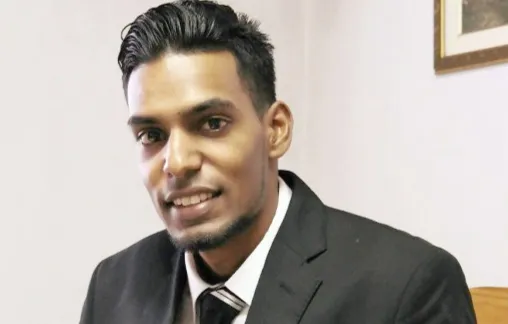
Previn Vedan is a lawyer, human rights advocate and activist based in Durban
Image: Supplied
Disability arrives uninvited.
Sometimes it comes with a birth. Sometimes with a diagnosis. Sometimes, as in my case, it comes violently, in a flash of steel, a spasm of pain and a slow, quiet aftermath that rewrites your life.
I was 30 years old when I was stabbed in my right hand during a robbery - the hand I used to write, sign court documents, to hand over title deeds, shake hands and ironically, protect others.
That single act of violence left me with a permanent disability and forced me to enter a world I had never truly seen before, the world of the disabled.
And let me tell you, South Africa is not kind to disabled people.
Recovery was not just medical. It was existential. Multiple surgeries later, I found myself unable to hold a fork or press a button at a boom gate. I had to learn how to write again.
But the hardest thing was not the pain, it was the stares. The long silences. The assumptions. The way people treat you as less.
At airports, I would lean awkwardly to reach the intercom with my left hand while drivers behind me hooted impatiently.
They could not see my gold glove or my scar tissue. They only saw delay. And I, like many disabled people, would just apologise, because explaining takes time and society does not give us that.
Sometimes I struggle to reach into my right pocket. People watch. They think I am hiding something. That I am slow. Suspicious. Or faking it.
That is what disability often feels like, constantly justifying your presence in a world not built for you.
There is a profound difference between being born disabled and becoming disabled. That is not to rank pain, it is to describe the experience.
When you are born with a disability, it becomes part of how you learn and grow. But when you have lived 30 years in a different body, with a different rhythm, a different confidence, losing that feels like mourning your former self.
After my injury, I avoided mirrors. I avoided public spaces. I questioned whether I would ever be seen as strong again, as a leader, a lawyer, a man. I worried whether women would still find me attractive. Whether the community would still trust me. Whether the world would still let me matter.I went from being a public figure to being a public ghost.
I was lucky to have supportive friends family who never left. A few leaders who reminded me that purpose does not live in a hand it lives in a voice and in a mission.
I had to accept myself again. Not as broken. But as changed. And that journey taught me something that too many people learn in isolation that disability is not a medical condition. It is a social reckoning.
According to Stats SA, about 7.5% of South Africans live with a disability. Globally, that number is closer to 15%. But in South Africa, disabled people remain among the most excluded in transport, employment, education, housing and public services.
We have policies on gender, for youth and LGBTI inclusion, but where is the national outcry for disability?
If you live in a government flat on the second floor with no ramp and you use a wheelchair, how do you get home?
If you are blind and want to write your matric what happens when there is no reader? If you are a disabled youth trying to access NYDA programs, what do you do when the venue is inaccessible and the forms are not available in accessible formats?
Section 9 of the Constitution promises equality. Section 10 promises dignity. South Africa has ratified the United Nations Convention on the Rights of Persons with Disabilities. The Employment Equity Act requires reasonable accommodation. The Promotion of Equality and Prevention of Unfair Discrimination Act (PEPUDA) prohibits disability discrimination.
But the reality on the ground tells a different story.
If a disabled grant applicant must queue for five hours with no seating, if a deaf citizen cannot access justice because no interpreter is present, if a job application says “must be able-bodied” then our rights mean nothing.
Words do not build ramps. Laws do not lift wheelchairs. Promises do not open doors. Disability is not charity. It is justice.
Inclusion is not sympathy. It is access. It is planning with disabled people in mind, not as an afterthought, but from the start.
As a nation, a thorough introspection at all levels and facets of life on how we treat, accommodate and coexist with disabled people is in urgent need. Disability is not a defect. The only real defect is in how society treats the disabled.
Let us never forget Black Coffee, Grammy winner, who lost use of his left arm in a taxi accident. Ntando Mahlangu, double-amputee Paralympian who flies across the track. Rosalie Abrahams, a deaf legal trailblazer.
Stephen Hawking, who explained the universe from a wheelchair and millions more, unnamed and unseen, who rise every day in a country that too often refuses to meet them halfway. Their lives are not exceptions. They are examples of what is possible when society stops obstructing and starts enabling.
Disability changed me. But it also gave me vision. I am still a lawyer. I am still a leader. Not because I never fell, but because I rose when it mattered most.
To every person living with disability, trauma, pain or shame, hear this, you are not defined by what happened to you.
Let us build a South Africa where no one needs to apologise for being too slow at a boom gate, for walking differently or for existing outside the lines, a South Africa that does not just talk about dignity but designs for it. Let us be the society that sees every body, every voice and every dream.
*The opinions expressed in this article does not necessarily reflect the views of the newspaper.
DAILY NEWS