
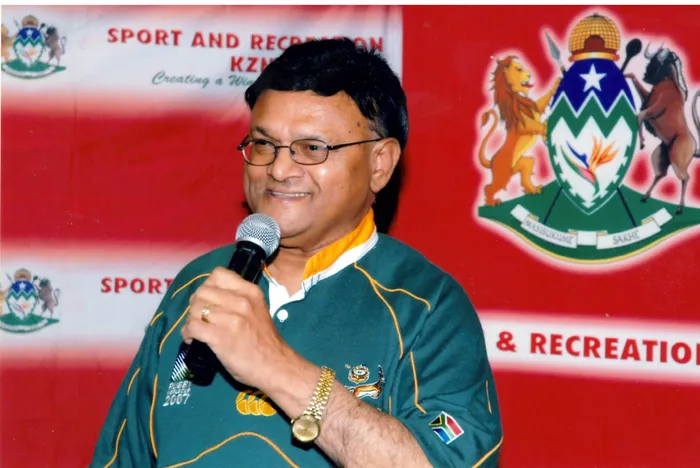
The days when politician Amichand Rajbansi was the KZN for Sports and Recreation in KwaZulu-Natal.
Image: Supplied
Recently, I had the distinct privilege of attending the premiere of the documentary The Bengal Tiger: The Rajbansi Story. The production is the long-cherished dream of his widow and parliamentary consort, Mrs. Shameen Thakur Rajbansi, who sought to immortalize the remarkable journey of her late husband, Mr. Amichand Rajbansi.
It was an inspiring and thought-provoking event, drawing a diverse audience of civic leaders, nonprofit stakeholders, religious leaders, professionals, and academics. The turnout itself spoke volumes of the man—popularly known as “The Raj”—who commanded the attention of statesmen without ever losing his “common touch.”
Remarkably, Mrs. Rajbansai herself has mastered this delicate art of balancing leadership with accessibility.
The film succeeds not merely as a tribute but as an honest historical account. It impressed with its integrity in portraying both the admirers who saw Rajbansi as a hero and the critics who opposed his political style.
This balance of perspectives allowed viewers to appreciate the full complexity of his legacy. The result was a refreshingly nuanced portrait of a man who, in his humanity, was like all of us, yet in his political and cultural influence, was undeniably a giant among us.
To contextualise, Rajbansi emerged during a turbulent era in South African politics, navigating a contested and divided landscape. He was a formidable voice for the Indian community at a time when Indians were caught in the paradox of being “too black to be recognised during apartheid, and now too white to be recognised in democracy.”
His leadership was defined by an unwavering commitment to securing representation for South Africans of Indian origin, while simultaneously advocating for principles of social justice and inclusivity. Though controversial at times, his career reflected a fearless pursuit of recognition and equity in a system that often marginalised his community.
What stands out about Rajbansi’s legacy is his ability to combine sharp political acumen with an instinctive connection to ordinary people. He could hold his own in discussions with global leaders, yet never lost sight of the lived realities of common citizens.
This duality ensured that his voice carried weight both in the corridors of power and in the streets where real lives were affected. His absence has left a void, particularly for South Africans of Indian origin.
As we mark 165 years since the first arrival of Indians in South Africa, the documentary forces us to confront an uncomfortable truth: the political influence of Indians has diminished in ways that compromise prospects of social justice and equality.
Despite the rhetoric of inclusiveness, South Africans of Indian origin often find themselves disadvantaged by legislative frameworks such as BBBEE, employment equity quotas, and preferential workplace policies.
While these measures seek to address systemic injustices, they frequently fail to acknowledge the layered marginalisation of Indians, who suffered exclusion both under apartheid and, paradoxically, in democracy.
Against this backdrop, The Bengal Tiger: The Rajbansi Story does more than memorialise a political leader; it sparks an urgent conversation about identity, belonging, and the promise of the rainbow nation. It challenges us to reflect on what true inclusivity should look like, three decades into democracy.
I wish to congratulate Mrs. Shameen Thakur Rajbansi for her courage and determination in bringing this project to life. In doing so, she has preserved not only the memory of her late husband but also an important chapter of South Africa’s political and cultural history.
Her efforts deserve to be applauded, and the film deserves to be widely viewed by all citizens committed to understanding the multifaceted role of the Indian community in dismantling apartheid and shaping democracy.
Dr Jonathan Annipen
*IFP Councillor in the eThekwini Municipality, IFP Whip on the Finance Committee – writing in his personal capacity
The Merebank Tamil School Society has once again proved itself to be a stalwart of Tamil Culture in our community.
Well done to Morgan Dasen, Yogin Nadasen and the team who have brought a variety of talent to the stage showcasing the rich heritage of Tamil arts and culture. The society's dedication to promoting Tamil culture is truly commendable.
Through their tireless efforts they have created a platform for local talent to shine, and for the community to come together and celebrate their heritage. The upcoming festival promises to be a spectacular celebration of Tamil culture, with a range of performances and activities that showcase the best of tamil arts.
This will definitely be a treat for all those that attend. I would like to extend my heartfelt thanks to the Merebank Tamil Society for their outstanding work in promoting Tamil culture in our community.
This is a wake up call to all other Tamil Society's we need to promote and encourage our youth participation in our culture, otherwise we are doomed. Sadly very little is done.
Merebank Tamil School Society Society is a true gem in our community and we are fortunate to have them. The saying is so true, "Aram seya virumbu" which means "Desire to do good" This quote emphasizes the importance of doing good deeds and living a virtuous life, which is a core aspect of Tamil culture.
Dhayalan Moodley
Mobeni Heights