

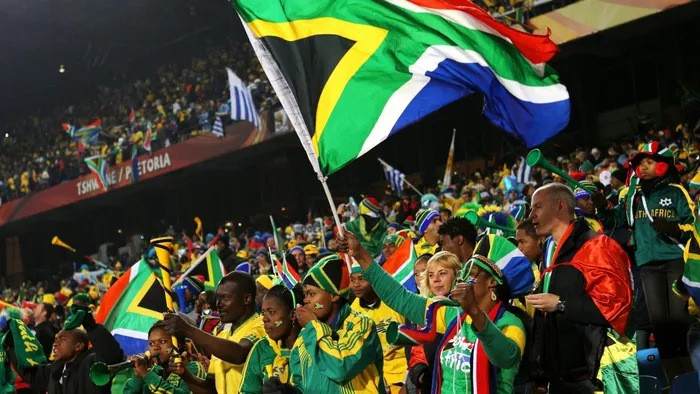
National team jerseys were celebrated, with South Africans proudly wearing the green and gold of Bafana Bafana. Sport is a great way to unify people, says one letter writer
Image: FIFA 2010
Recently India won the Asian Cup by defeating neighbours Pakistan in the final. Unfortunately at the end of the match the victorious Indians did not shake the hands of their opponents.
To add insult to injury, the Indian team refused to accept the prized President’s Cup. It is customary in professional and amateur sport for the shaking of hands between teams after a match. Shaking of hands is not just a greeting but also a gesture of mutual respect, acknowledgement and appreciation, rivalry notwithstanding, noting keen competitiveness and pride.
The actions of the Indians is, with respect, unsporting and unbecoming. It is common knowledge that over decades there has been rivalry, bitterness and strife between India and Pakistan, primarily the contentious border conflict.
It is hoped that in the future good sportsmanship will prevail with humanity and mutual respect restored. In the bigger picture and scheme of things. It is also hoped, through dialogue and necessary multi –state interventions, peace and harmony would become a reality in areas of conflict and strife, especially in the Middle East, Ukraine, Sudan, DRC and Haiti.
Sport is such a big unifying factor, Remember in 2010 when South Africa hosted the Soccer World Cup and the various times when the Springboks won the Rugby World Cup on multiple occasions how the country was united in joy, patriotism and pride.
Like Louis Armstrong (Satchmo) it will indeed then be a wonderful world and John Lennon’s words of the world living in peace in the song Imagine would come to fruition. Yes the noble and humble pen is indeed mightier than the perilous and crippling sword.
Simon T Dehal
Verulam
It would be wonderful if, 14 weeks after the protests started, we could report good news. But sadly not: the vigilantes are still continuing their completely illegal blockade of hospitals. Meanwhile police and Government officials stand at the sides failing to intervene and increasingly medical staff seem to be complicit in the actions.
The impact of this on ordinary families is seen daily at the Dennis Hurley Centre clinic since many of the rejected patients are coming to us in search of healthcare. Now that people’s supplies are running out, we are seeing more and more patients needing insulin for diabetes and anti-hypertension drugs which they would have usually collected from Addington Hospital. Without these, patients will quickly become sick and their lives will be at risk which is why we have been buying these medicines and dispensing them to those in need.
We are very grateful that so many of you have supported our appeal for extra funds for our clinic so that we can buy these medicines. We have received help from Aspen Pharmacare, the Batho Batho Trust and the Islamic Medical Association among others. But we are still in need of funds and would appreciate financial donations, large and small, if you can assist.
We have also been requesting messages of solidarity from religious leaders – and we mentioned before the statements from the Catholic Bishops’ Conference and from +Mandla Jwara, the Archbishop of Durban. We were honoured to receive a very strongly worded message from Archbishop Thabo Makgoba, very much in the spirit of his predecessor, +Desmond Tutu. He stated:
South Africans who are trying to prevent migrants seeking healthcare are not only defying our constitution, they are defying a biblical injunction. …Section 27 of the Constitution reads, ‘Everyone has the right to access healthcare including reproductive healthcare’; in the New Testament, we are told: ‘Do not neglect to show hospitality to strangers, for by doing that some have entertained angels without knowing it.’ (Hebrews 13:2).
The police ought to enforce the constitutional rights of all who live in South Africa, and make it clear they will not allow vigilantes to rule our streets and our health facilities. Not to do so is to act in dereliction of their duties. We are not a banana republic.
Some parts of Government have been trying to help. The KZN Department of Health has promised that they will find ways of distributing chronic medication to those who are reliant on them, though this initiative has still to actually begin. And the Office of the Premier responded to a request to intervene, though the meeting mainly seemed to prove that most departments felt unable or unwilling to do their duty.
Government officials are bound by an oath that they take to ‘respect, protect and fulfil’ the rights promised by the Constitution. We pray that they will do this and not descend to the populist politics that we see happening in so many other places around the world.
Meanwhile, the problem is spreading to other healthcare sites. Patients whom we have referred to other government facilities for much-needed treatment have been sent back to us having been refused admission by the hospital’s own staff. One comment made was how much quieter the hospitals are now – which of course was also true when the hospitals only treated people who were white! The role of a hospital is not to be quiet - it is to serve those it is mandated to assist.
Dennis Hurley Centre
Durban
The recent rhetoric from British politicians advocating against the acceptance of 'Indians' in the UK has ignited conversations that echo historical injustices. This controversial stance mirrors a broader trend in Western countries, particularly the United States, which has been perceived as increasingly hostile to individuals of colour, especially those with black and brown skin.
The residue of colonialism continues to influence contemporary politics, raising urgent questions about race, identity, and belonging in our increasingly globalised world.
Critics argue that the colonisers, having once spread their influence across continents without regard for the people who inhabited them, are now unwilling to embrace those they once deemed inferior. This hypocrisy is evident not only in immigration policies but also in military alliances, such as NATO, which, as some have noted, lacks representation from non-white countries within its ranks.
Drawing parallels to the Apartheid-era propaganda in South Africa, where the government demonised communism while suppressing black voices, similar narratives are being propagated today. The refrain of 'Communism is bad' used to justify actions such as military interventions is echoed in the rhetoric surrounding current geopolitical tensions, particularly regarding Russia and its interactions with Afro-Asian nations.
In the Middle East, Israel's military campaigns, often portrayed as targeted operations against Hamas, illustrate the ongoing struggle faced by countries marked by their ethnic diversity. The branding of Hamas as ‘perpetual terrorists’ reflects an Orwellian misuse of language reminiscent of how anti-apartheid rebels were labelled as terrorists by the apartheid regime.
The argument is that without the support of countries such as Cuba and the assistance of various liberation movements, South Africa might still be under the grip of institutionalised racism and segregation.
Looking back at the Bantustans in South Africa, one cannot ignore how they were designed to deny genuine autonomy while perpetuating poverty and disenfranchisement. Today, similar tactics appear to be at play in political negotiations involving nations like Palestine, where the imposition of ultimatums on leadership devoid of consultation raises alarms.
For many South Africans who may trivialise the complexities of global conflicts — referring to events like the Hamas conflict as mere entertainment — it is vital to remember the sacrifices made by those labelled 'terrorists' in the fight for freedom. The legacy of apartheid, where privileges were preserved for a select few at the expense of the majority, lessons remain deeply rooted in socio-economic divisions across racial lines.
The emerging narrative suggests that along with religion, race has become an all-too-familiar tool of division, used by the West to undermine solidarity among countries with shared experiences of colonisation.
A call for unity among black and brown nations appears crucial in countering the tactics of oppression exhibited by the NATO alliance and its partners. Only through solidarity can these nations hope to challenge the ongoing spectres of colonisation and oppression confronted in this modern era.
Ebrahim Essa
Durban
DAILY NEWS