

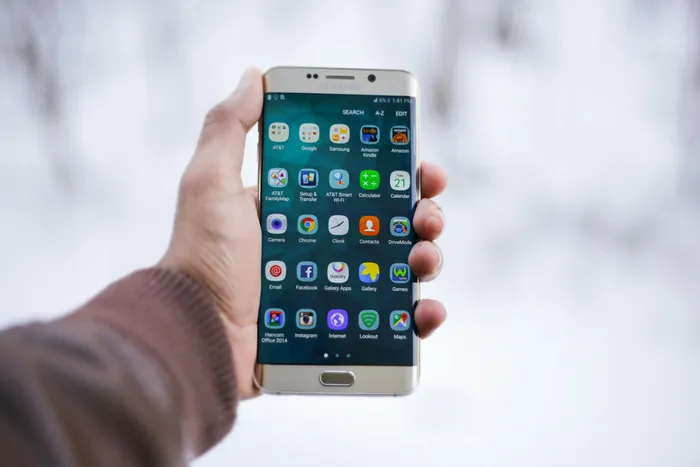
Too much time on their phones is not good for our children.
Image: Pexels
As a practising psychologist I have had countless conversations with colleagues including psychologists, psychiatrists and general practitioners about the growing crisis in children’s mental health. Again and again one issue rises to the top of every discussion: Excessive screen time.
Never in my life when I decided to study psychology did I imagine that one day I would speak about screen use 10 times a day. Yet here we are. It has become one of the most urgent and distressing topics in my consulting room. We now see children who spend more hours on screens than they do sleeping. Some report being online for up to 19 hours a day.
These children often struggle to sleep, eat poorly and find real-world interaction confusing or overwhelming. Their attention, emotions and sense of identity are shaped by a digital world that rewards comparison, instant gratification and performance.
Another serious concern is the sharp rise in autism spectrum diagnoses over the past few years. Of course there are children who genuinely meet the diagnostic criteria and who need proper assessment and support. But we are also seeing a pattern where children with extremely high screen exposure begin to show symptoms that resemble autistic traits: limited eye contact, flat affect, reduced reciprocal conversation, poor frustration tolerance and social withdrawal. If you think about it, it makes sense.
When a developing brain spends its formative years engaging mostly with screens rather than with people, social communication and emotional attunement will inevitably be affected. This is not true autism, but the functional outcome can look very similar. It is heartbreaking to see how preventable some of this may be.
What is even more concerning is that screen overuse does not only create new problems but also worsens existing ones. Anxiety, depression, attention difficulties, irritability and social withdrawal all increase when a child’s nervous system is constantly flooded by stimulation that the human brain was never designed to handle. This is not a normal activity for a developing mind. It is not natural for children to sit still for hours scrolling through content that hijacks their attention and emotions. Our brains were built for movement, touch, conversation and human connection, not for the endless dopamine loop of screens.
Schools, without realising it, have become part of the problem. Homework is posted on digital platforms. Class notices are sent to learners’ phones. Parents are directed to WhatsApp groups for updates. What happened to the homework book? What happened to sending a note home or allowing a child to take responsibility by writing something down? Children should be allowed to disconnect when they leave school. Home time should mean family time, a chance to rest, talk, play and simply be. Yet the expectation to stay connected has blurred every boundary between school and home life.
Every parent also carries responsibility. We cannot expect schools to carry this alone. Families need to set boundaries for device use and decide when screens are put away so that rest, presence and connection takes priority again. It is not easy, and many parents feel trapped in a system that demands digital participation, but we still have a say in how we raise our children.
This is not about being anti-technology. It is about restoring balance. It is about helping our children develop the skills and the inner calm that screens have begun to erode: focus, empathy, curiosity, imagination, patience and rest.
Our children’s mental health is paying the price for a system that has gone too far. We, as adults, have the power to change it. Let us not allow our children to one day look back and resent us for standing by while their childhoods disappeared behind a screen.
If we want a generation that is emotionally healthy, curious and connected, we must give them back what technology has quietly taken away: their childhood. | (Name withheld) A concerned psychologist
Xenophobia in South Africa is utterly unacceptable and must be addressed immediately. We have reached a point where statements and pledges are insufficient; we demand concrete actions from the government, the Human Rights Commission, and the Equality Court.
Their focus on gender issues while ignoring the rise in xenophobia is troubling. Xenophobia is being used as a political tool by the African National Congress (ANC) and the Patriotic Front. The ANC can deny this, but the reality is that xenophobic attitudes are rooted in unresolved tribal divisions among Black South Africans.
Certain cabinet ministers, such as Aaron Motsoaledi and Phophi Ramathuba, have even exploited these sentiments for their political gain, dismissing the suffering of traumatised foreigners. Minister Ramathuba’s rise to Premier of Limpopo was overshadowed by the political exploitation of a sick Zimbabwean woman.
Her nationality and sad state of being unwell were insulted in a manner that made the humiliation suffered by Black people before 1994 seem minor by comparison. If the government genuinely aimed to combat xenophobia, it would prioritise raising awareness about these issues with the same intensity it applies to gender-based violence and LGBTQ+ rights. The roots of xenophobia are deeply embedded in the psychological and physical barriers that have developed over centuries within Black urban communities.
These communities cannot continue to reflect the “divide and rule” tactics that characterised racial oppression. The outcome is a troubling environment that enables violent attacks against Black foreigners. It is entirely unacceptable for Black South Africans to rationalise taking the law into their own hands as a supposed constitutional right, fuelled by an evil hatred of their own race. If we begin to accept this reasoning, it sets a dangerous precedent for the government to justify retribution against those who have committed injustices in the past, all taking place on the streets instead of in the courts.
We urge the Human Rights Commission to bring the issue of vigilantism before the Constitutional Court. As a signatory to UN human rights treaties, South Africa must address these concerns seriously. Additionally, we call on Israel to take action at the International Court of Justice (ICJ) on behalf of foreigners, as severe human rights violations are ongoing in a country that claims to champion human rights while grappling with sexual violence, poverty, and xenophobia.
Organisations like Afriforum are already pushing for sanctions against South Africa, exploiting claims of white genocide.
African nations must hold our government accountable and consider sanctions and boycotts, especially against those who harass Black African foreigners while making despicable remarks like “We don’t need Africa, and as long as whites are safe, we won’t starve like Zimbabwe, so they must leave!”
This is a disgusting mentality! How can other races respect us when they see Africans – among the most dehumanised in history – treating each other poorly while being affectionate toward those who despise them?
This xenophobic nonsense must come to an end. | Khotso Moleko Bloemfontein