

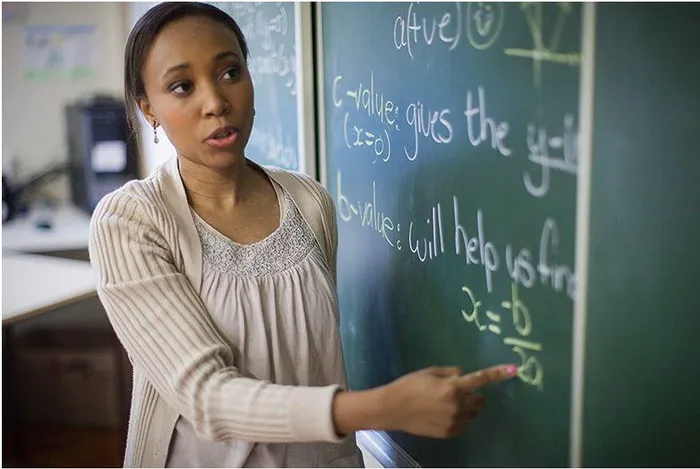
Teaching: An often overlooked, unforgiving but vital job that shapes the minds of the next generation. We owe so much to their selfless efforts.
Image: nwlc.org
As our students begin their matric exams, it is fitting that we pause to honour the tireless work of our teachers.
A teacher is a beacon in the darkness – a source of courage, strength, and wisdom guiding young minds toward a brighter future.
Teaching is a noble profession, one that shapes character and builds nations. Parents give life to a child, but teachers mould that life into purpose. They dedicate their hearts, minds, and souls to nurturing scholars and preparing them for success.
Their influence, as Henry Adams once said, “affects eternity; no one can tell where it stops.”
George Bernard Shaw aptly remarked: “The sole hope of human salvation lies in teaching.”
Indeed, teachers are the cornerstone of civilization. They are our unsung heroes – multitasking, underpaid, yet steadfast in their mission to educate and inspire. Every leader, thinker, and innovator was once guided by a dedicated teacher who believed in them.
During these challenging times, teachers continue to shoulder immense responsibility, striving to create normalcy amid uncertainty. They remind our children that the pen is mightier than the sword, and that knowledge remains the most powerful weapon of all.
As we near the end of 2025, let us salute these extraordinary men and women for their patience, sacrifice, and service. Without teachers, no society can flourish.
A grateful nation owes them its deepest respect and eternal gratitude. | Farouk Araie Benoni
I fully acknowledge that violence against women and children remains one of South Africa’s most urgent and painful challenges. It is a national crisis that demands co-ordinated, long-term action from every part of society.
Yet, while strategies to combat gender-based violence (GBV) are essential, they will not succeed unless we address a more fundamental problem: men’s disposition towards violence itself. Any approach that begins with GBV as the starting point risks treating the symptom rather than the cause.
The harsh truth is that men in South Africa are overwhelmingly responsible for violence in all its forms, not only against women and children, but also against one another. According to the SAPS 2023/24 crime statistics, more than 80% of murder victims were men, and men were also the main perpetrators.
The South African Medical Research Council reports that the country’s male homicide rate is about seven times the global average. Daily, men physically assault, stab, shoot, and kill each other.
This relentless violence has become so normalised that it seldom makes the news unless the death toll is unusually high. Male aggression has been woven into the social fabric, seen as an unfortunate but inevitable part of life. This reality suggests that our strategies need to change direction. Instead of positioning women and children as the central focus, as those who must be shielded from violence - we should place men at the centre of the solution.
The goal should be to understand and transform the roots of violent masculinity: how boys are socialised, how power and control are expressed, and why violence is seen as a measure of manhood.
We need large-scale education initiatives that promote empathy, self-regulation, and non violent conflict resolution. Programmes that challenge harmful notions of masculinity, while offering positive role models and safe spaces for men to express vulnerability, are essential. Community-based rehabilitation and accountability mechanisms must be strengthened to interrupt violent behaviour before it escalates into GBV.
Ultimately, the fight against gender-based violence will not succeed if we do not first tackle the broader culture of male violence. South Africa cannot hope to protect women and children while men remain trapped in cycles of aggression and trauma.
The time has come to confront this uncomfortable truth and reshape our strategies accordingly. | Khwezi Nala Bonani Cape Town
Busisiwe Mavuso gives praise to the FATF in her letter, What Our Fatf Exit Teaches Us About Effective Reform, in your sister paper, The Star, October 28.
The following example puts a big question mark over this claim.
On a public holiday, a client of Nedbank steals a large sum of money from another Nedbank client and uses this money to by Bitcoin. Gone. No trace.
Nedbank make no attempt to contact their fraudulent customer to reclaim the stolen money.
The Ombudsman is not interested in the matter. Reporting the crime to SARS, the SARB, the FIC, the FSCA, the HAWKS is not only very difficult, one gets no response.
And SAPS has had no success in apprehending the fraudster, showing no capacity to do so, and simply closing the case. So much for Fica. What then should we be celebrating?
As I have mentioned to Ismail Monomiat, our FATF representative – Harry Scherzer, CEO of Future Forex, makes the broad statement that, “South Africa must develop a clear policy to facilitate the movement of money in and out of the country through crypto assets”.
He doesn’t seem to appreciate how easy it is to do this. A phone call to Binance would tell him.
The FATF have unfortunately reached the wrong conclusion and without proper inspection. | C Richards Craighall Park
Recently, we have seen destruction by students at universities in one form of protest or another.
It seems the only form of expression is to destroy if we don’t get our way and this does not bode well for the future of our country.
What is needed are young leaders who can add value to our society. In general, this is the biggest challenge we face in our country if not the continent. Student leaders should be hands-on and innovative instead of just demanding, protesting and destroying. If there are safety issues at an institution, help to work with authorities and get an electric fence, safety plans or security in place. At many institutions there are students who can’t afford to buy food.
Do we have leaders who can facilitate or start food or soup kitchens?
Are there leaders who can preserve our heritage and start up fundraising events for students in need of funding or work with businesses who want to contribute in this field?
Right now, this is the type of leadership that is needed in our country, otherwise the future will become bleak for future generations.
The type of leaders that we see are the ones who are too charismatic, arrogant, self-serving and can’t wait to get their hands on the riches of this country.
Leadership should be a calling to help those in need. | J Hendricks Bellville
DAILY NEWS