

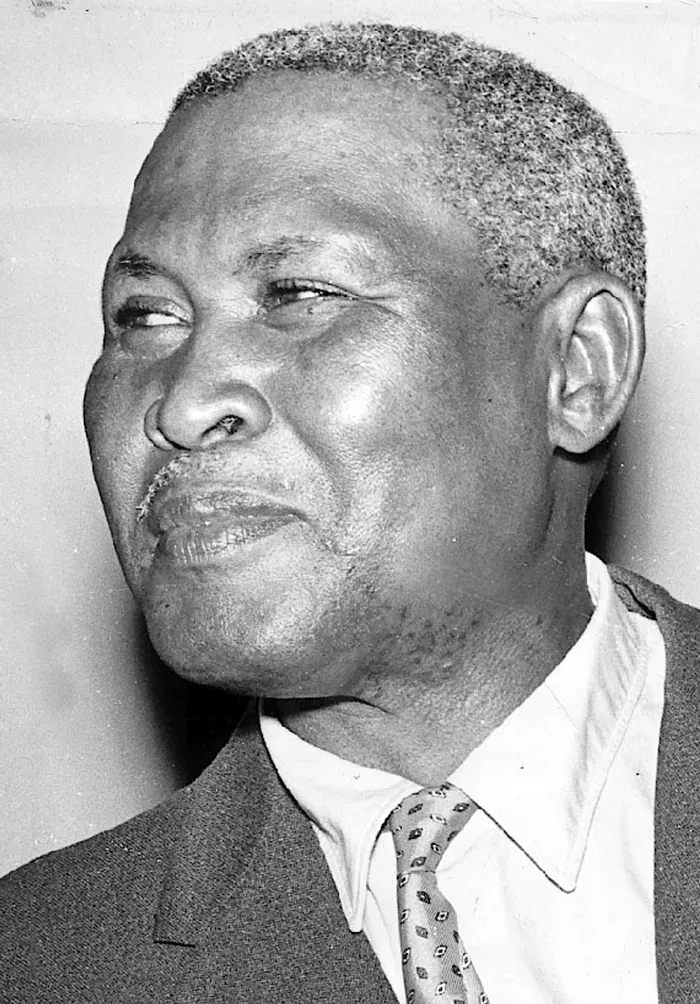
Nobel Peace Prize winner, Inkosi Albert Luthuli. They could not hide the truth about his death.
Image: Supplied
Sir,
The brutal and bloody massacres in Sudan by outside forces amount to a holocaust of frightening proportions.
The magnitude of these killings – the obliteration and extermination of the Sudanese population – is visible even from satellite images. Mutilated and dismembered bodies in their thousands dot the landscape of the killing zones. Starvation and famine of biblical scale threaten the survivors, while disease takes its toll. Millions face death as humanity itself seems to have ceased to exist.
Military powers are dismantling civilisation, destroying entire regions in a macabre strategy of domination. Scorched-earth tactics are being used to reshape geography and subdue populations, with chilling consequences for peace in this strategically vital area.
Across the world, military conflicts rage unabated while the United Nations appears powerless to intervene. War seems to have become the human condition, while peace remains a vague utopian dream. US General Douglas MacArthur once warned at the end of World War II: “Military alliances, balances of power, league of nations – all in turn failed, leaving the only path to be the way of the crucible war. The utter destruction of war now blacks out this alternative. We have had our last chance. If we will not devise some greater and more equitable system, our Armageddon will be at our door.”
It is sobering to realise that in just the last 65 years – barely a tick of the cosmic clock – humanity has developed, deployed and used weapons capable of omnicide. It took nearly 15 billion years for the universe to evolve to the point of human self-awareness, yet that awareness could be obliterated in a blinding flash of thermonuclear war and the nuclear winter that would follow.
Sanity demands that the crises in Sudan, Gaza and Ukraine be resolved urgently through dialogue and diplomacy. A culture of naked aggression can only lead to anarchy and chaos, destabilising the entire planet. | Farouk Araie Benoni
Dear Sir,
It’s become a tired cliché that education standards in our country are poor compared to the rest of the world.
But this claim needs closer analysis.
Having taught Mathematics, History, Geography, and Natural Science at both primary and high school levels (up to Grade 8), as well as Physical Science at matric level, I can say confidently that our curriculum content is largely of international standard. The real problem is that many learners cannot cope with these standards – and even qualified teachers struggle to convey basic concepts, through no fault of their own.
We cannot call our standards ‘low’ simply because our learners perform poorly. Perhaps the mismatch lies between expectation and ability.
A major factor, I believe, is the lack of motivation among parents. With so many educated and skilled South Africans unemployed, many parents have lost faith in the value of education. That hopelessness filters down to their children, who begin to see no point in trying.
Add to this the daily burdens – transport costs, uniforms, traffic, weather, and domestic tension – and education becomes just another struggle for survival. For the poor, it’s even worse.
Then come the screens – video games and mobile phones – which have replaced books entirely. Libraries stand empty except during exams.
Teachers face overcrowded classes, rote-driven syllabuses, endless marking, and bureaucracy that kills creativity. Learners are pushed through grades to inflate pass rates, while politicians chase the illusion of a 100% matric success.
The result? Questions without answers – and a system quietly collapsing under its own contradictions. | Ebrahim Essa Durban
The judgment delivered by Judge Nompumelelo Radebe on the death of Nobel Laureate Chief Albert Luthuli vindicates my many press articles asserting that his death lay at the hands of the apartheid regime of the day.
This profound verdict by Judge Radebe now stands as a living memorial to the victims of that heinous system. From our collective memories of immense suffering and humiliation under institutionalised racism, we must now forge unshakeable bonds with all decent people to ensure that never again will the world stand silent in the face of such atrocities.
The truth has finally emerged – after 58 painful years. As Winston Churchill reminded us: “The truth is incontrovertible, malice may attack it, ignorance may deride it, but in the end, there it is.”
We must never again be bystanders or perpetrators when crimes against humanity are repeated. Apartheid was such a crime.
And, in the words of Elie Wiesel, “For the dead and the living, we must bear witness.”
“Never again” is not a slogan – it is a sacred promise to defend our hard-won, non-racial democracy.
The final judgment on the death of stalwart Chief Albert Luthuli has been delivered. Death could not conquer this martyr, for he lives on in the hearts of the masses he fought and died for.
As Soren Kierkegaard wrote: “The tyrant dies and his rule is over; the martyr dies and his rule begins.” | Farouk Araie Benoni
The tobacco market in South Africa has effectively gone underground.
The sales ban during the pandemic, coupled with ever-rising sin taxes, has driven most tobacco trade into the shadows – costing the state billions.
When Finance Minister Enoch Godongwana recently floated a 2% VAT hike, much of the outrage centred on government waste and corruption. Yet few questioned the relentless increase in excise duties on tobacco – a policy that has backfired spectacularly.
In the 2024 financial year alone, tax revenue on cigarettes fell by 8.4%.
While SARS tried to keep taxes aligned with inflation, illicit traders flourished. Before the pandemic, untaxed cigarettes made up 22% of the market. After the ban, they surged to 75%, where they have largely remained.
Today, about 70% of cigarettes sold in South Africa are illegal, costing the country an estimated R28 billion per year – or R100 million every day. That lost revenue could pay 100 000 teachers, nurses, or police officers, or fund the building of 20 hospitals.
The pandemic ban proved what prohibitionists refuse to see: Outlawing demand does not kill it – it just shifts it underground. Once consumers experience cheaper, tax-free cigarettes, they rarely return to legal products.
If the government truly wants to sustain revenue and control tobacco, it must invest in enforcement, tracking and tracing, and equitable policy. Otherwise, the legal industry – and honest taxpayers – will keep paying for a system that rewards lawbreakers. | Ivo Vegter Free Market Foundation
Ebrahim Essa, in How Will The Modern Heroes Be Remembered? claims the RSS “catalysed” India’s partition, with Jinnah driving the agenda.
I wish to remind him of my earlier letter, Antipathy Against India, which pointed out that the two-nation theory is rooted in Quranic teaching.
Dr Tanveer Hussain of Pakistan explains that humanity is divided into believers (Muslims) and non-Muslims, a distinction BR Ambedkar described as “inexorable.”
Karl Marx, in 1854, also noted that Islamic legislation reduced diverse peoples into two nations. How, then, can the RSS be blamed for “catalysing” a division that has existed for 1 400 years?
The RSS has its own achievements, though they cannot all be listed here.
Prime Minister Modi, however, will be remembered for remarkable accomplishments: Operation Sindoor, establishing that acts of terror would be treated as acts of war; vaccinating a billion Indians twice in one year, saving millions of lives; providing 300 million LPG connections, reducing household pollution and infant mortality; abrogating Article 370 to integrate Kashmir and restore civil rights to marginalised groups; building 112m Swachh Bharat toilets, improving hygiene and dignity; issuing 370m Ayushman Bharat health insurance cards; and building 50 000km of highways, driving economic growth.
Attributing India’s partition to the RSS ignores centuries-old religious and ideological foundations, while Modi’s achievements have transformed the nation. | Kamini Prakash Umhlanga
DAILY NEWS