
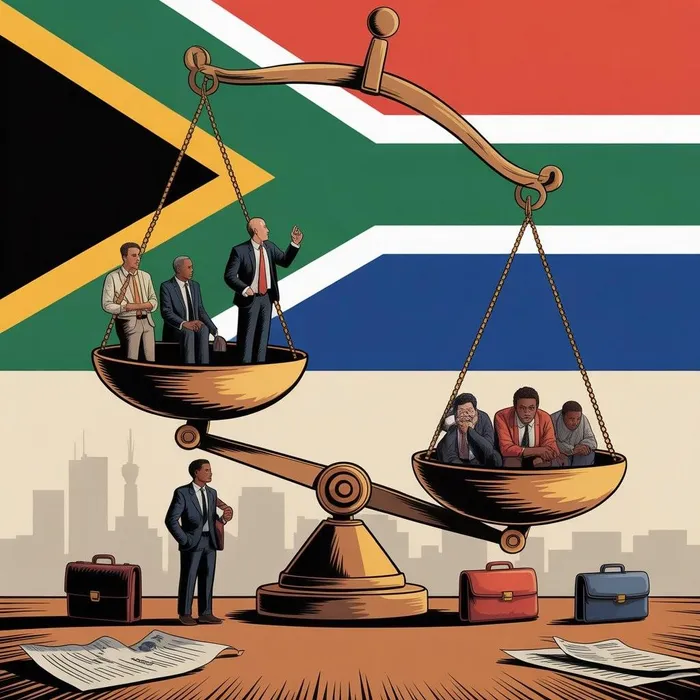
BEE is a con that benefits only the wealthy elite and does nothing to help poverty-stricken South Africans.
Image: Ideogram.ai
SIR,
South Africa’s new Expropriation Act, signed into law by President Cyril Ramaphosa in January, gives the state the power to seize private property without paying compensation.
It’s being sold to the public as a step towards “justice” and “transformation,” but in truth, it strikes at the very heart of our Constitutional order and undermines the protection of property guaranteed by section 25 of the Constitution.
The Act introduces the concept of “nil compensation” – a linguistic sleight of hand that treats the absence of payment as if it were a form of compensation. Section 25 requires that an amount of just and equitable compensation be paid when property is expropriated. “Nil” cannot possibly meet that definition. It’s not an amount, and it’s certainly not compensation. It’s confiscation dressed up as reform.
Supporters of the Act justify it by invoking South Africa’s painful history of dispossession – the Natives Land Act of 1913, the Group Areas Act, and countless other laws that robbed black South Africans of their homes and opportunities. That history is real and must be reckoned with. But it does not follow that the state must now have unlimited power to take property without compensation, least of all in a country where government corruption and inefficiency are chronic.In fact, the public appetite for land reform is far smaller than political rhetoric suggests.
According to research by the Institute of Race Relations, only 1% of South Africans cite land reform as a top national concern. What people overwhelmingly want are jobs, better education, and the chance to build wealth – not to be relocated to under-resourced rural land in the name of ideology.
This disconnect exposes how land reform has become more of a political slogan than a genuine social policy. The state’s own priorities make that plain: next year’s land reform budget is about R5 billion, compared to R12 billion for sports, arts, and culture. Meanwhile, corruption and waste have cost taxpayers an estimated R1.5 trillion between 2014 and 2019. That money alone could have paid market-based compensation for nearly every hectare of desirable agricultural land in the country.
Hostility to property rights is not new. Over the past three decades, the government has steadily extended state control over assets – nationalising water resources under the National Water Act, minerals under the Mineral and Petroleum Resources Development Act, and undermining investor protections through the so-called Protection of Investment Act. These measures have eroded confidence, constrained growth, and discouraged both local and foreign investment.
When property rights are weak, democracy suffers.
Property ownership gives citizens independence, a sense of stake, and the ability to resist political overreach. When everything belongs to the state, the state decides who may use what – and under what conditions. We’ve already seen where this leads: the Gauteng government cancelling events at Constitution Hill for political reasons, or municipalities denying venue use to those with unpopular views.
Property under government control becomes a tool for political enforcement.This is why, in all successful constitutional democracies, the bulk of property is privately owned and legally secure. Countries like the United States, Switzerland, and Singapore treat expropriation as a last resort, with full or above-market compensation to ensure fairness and trust. The contrast with South Africa’s approach could not be starker.
The consequences are already visible internationally. The United States has sharply criticised the Act. Aid has been suspended, and South Africa’s AGOA eligibility is under review. Investors are uneasy, and our alignment with regimes like Russia and Iran does not help our credibility as a stable, rights-respecting democracy.It doesn’t have to be this way. South Africa can pursue constitutional land reform without shredding property rights. The restitution programme has a proven track record: of over 64 000 settled claims, nearly nine out of ten claimants chose financial compensation over land, proving that most people seek empowerment and opportunity, not ideology.
If the government truly wanted progress, it could start by releasing the 2.5 million hectares of underutilised land it already owns to deserving citizens, rather than confiscating private property. It could replace the current Act with an Expropriation Control Act that entrenches market-based compensation and ensures that owners are made whole. The Institute of Race Relations’ Right to Own Bill offers another practical, rights-based blueprint.Land reform that respects property rights can uplift communities, strengthen democracy, and restore investor confidence. Confiscation without compensation will achieve the opposite.
South Africa must decide whether it wants to be a nation of owners – or subjects. | Martin van Staden Free Market Foundation
Sir,
When the ANC led government introduced BEE a few years ago, it had good intentions.
The idea was to deracialise the economy and empower blacks, who have been – and still are – disempowered economically for a long time. Introducing BEE was the right move.The second powerful political party in the land, the DA, is opposed to BEE in its current form. It has made a proposition that the black empowerment policy be reconstructed. The DA says it’s not opposed to BEE, it just need tweaking. Nice words.
That said, let’s take the DA out of the BEE debate. Is BEE benefiting blacks, including women? Who is benefiting from BEE? Is it blacks? The answer is no. It is mostly the politically connected individuals that benefit from this policy. So, it is not benefiting the broader black society.
When you look at the people who are defending BEE, they are the beneficiaries of this policy: The black fat cats. I understand why they are defending it, they stand to lose big time. However, the truth is that this policy is not benefiting the majority of blacks, only a select few.
On the other hand, BEE is benefiting whites, who are using blacks as a front. They put the names of blacks in the company papers or letterheads and pay them peanuts. No one is talking about that. Lastly, I’m concerned that the majority people of in this country are not participating in this important debate. Yet it is about them. They are allowing black fat cats to be their voice yet they are serving their own interests.
Scrap BEE, it does not benefit blacks. | Thabile Mange Cape Town
DAILY NEWS