

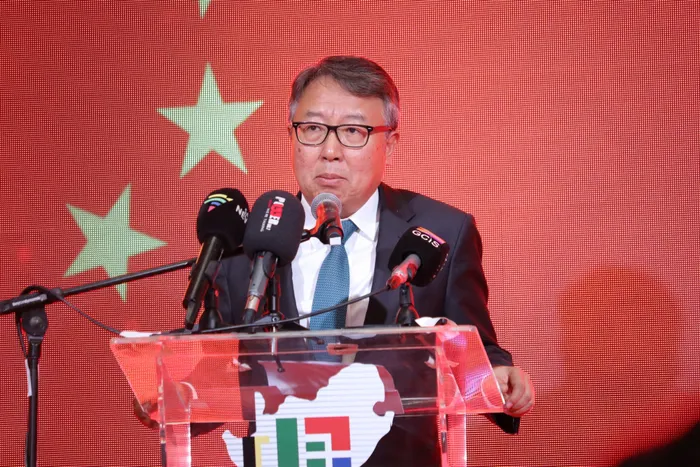
Wu Peng, Ambassador of China to South Africa,
Image: Supplied
The Chinese Embassy in South Africa offers warm congratulations on the publication of the book, Xi Jinping and the Global South and express my sincere thanks to everyone from different sectors who have long cared about and supported China–South Africa relations.
In few days, the G20 Summit will open in Johannesburg. This will be the first G20 Summit held on the African continent. China firmly supports South Africa’s G20 Presidency, and we look forward to this Summit sending out a strong voice of the Global South on global governance.
Today, we are gathered with friends from South Africa’s policy, academic and media communities to discuss a major question: Where is the Global South headed, and how can China and the Global South move forward together? This is a timely topic. It also has far-reaching significance.
I would like to share three thoughts, drawing on Professor (David) Monyae’s book. First, the rise of the Global South is the trend of our times and the direction of development. In his book, Professor Monyae points out that the Global South is not just a simple geographic term.
It is a political identity and a collective consciousness formed after countries with a shared history of colonialism and setbacks in development went through common struggles. It represents “historical actors” who strive for a fairer international order for themselves. This breaks away from labels such as “underdeveloped countries” and “the Third World”, which carry a sense of hierarchy.
Instead, it highlights dignity, rights and responsibilities. I fully agree with this view. Today, more than 130 countries belong to the Global South. They account for about 85% of the world’s population and over 40% of global GDP. On average, developing economies are growing faster than developed ones.
We can say that the Global South is no longer the “silent majority” of the international system. It has already become an important force driving multipolarity, economic globalization and diversity of civilizations.
Going forward, global governance will enter what we may call “a Global South moment”. South Africa, Brazil and Qatar, as hosts, will convene the G20 Summit, the United Nations Climate Change Conference and the World Summit for Social Development.
China firmly supports these Global South countries in hosting these major events. Second, China and Africa are key members and strong pillars of the Global South. Professor Monyae gives a systematic review of the history of mutual support between New China and the wider developing world.
As the largest developing country, China is a natural member of the Global South, and always gives high priority in its diplomacy to developing countries. From putting forward the Five Principles of Peaceful Coexistence more than 70 years ago, to long-term support for national liberation and independence in Africa, to today’s joint efforts for economic development and national rejuvenation in the new era.
Together, China and Africa account for one-third of the world’s population. China–Africa cooperation is a fine example of equality and win–win cooperation among Global South countries.This June, China, 53 African countries and the African Union issued the China–Africa Changsha Declaration on Upholding Solidarity and Cooperation of the Global South.
It sent a strong message in support of multilateralism and international fairness and justice. China has remained Africa’s largest trading partner for 16 consecutive years. In 2024, China–Africa trade reached nearly 300 billion US dollars, a record high.
Since the beginning of this year, some countries have launched trade wars and tariff wars. This has seriously harmed the legitimate interests of many countries and undermined the modernisation process of the Global South.
China has announced that we will apply zero-tariff treatment to 100% of taxable tariff lines for products from all 53 African countries that have diplomatic relations with China.
This is a major step for China to further open up and expand cooperation, and to truly help African countries grow their economies and advance modernisation.
Third, China–South Africa cooperation is leading the way in strengthening Global South solidarity and cooperation.
Professor Monyae has long focused on China studies. He has carried out systematic research and in-depth thinking on China’s development path and on Xi Jinping Thought on Socialism with Chinese Characteristics for a New Era.
In the chapter “China, South Africa and the Global South in the Evolving Global Order”, he reviews the history of China–South Africa relations and, through this lens, observes the growth of Global South strength.
I believe this is a very meaningful perspective. Since the establishment of diplomatic ties in 1998, China–South Africa relations have achieved a “four-step leap”: from a partnership, to a strategic partnership, to a comprehensive strategic partnership, and now to a “Comprehensive Strategic Partnership for a New Era” featuring all-round cooperation. This shows the deep political trust between our two countries.
In 2024, our bilateral trade made up nearly 20% of total China–Africa trade. In recent years, China and South Africa have worked together to promote the historic expansion of BRICS and to support the African Union in joining the G20.
China is ready to maintain close high-level exchanges with South Africa, to deepen practical cooperation in economy, trade, people-to-people and cultural exchanges, and to keep raising our relationship to new levels.
Another important part of today’s event is the signing ceremony for the establishment of the “Institute for the Study of Chinese Modernisation” under the Center for Africa–China Studies at the University of Johannesburg.
As President Xi Jinping has stressed, Chinese modernisation is modernisation for a huge population, modernisation for common prosperity, modernisation that combines material and cultural-ethical progress, modernisation where humanity and nature live in harmony, and modernisation that follows the path of peaceful development.
South Africa and Africa are advancing the African Union’s Agenda 2063, with the goal of building an integrated, prosperous and peaceful Africa. China does not export its model or offer a “textbook” for others. We are ready to strengthen exchanges on governance experience with Global South countries, including South Africa and other African countries, and support each other in following development paths that suit our own national conditions.
*The opinions expressed in this article do not necessarily reflect the views of the newspaper.
DAILY NEWS