

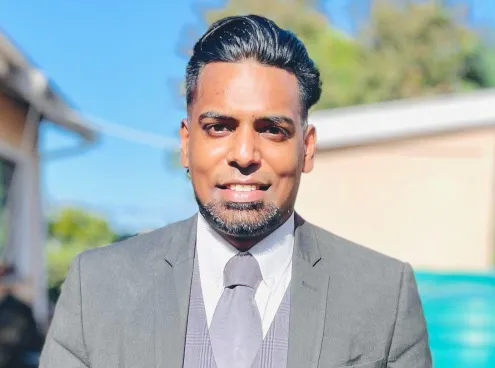
Previn Vedan
Image: File
In the age of generative artificial intelligence, creators, lawyers and companies are asking “if I prompt an AI system to write an article or generate a picture, is it still my work?
Can that same AI system generate identical content for two different users and leave us both none the wiser? And what rights do I, as a South African creator, have to protect so-called AI-protected work”?
These questions are central to authorship, ownership and the future of our cultural economy.
Copyright in South Africa is governed by the Copyright Act 98 of 1978 (“the Copyright Act”), which grants the owner of original works the right to reproduce, adapt and distribute them.
The Act defines an “author” as a natural person and in limited instances, acknowledges “computer-generated works” where the “arrangements necessary for the creation” are made by a person.
However, the world of AI strains this definition. Recent articles note that while South African law may recognise human-assisted AI output, purely autonomous AI creations, which lack identifiable human creative input, fall into a legal grey zone.
Therefore, if you stand behind the prompt, editing and curating the result then you may claim authorship. If the AI does it all and you simply click “generate,” then the work may not be protectable.
Imagine two journalists, Alice and Bongi, both prompt the same AI tool with “Write an opinion piece on workplace bullying in South Africa.” They both receive near-identical texts. Who owns what?
Because South Africa lacks an explicit statute for AI-authored works, the analysis focuses on whether there is human originality and sufficient input. If both simply input identical prompts and do no further editing, the “author” argument weakens and the output may not be uniquely owned.
The risk is that neither Alice nor Bongi may hold enforceable rights, and the duplication undermines the notion of exclusive authorship.
Moreover, because many AI models are trained on copyrighted works without clear licence flows, the output may inadvertently incorporate or mimic protected content, opening the user to infringement claims.
The bottom line is that two people may end up with effectively the same AI-produced content and neither may have strong legal ownership.
You can safeguard your AI generated work in four ways. Firstly, by you documenting your input and editing process by keeping records of prompts, iterations, human edits and enhancements so you can show meaningful human contribution.
Secondly, you should prefer tools that licence outputs cleanly. Even if a platform says you “own” the output, that promise does not override South African law. The work must still meet originality and human-authorship thresholds.
Thirdly, you should watch underlying datasets and third-party content. If the AI tool’s training data includes copyrighted or scraped works, your output may be infringing, even if it looks new. And lastly you should register or contract a licence where possible.
While South Africa does not require registration for copyright protection, having a contract or licence clarifies rights, especially if you intend to use the work commercially.
So some practical advise? When you receive AI output, treat it like a first draft. Revise, personalise, re-structure.
The more you transform, the stronger your authorship claim. If you know others might generate the same prompt, make your prompt and editing unique, personalise style, context, angle. Include disclaimers if you used AI assistance, transparency builds trust, particularly in legal or journalistic work.
For visual art generated with AI, add distinct human touches e.g., hand-drawn elements, photographic overlays, to raise the “human authorship” bar.
If you are entering commercial agreements or licensing your AI-aided work, build in indemnities, that you will defend the work from third-party claims, and ensure you have required rights to the underlying data and tools.
South Africa is at a crossroads. The Copyright Amendment Bill (2017 onward) contemplates a US-style “fair use” exception, which might ease training of AI systems but it remains silent on full AI-authorship and ownership.
For now, creators must rely on established principles, originality and human-authorship, to navigate the AI-era.
For creators in law, art, media and commerce, the message is clear, AI is a tool, not a substitute for human creativity. If you command the tool, shape the process and add your effort, it still counts as your work. If you hand it over to the machine and press “generate,” you may find yourself with no clear rights.
As digital production accelerates and AI becomes ever more accessible, the question is not just can a tool replicate content for two people, it is will our laws recognise either person as the true author? And if not, what rights remain to us?
In conclusion, you may treat AI-assisted content as your work provided you contribute meaningful creative input and document the process. You cannot assume exclusive rights if the AI does all the creative heavy-lifting and produces the same output elsewhere.
You have legal rights, but they hinge on human authorship and originality under the current Copyright Act. You must guard against copyright risk, infringement and duplication, even from content you did not realise others could receive.
In a world where machines generate words, images and ideas, being the human behind the content is what still matters.
Until our laws catch up, the power of authorship remains one of humanity’s last un-automated assets.
*The opinions expressed in this article do not necessarily reflect the views of the newspaper.
DAILY NEWS